Baseball Game Scorebook: Download GoRout's Free Printable Scorecard Sheet [PDF]
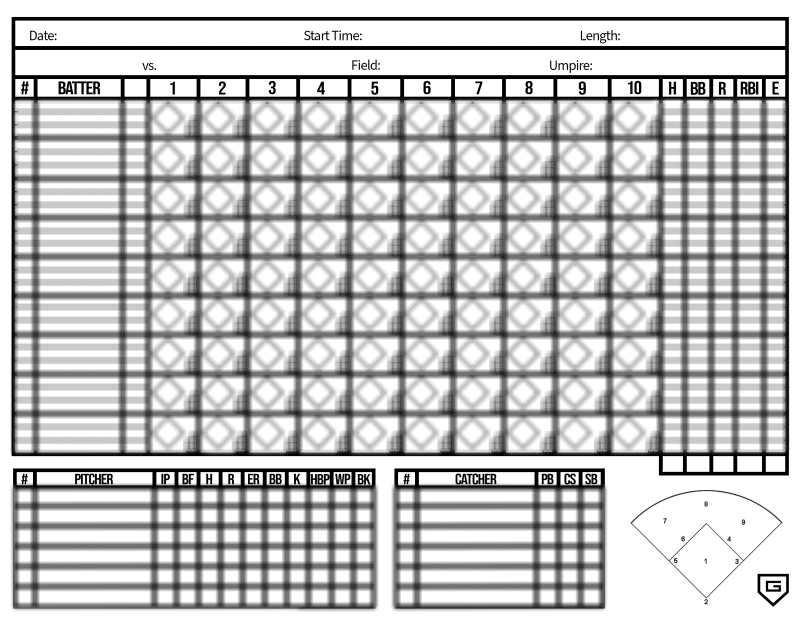
We’ve created a FREE printable baseball scorebook sheet designed for coaches at every level. This easy-to-use template helps you track key stats like hits, runs, errors, strikeouts, and more all in one place. Whether you're a first-year coach or a seasoned veteran, this scorebook sheet is a simple tool to help you stay organized and keep your team locked in throughout the game.
Get this FREE assets delivered to your inbox by filling out the form below. Wait for 60 seconds and refresh your inbox to see an email from us with the PDFs attached.
What Is A Baseball Scorebook?
A baseball scorebook is a pre-printed booklet or sheet used to record every detail of a baseball game as it unfolds. It allows coaches, players, and fans to follow along and track performance including runs scored, hits made, and errors committed. Whether you’re on the field, in the dugout, at the stadium, or watching at home, a baseball scorebook sheet enables you to actively participate in the game.
Baseball scorebooks are available in various formats, styles, and designs. Some options include additional sections for advanced stat keeping, while more basic versions keep it simple for the user. If you have the funds to invest, there are baseball scorebooks designed to accommodate 60 games or more.
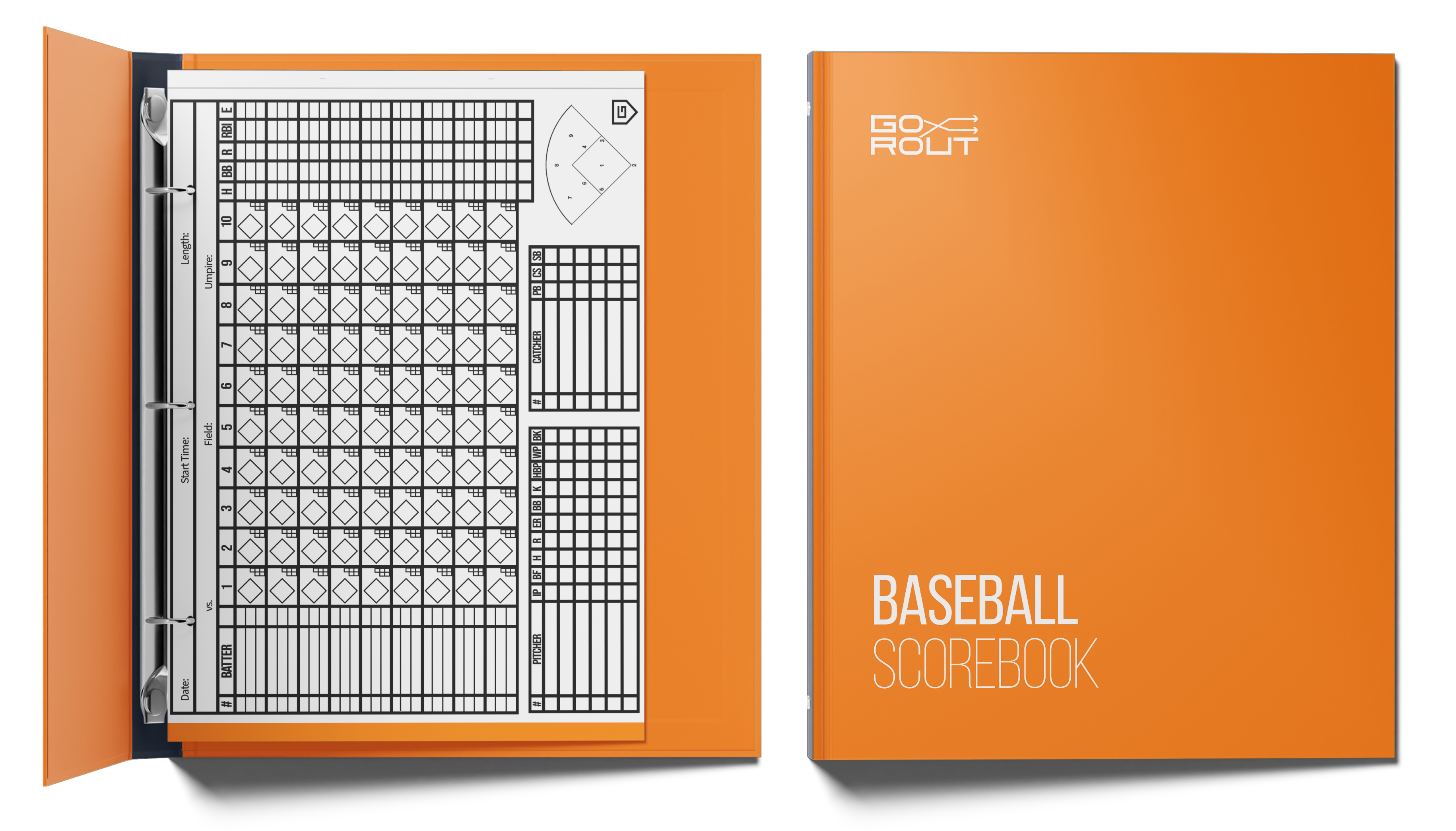
Teams or individuals looking for a great cost-free option can print off multiple copies of our free printable PDF and create a DIY baseball scorebook in a folder, binder, or other type of binding.

What Is GoRout’s Free Printable Baseball Scorebook Sheet?
Our free printable baseball scorebook sheet is an all-encompassing downloadable resource for teams, coaches, scorekeepers, parents, and fans. It can be used for recording game statistics and play-by-play actions during any baseball game.
GoRout’s printable scorebook has everything you need for baseball scorekeeping, whether you’re documenting a game for official league records or tracking your child’s performance from the stands.
The official GoRout baseball game scorecard includes:
- High-level game information including date, start time, teams, field location, and more
- Key sections such as lineups, scores, and inning-by-inning statistics
- Space for tracking of detailed player stats like hits, walks, runs, runs batted in (RBIs), and errors
- Pitcher stats including innings pitched, batters faced, hits, runs, earned runs, strikeouts, hit by pitch (HBP), wild pitches (WP), and balks
- Catcher stats including passed balls (PB), caught stealing (CS), and stolen bases (SB)
- Game totals for team stats
- A diagram of the diamond to reference position numbers
An easy-to-download PDF file, the scorebook’s printable nature ensures accessibility for you to engage during games without needing electronic devices. It’s accessible online, allowing you to print and fill out as needed. Paired with our Baseball Scorekeeping Cheat Sheet, you can access and download everything you need to keep score in baseball.
GoRout’s Coaches Toolbox: A One-Stop Shop for Baseball Coaching Needs
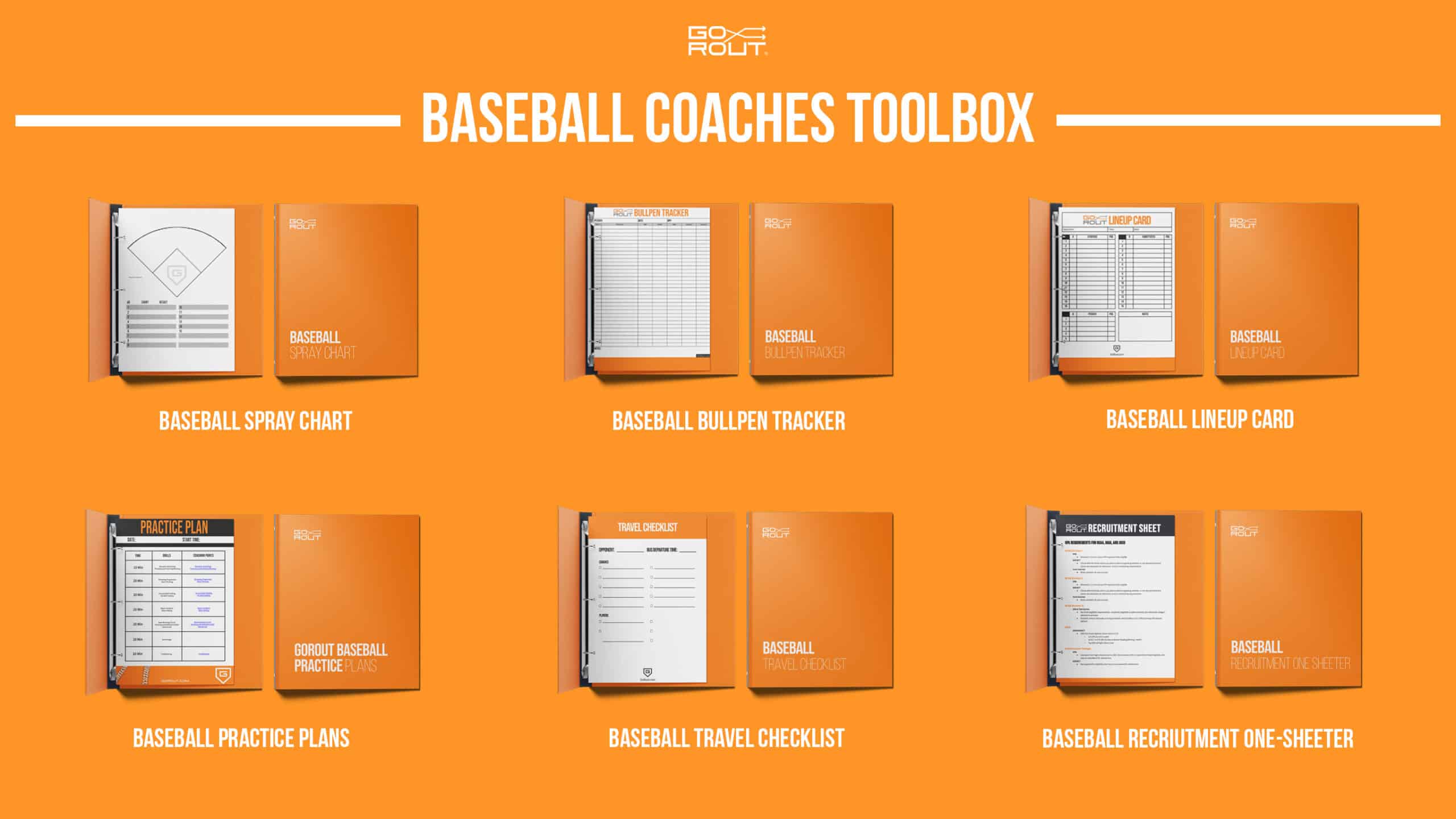
Coaches and teams looking for more advanced stats, analytics, and insights can access additional tracking templates, along with resources to maximize efficiency, in GoRout’s Coaches Toolbox.
This one-stop shop for free coaching tools includes our:
- Baseball spray chart
- Baseball bullpen tracker
- Baseball lineup card
- Baseball practice plan
- Baseball travel checklist
- Baseball recruitment one-sheeter
There's no cart or paywall behind these products. Simply enter your name and email address, and we'll deliver the file to your inbox.
What Are The Benefits of Using a Baseball Scorebook for Games?
A baseball scorebook is essential for league operations and serious teams. In advanced leagues, they’re non-negotiable. For lower levels of youth baseball and fans at home, they offer numerous benefits.

No matter the experience level, baseball scorebooks:
- Document an official record of the game
- Evaluate individual performance
- Set goals and track progress
- Reveal strengths and weaknesses
- Allow fans to participate in the game
Document an official record of the game
For most leagues, professional and amateur, there’s an official scorekeeper whose job it is to track every pitch for record keeping. It serves as the official game record, and is crucial for confirming pitch counts and settling judgement calls.
Scorebooks help keep game information organized and accessible.
Evaluate individual performance
By tracking every pitch and play, a scorebook allows coaches and players to evaluate individual performances. Aside from the play-by-play account of a game, scorebooks include specific charts totaling each player’s individual statistics on offense and defense.
Baseball teams use scorebooks to calculate batting average, ERA, fielding percentage, and other key metrics to analyze performance. Players and coaches can view stats on a game-by-game basis, or compile stats from multiple games to get a wider perspective and evaluate individual performance over time (multiple games, a full season, or an entire career).
Set goals and track progress
Tracking progress in a scorebook helps players set specific goals and stay motivated as they visually monitor their improvement. Every player on the roster, regardless of position, can use stats from the team’s scorebook to assess their performance.
At the beginning of each year, players and coaches set team and individual goals. Throughout the season, they monitor progress and adjust accordingly. Diligently tracking every pitch of each game ensures enough data is compiled to accurately track the progress of each agreed upon goal.
Reveal strengths and weaknesses
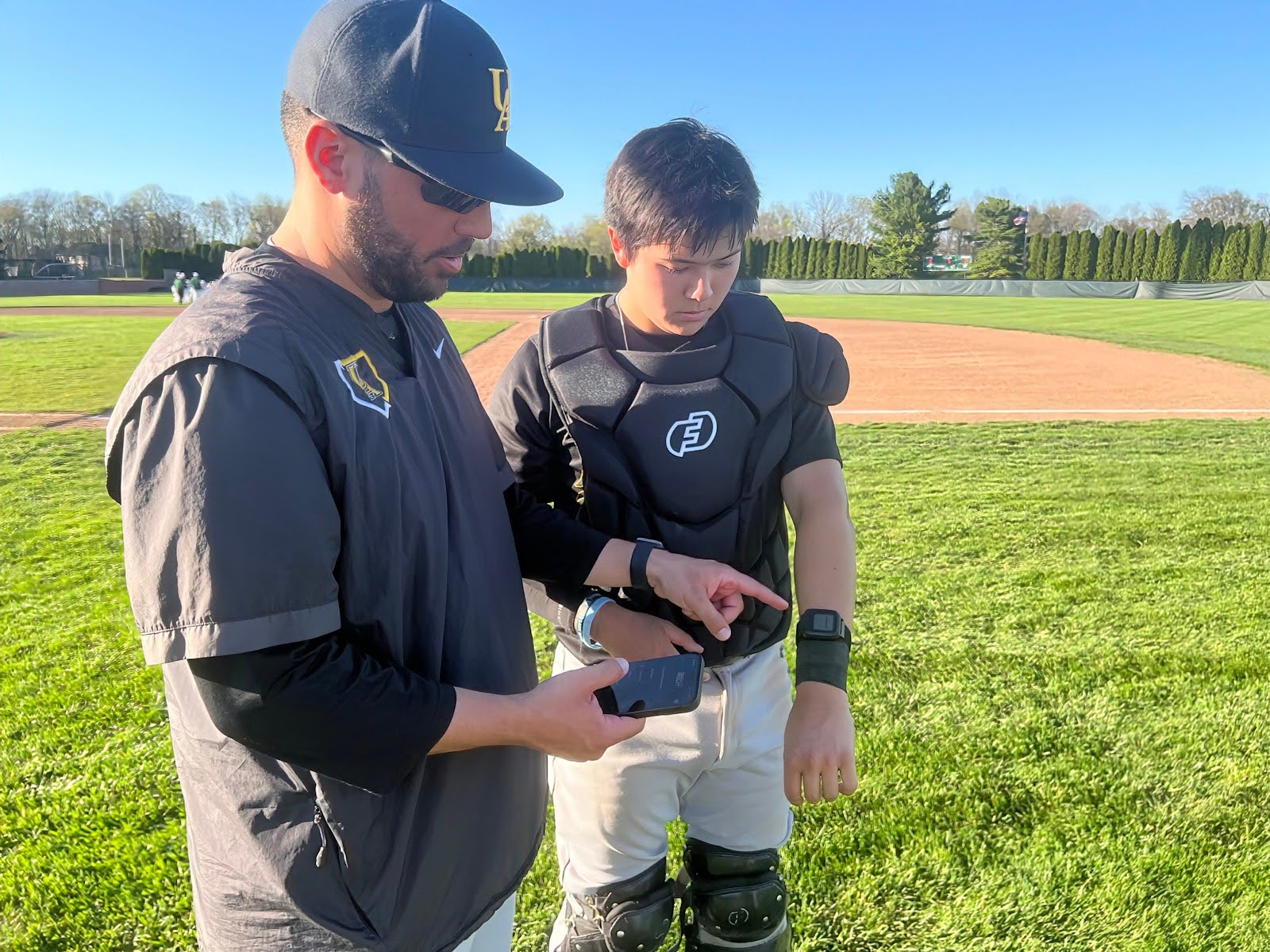
Data doesn’t lie and baseball scorebooks track every pitch. Over time, the stats tracked within a scorebook reveal strengths and weaknesses for your team and opponents.
Detailed data from the scorebook can reveal specific weaknesses or strengths for targeted training. If a player consistently struggles to put the ball in play with runners in scoring position, coaches can tailor their approach in practice.
On the flip-side, coaches may use data from scoresheets to identify weaknesses, strengths, or tendencies of the opposing team. This provides a competitive edge, allowing coaches to attack specific weaknesses or expose predictable tendencies.
Allow fans to participate in the game
For fans, keeping a scorebook provides an immersive way to engage with the game and understand baseball’s nuances. Diehard fans may track every game of their favorite team for a more immersive experience and to feel like they’re a part of the game.
A completed scorebook also serves as a personal journal, preserving memories and details of specific games. Some parents love to track their child’s performance over time to remember their playing career.
How To Keep a Baseball Scorebook
To get the most out of your baseball scorebook, you must keep accurate records of every pitch and play. Scorekeepers use a system of shorthand notations, abbreviations, and position numbers to document the action within individual boxes on the scorebook page. From filling out the scorecard completely to using the correct notation on scoring plays, there’s a lot to stay on top of.
In the sections below, we’ll provide a high-level overview of how to keep a baseball scorebook. We’ll break it down into the following components:
- Game information
- Balls and strikes
- Hits and outs
- Individual stats
- Pitcher and catcher stats
- Team stats

For a full breakdown, check out our comprehensive ultimate guide to baseball scorekeeping. It covers a definition of scorekeeping, history of the practice, and a detailed, robust breakdown of each type of scoring play. You can also download our free baseball scoring cheat sheet to use as a reference when filling out your scorecard.
Game Information
Filling out a baseball scorecard begins with entering game information such as the date, start time, and teams involved. It ensures specific details about the game are properly documented for historical records.
Each scorebook features a unique design, so this section may be located in different areas depending on your specific card. In general, game info is located at the top, bottom, or side of the scorecard.
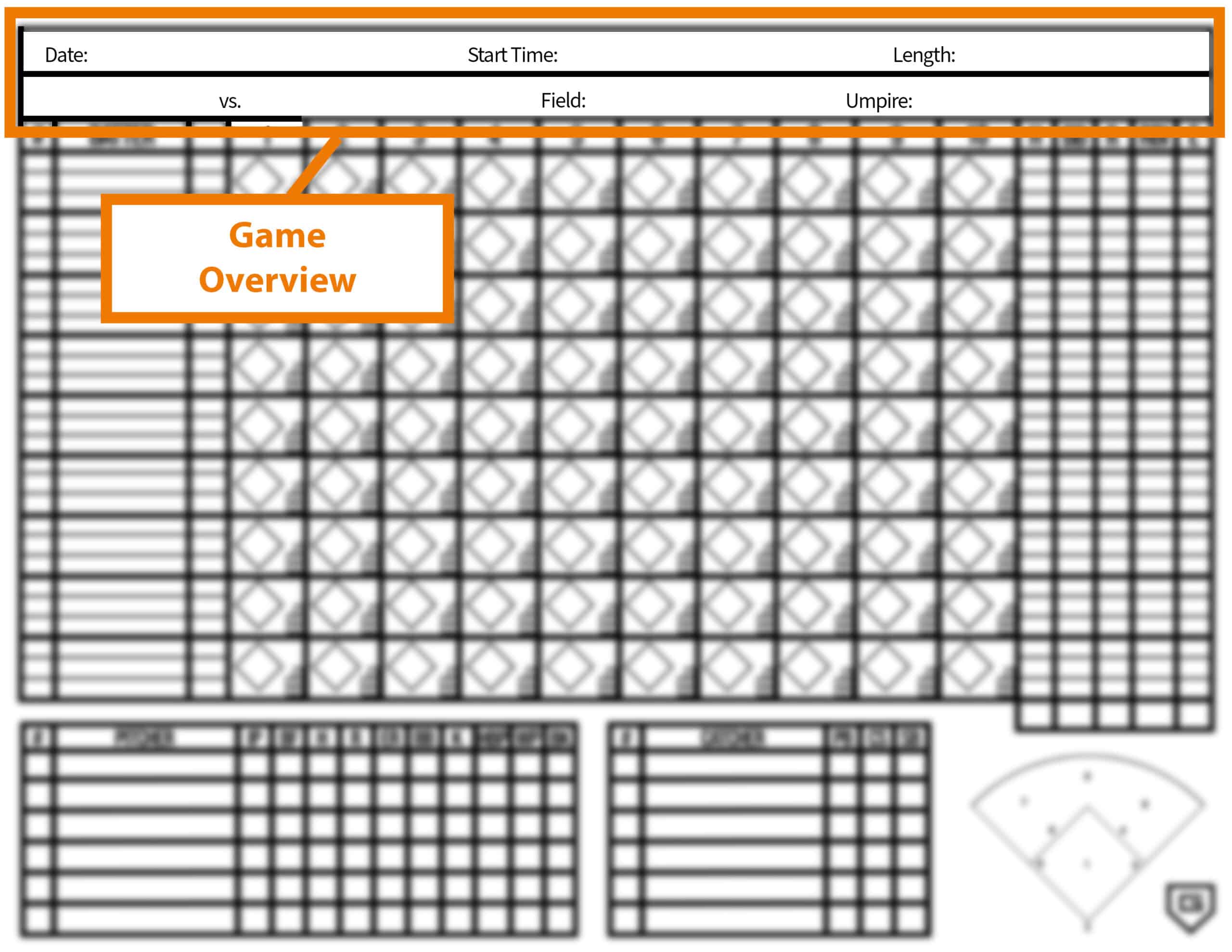
While it varies by design, game information to fill out typically includes
- Team names (home and visiting)
- Location and/or stadium/field name
- Date
- Time (start and end)
- Umpires
- Scorekeeper
This is the first step in filling out your scorebook.
Lineup
The lineup or batting order section documents starting lineups and substitutions. Each scorebook page covers one team. If you’re scoring both your team and opponents at bats, you’ll need two sheets (one for each team).
There are three sub-rows within each position in the batting order on your scorecard:
- In the first sub-row of each position, write the name and name of each starter
- In the lower two sub-rows of each position, add substitute players, writing their name and number once they enter the game. If there are no substitutes for a position, leave the bottom two sub-rows blank.
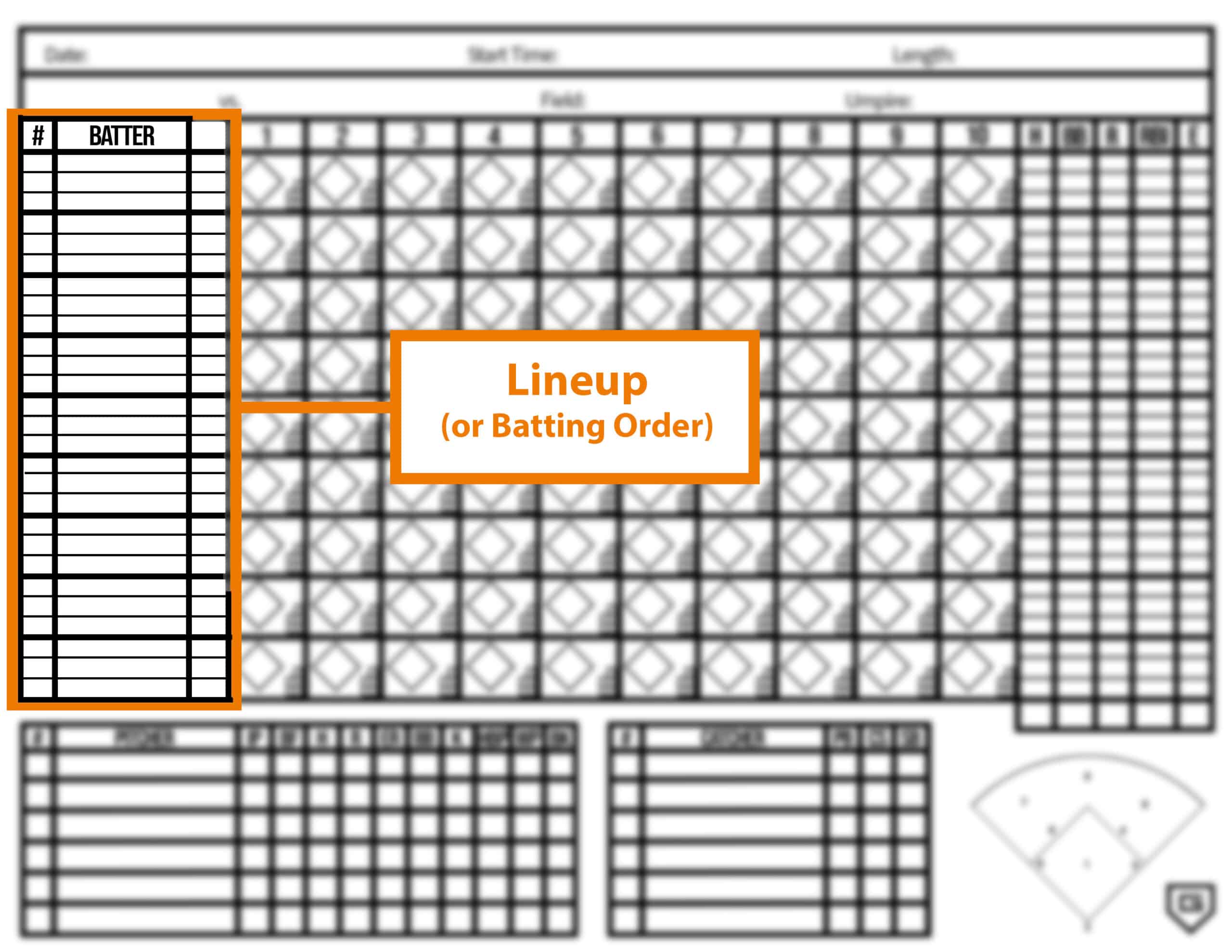
It’s essential to fill out the starting lineup in the exact batting order coaches submit to umpires. Not only does it ensure proper record keeping, but it ensures your team doesn’t bat out of order. The scorekeeper can’t alert the umpire if a player is batting out of order, but they can let a coach know before the team gets penalized.
Balls and Strikes
When keeping records of a baseball game in the scorebook, you’re tasked with accurately documenting every single pitch. You document each individual at-bat in the score boxes aligned with the appropriate batter and inning.

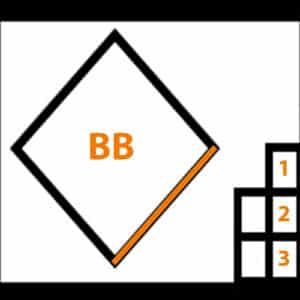
Within each score box, there are typically smaller boxes to mark strikes and balls. It’s relatively simple: three boxes for balls and two boxes for strikes. There are three primary methods to mark balls and strikes:
- Strike a line through the area
- Color the are in completely
- Numbers (marking balls and strikes by pitch number)
Simply select your method of preference and mark each pitch accordingly.
Hits, Outs, and Errors
One of the major responsibilities when keeping a baseball scorebook is documenting the result of each play. The outcome of an at-bat is recorded in the center of the score box, and often falls under one of three results:
- Hits
- Outs
- Errors
Hits
Hits in a scorebook are indicated by circling the hit type, or writing the abbreviation, and drawing a line along the base paths the batter reaches.

For example, to score a triple you:
- Write 3B in the center of the score box, or circle the 3B option if your scorebook includes them
- Draw a solid line from home plate to first base, first base to second base, and second base to third base on the baseball diamond graphic in the score box
If there are runners on base, you fill out their journey on the base-paths in their respective score box. Using the triple as an example, let’s say there was a runner on second base at the time:
- In that runner’s score box, draw a solid line from second to third base, and from third base to home plate.
- A fully shaded diamond in a scorebook indicates a run scored, so completely fill the runner’s diamond.
Walks are noted with ‘BB’ (Base on Balls) in the scorebook and a solid line from home plate to first base.
Outs
The outcome of an at-bat is recorded in the center of the box, with outs noted by the position numbers of the fielders involved and the out number circled. Positions in baseball are designated by numbers, with:
- 1 for pitcher
- 2 for catcher
- 3 for first base
- 4 for second base
- 5 for third base
- 6 for shortstop
- 7 for left field
- 8 for center field
- 9 for right field
The main types of outs include:
- Fly outs to the outfield, designated by F for fly out and the position number.
- Ex: F7 is fly out to the left fielder
- Groundouts in the infield, designated by the order in which players touched the ball starting with the player who initially fielded it.
- Ex: 6-3 is a groundout fielded by the shortstop and thrown to the first baseman. 6-4-3 is a double play fielded by the shortstop, thrown to the second baseman at second base for the force out, and thrown from the second baseman to the first baseman for the out at first.
- Strikeouts, indicated by the letter ‘K’. A swinging strikeout is recorded as a 'K', while a called strikeout is a backward 'ꓘ'.

Errors
Errors are designated by the letter E and the position number of the player who committed it. For example, an error by the second baseman is E4.
There are other stats like wild pitches, past balls, fielders choice, and more that you can learn about in our dedicated baseball scorekeeping resource linked earlier.
Individual Stats
There is a table, similar to a box score, for individual stats adjacent to each player’s dedicated row in the lineup. Common stats tracked include:
- Hits
- Walks
- Runs
- RBIs
- Errors (committed in the field by the player)
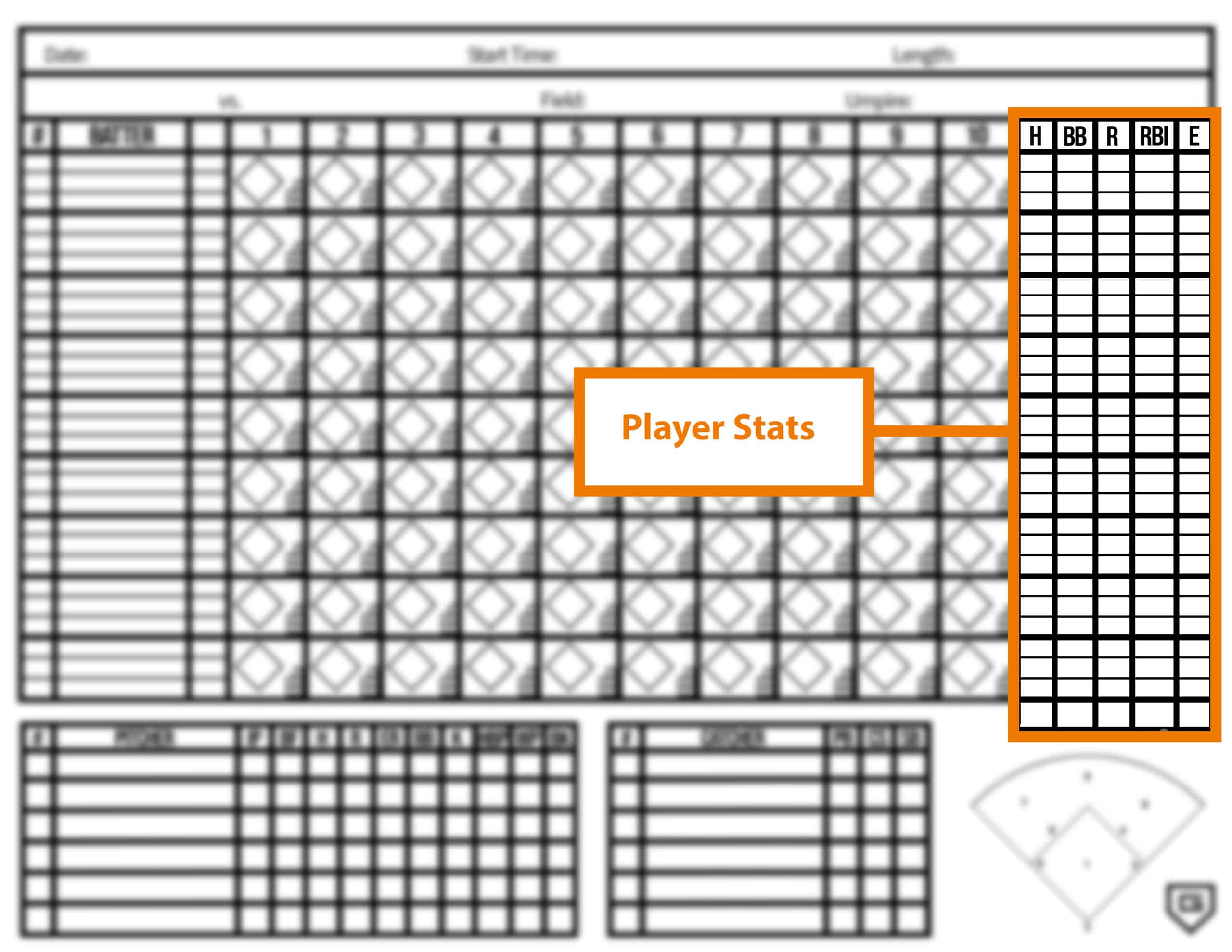
To mark individual stats, you can either:
- Record the stat in the individual stats table immediately upon marking the decision in the score box, or
- Compile all of the individual stats from an inning, and mark them in the stats table in between innings
Pitcher and Catcher Stats
Similar to individual stats, at the bottom of the scorebook are areas for pitcher and catcher statistics.
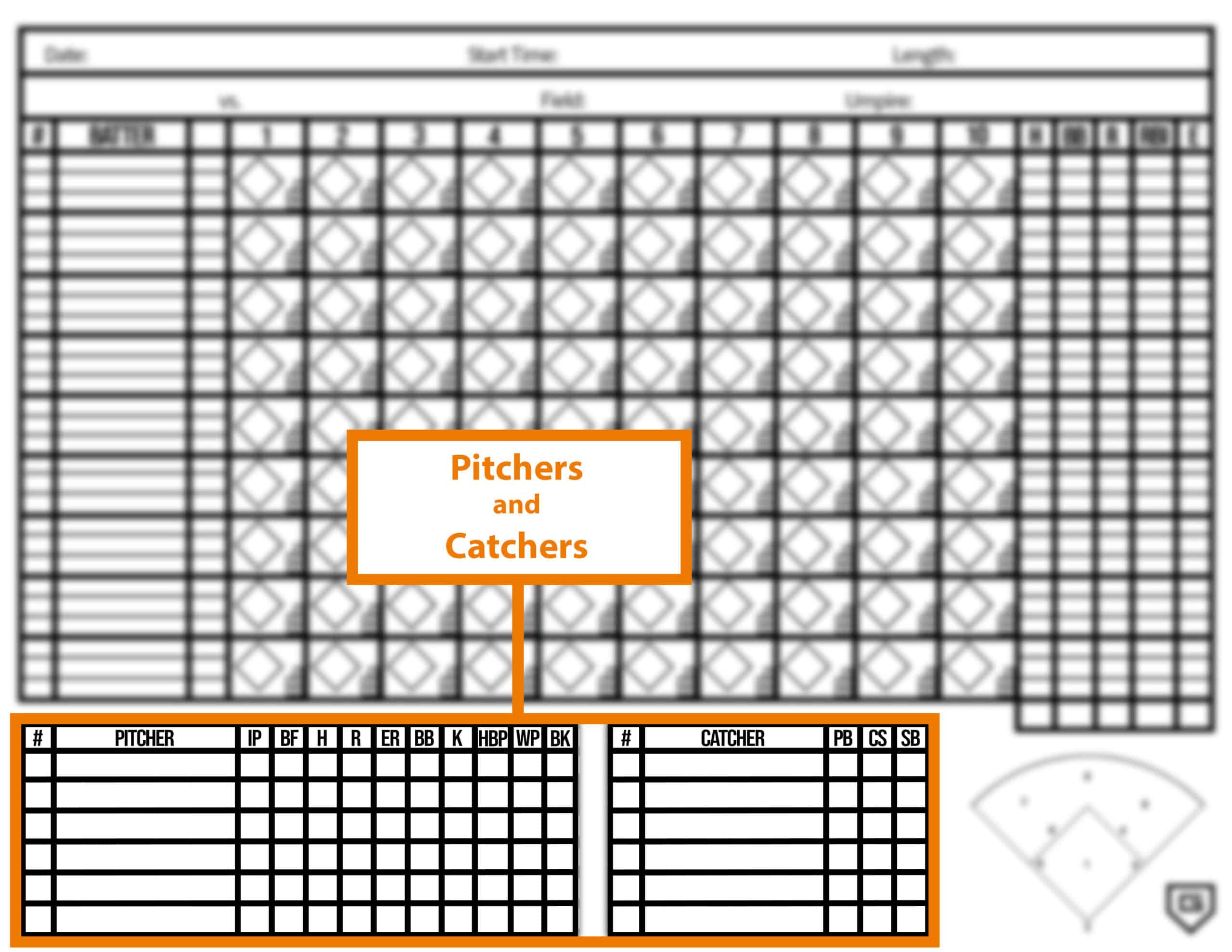
For pitchers, tracked stats include:
- Innings pitched
- Batters faced
- Hits
- Runs
- Earned runs
- Walks
- Strikeouts
- Hit by pitch
- Wild pitches
- Balks
Catcher stats include:
- Passed balls
- Caught stealing
- Stolen bases
Team Stats
Some scorebooks have areas to compile total team stats, either by inning or game totals.
Team stats typically include:
- Hits
- Runs
- Errors
- Players left on base
Some scorebooks allow customization of fields to suit specific game needs, outside of the sections covered in this resource.
Tips for Keeping an Efficient Scorebook in Baseball
With an understanding of baseball scorebooks and the components within a scorecard, you’re all set to become a successful scorekeeper. In our collective experience, we’ve compiled a few tips, tricks, and recommendations to help maximize the efficiency of your scorekeeping process for a cleaner, accurate scorebook.

- Familiarize yourself with traditional scoring symbols. A comprehensive understanding of symbols, abbreviations, and notation helps ensure accurate completion of the scorecard. We covered this throughout our various scoring resources, so refer to those your guiding documents to learn and memorize each.
- Update plays in real time. Recording information immediately after each play, and consistently, helps maintain an accurate representation of events. It’s essential for accurate documentation of runs and other metrics during the game.
- Stay attentive and diligent throughout the game. Keeping track of the game momentum requires your complete, undivided attention. If you drift off, you may miss important moments in the game or inaccurately document results.
- Be aware of and avoid scoring mistakes. Common mistakes when completing a baseball scorecard include missing entries, incorrect player positions, and inaccurate scoring decisions.
- Regularly review your entries during the game. Double-check every play after each inning and throughout the game to catch any scoring errors before they affect the overall statistics and records.
- Consult traditional scoring guides for questionable decisions. Referring to scoring guides, like any of our resources linked above, may aid in clarifying specific plays for accurate recording.
- Use different ink colors for different players. This is specific to teams tracking stats, but using different ink colors for different players can assist in recognizing patterns over time.
Baseball Scorebook FAQs

What Is The Best Baseball Scorebook?
There is no single “best” baseball scorebook. Countless options are available on the market depending on what you’re looking for. You can purchase individual scorecards or entire scorebooks with enough sheets for a long season or multiple years.
GoRout’s baseball scorebook sheet is a free PDF that you can download and print as many copies as you need. It's a smart cost-free option for teams on a budget or looking to save money.
What Scorebook Does Major League Baseball (MLB) Use?
Major League Baseball (MLB) doesn’t have an official scorebook. Scorekeepers that work for teams or the league use whichever scorebook is provided by their employer. Most baseball scorebooks on the market include everything you need to score an MLB game.
Is There An App To Keep Baseball Scorebooks?
Yes, there are several apps on the market to electronically keep score of a game. It can be beneficial to use both an app and a physical copy to preserve a backup of each game’s documentation.
If you choose an app, make sure to test it out before using it for live game action. You may find the process more difficult than a standard scorecard, and don't want to make errors when scoring a real game.
What Is A Baseball Scorebook Called?
A baseball scorebook refers to a book with numerous baseball scorecards inside. Baseball scorecards are the individual sheets within a baseball scorebook that you record and document game results on.
Download GoRout's Free Printable Baseball Scorebook Sheet
Keep Every Inning Accountable
Our printable baseball score sheet helps you track every pitch, play, and plate appearance with precision. From hits and errors to pitch counts and passed balls, this sheet keeps your team’s performance clear and organized, just the way coaches need it.
One Sheet. Every Stat.
No more flipping pages or guessing what happened in the 5th. This all-in-one score sheet gives coaches and scorekeepers an easy way to track every batter, pitcher, catcher and play. Whether you're managing a lineup or breaking down postgame stats, it’s built to keep everything in one place.
Built for Game Day Simplicity
Designed for coaches who want clarity on every pitch, this score sheet covers everything from walks and RBIs to wild pitches and strikeouts. It’s a game-tested tool that helps you stay organized and keep your team locked in from the first pitch to the final out.