Softball Scorebook: Download GoRout's Free Printable Scorebook Sheet for Softball
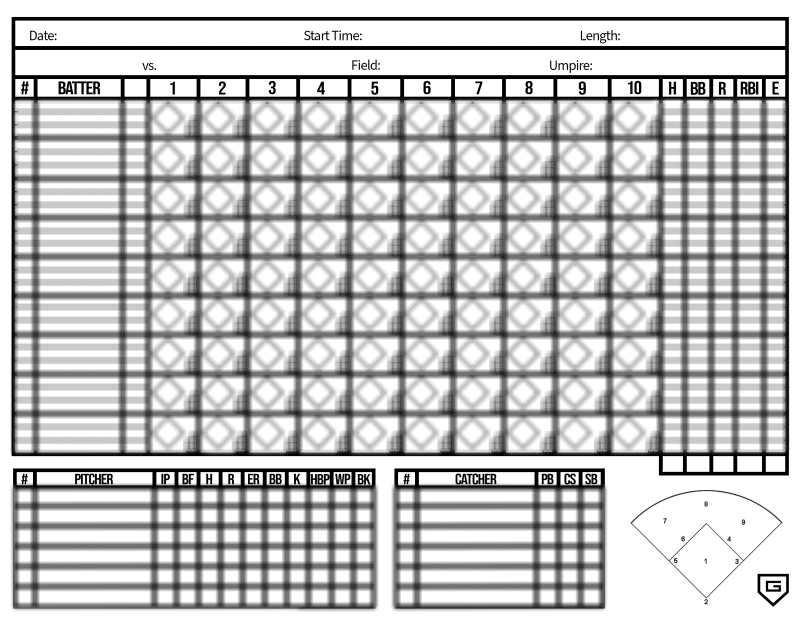
We’ve created a FREE printable softball scorebook sheet designed for coaches at every level. This easy-to-use template helps you track key stats like hits, runs, errors, strikeouts, and more all in one place. Whether you're a first-year coach or a seasoned veteran, this scorebook sheet is a simple tool to help you stay organized and keep your team locked in throughout the game.
Get this FREE assets delivered to your inbox by filling out the form below. Wait for 60 seconds and refresh your inbox to see an email from us with the PDFs attached.
What Is A Softball Scorebook?
A softball scorebook tracks every pitch, at-bat, and defensive play in a grid format, documenting the results and providing a historical record of each game. Softball scorebooks can be used to keep track of game statistics and player performance.
Different types of softball scorebooks may include features such as player statistics, game summaries, pitcher/catcher stats, and score tracking. Each design is unique to the creator, so there are numerous options to choose from. They all vary in price, as well as the countries they ship to.
Some softball scorebooks are designed to cover multiple games, allowing for extensive record-keeping. Others are individual scorebook sheets, sometimes referred to as a scorecard, that track one team’s performance for a single game. In general, scorebooks can vary in the number of games they can record, with some accommodating up to 75 games.
What Is GoRout’s Free Printable Softball Scorebook Sheet?
Our free printable softball scorebook sheet includes everything you need to keep score as a coach, player, official, parent, or fan in one downloadable resource. The sheet enables you to document every pitch and play, recording individual and team stats throughout the game.
GoRout’s printable scorebook sheet goes hand-in-hand with our scorekeeping resource and scorekeeping cheat sheet (specific to baseball, but applicable to softball as well). Whether you’re an official league scorekeeper documenting a game for league records or a dedicated parent tracking your child’s performance, our scorebook sheet and resources are helpful cost-free tools to utilize.

The official GoRout softball scorebook includes:
- General information about the game including date, start time, teams, field/location, and more
- Organized sections for lineups, scores, and inning-by-inning stats
- Detailed players stat-racking including hits, walks, runs, RBIs, and errors
- Specific stat-keeping section for pitchers and catchers
- Team stat totals
- Diagram/graphic of the diamond to reference position numbers for scoring
An easy-to-download PDF file, the softball scorebook’s printable nature ensures accessibility for you to engage during games without needing electronic devices. It’s accessible online, allowing you to print and fill out as needed. Print out unlimited quantities to create DIY baseball/softball scorebooks that can be used for teams in either sport.
What Are The Benefits of Using a Softball Scorebook for Games?
A softball scorebook is necessary for league recordkeeping and official statistics. It’s also vital for teams, including coaches and players, to track their performance and analyze statistics.
Whether you’re a college coach, a high-school program, or a first-time youth coach, softball scorebooks enable you to:
- Document an official record of the game
- Track player performance
- Track progress of goals
- Identify strengths and weaknesses
- Allow fans to participate in the game

Document an official record of the game
Nearly every level of serious, competitive softball incorporates an official scorekeeper. Whether it’s the league, tournament, or a member of your coaching staff, a scorekeeper must track every pitch for record-keeping.
It serves as the official game record for league and team archives. Scorekeepers also refer to scorebooks to confirm pitch counts and settle any judgement calls.
Track player performance
With every pitch and result documented, coaches and players can use scorebook sheets to evaluate their performance. The individual statistics section of a softball scorebook sheet tracks all major stats for each respective player.
Coaches and players can use scorebooks to calculate batting average, earned run average (ERA), fielding percentage, and other key performance metrics. Teams and leagues that keep robust, detailed scorebooks enable players and coaches to analyze performance on a game-by-game basis, over a run of multiple games, a whole season, or an entire season.
Track progress of goals
Coaches and players often set goals at the beginning of the season. Scorebooks provide stats, information, and insight into player performance that can help monitor the progress of goals. Regardless of their position, every player on the team can use the scorebook to review stats and assess their goals.
Identify strengths and weaknesses
Along with monitoring goals, information tracked in a softball scorebook helps players and coaches identify strengths and weaknesses. If a left-handed batter assesses their recent performances and notices a trend of groundouts to the right side of the infield, they may identify a weakness of trying to pull the ball too much.
Scorebooks can also help identify strengths and weaknesses in opponents.
Allow fans to participate in the game
Even if there’s no stake in the game, some fans love keeping score with a softball scorebook to be more involved. Instead of simply watching, fans engage with the game by marking the result of every pitch.
Some fans keep score every game their favorite team plays, with a historical archive of all their scorecards.

How to Keep a Softball Scorebook
Keeping a softball scorebook requires accurately recording every pitch and play. Scorers document how a player reached base or was put out using shorthand notations, abbreviations, and position numbers within individual boxes on the page.
To ensure proper historical documentation of the game, scorekeepers must complete every section of the scorebook in full detail. From filling out the scorecard completely to using the correct notations on scoring plays, there’s a lot to keep track of
In the sections below, we’ll provide a high-level overview of how to keep a softball scorebook. Within each section, you’ll get a better idea of how to keep a detailed, organized scorecard. We’ll break it down into the following components:
- Game information
- Lineup
- Score boxes
- Balls and strikes
- Hits and outs
- Individual stats
- Pitcher and catcher stats
- Team stats
Game Information
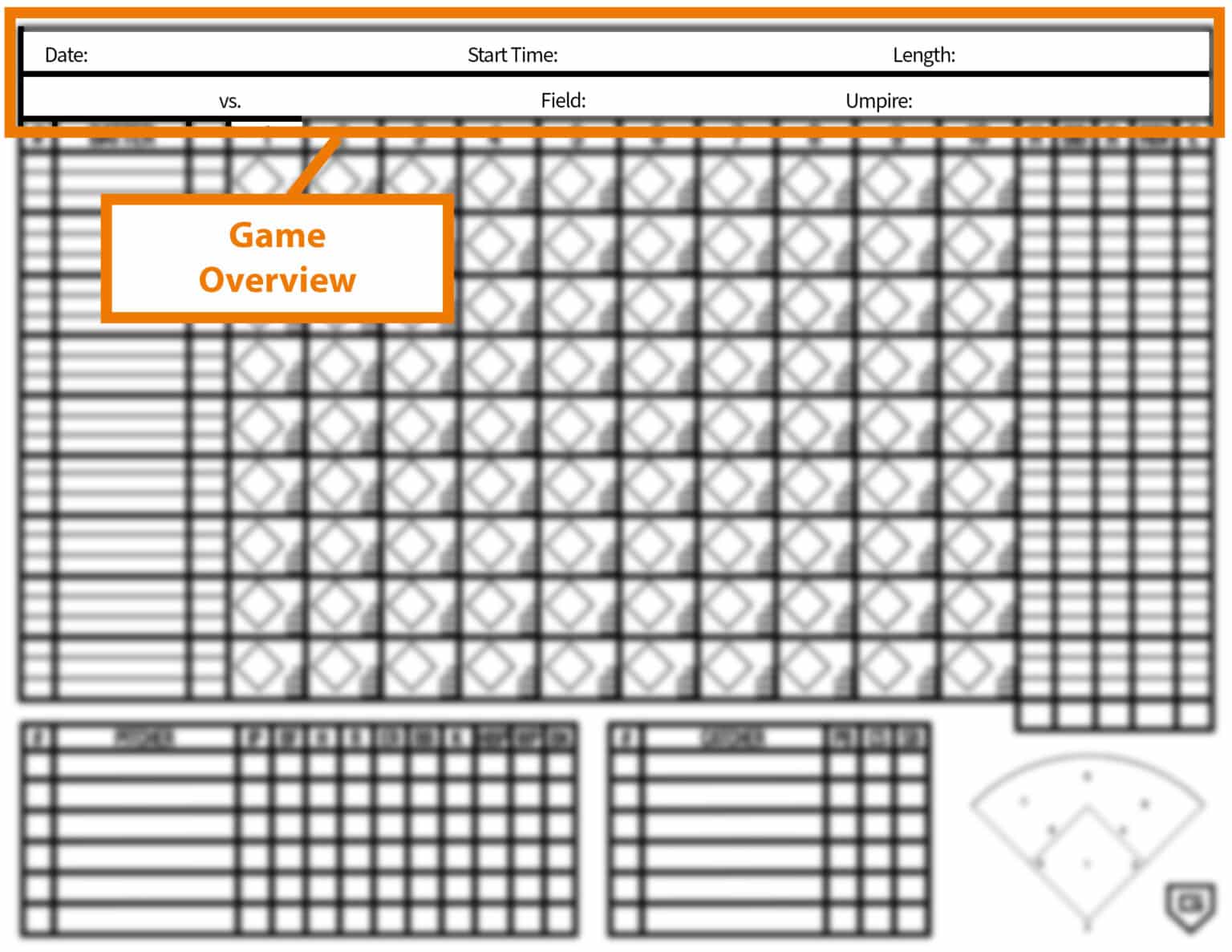
The first section to fill out involves high-level game information. It ensures specific details about the game are properly documented for historical records. The top of the scorebook page includes the date, location, team, and umpire’s name.
Each scorebook features a unique design, so this section may be located in different areas depending on your specific card. In general, game info is located at the top, bottom, or side of the scorecard.
Some additional information featured on GoRout’s scorebook sheet include:
- Day of week
- Time (start and end)
- Scorekeeper
Lineup
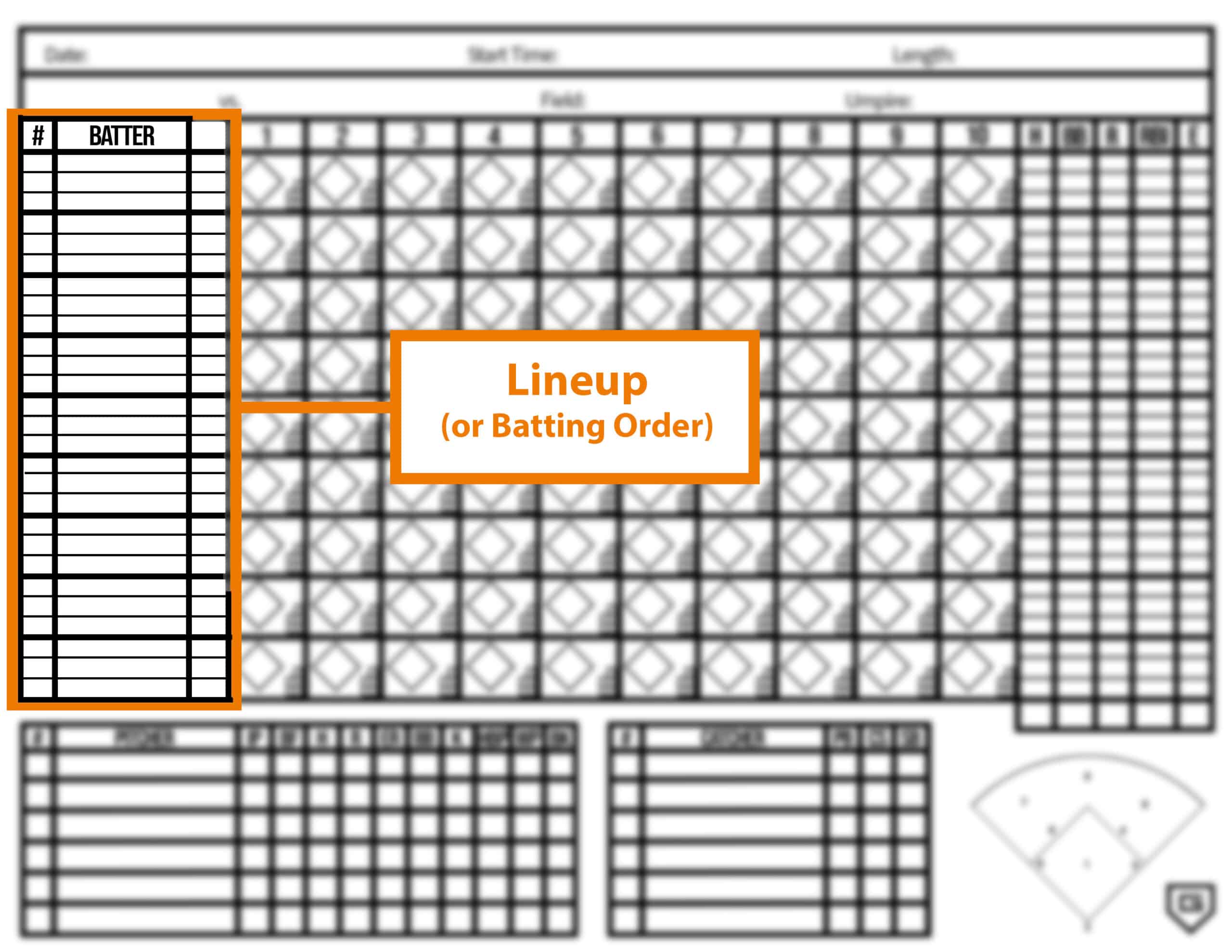
The lineup section documents starting lineups and substitutions in the batting order the coach submits to umpires prior to the game. Each scorebook page covers one team, so if you’re scoring both teams in a game, you’ll need two sheets (one for each team).
Each row in a scorebook represents a specific player in the batting order. There are three sub-rows within each row, with distinct uses:
- In the first sub-row of each position, write the name and name of each starter
- In the lower two sub-rows of each position, add substitute players, writing their name and number once they enter the game. If there are no substitutes for a position, leave the bottom two sub-rows blank.
Make sure to complete the starting lineup in the exact batting order coaches submit to umpires. It confirms accurate record-keeping and ensures your team doesn’t bat out of order.
Score Boxes
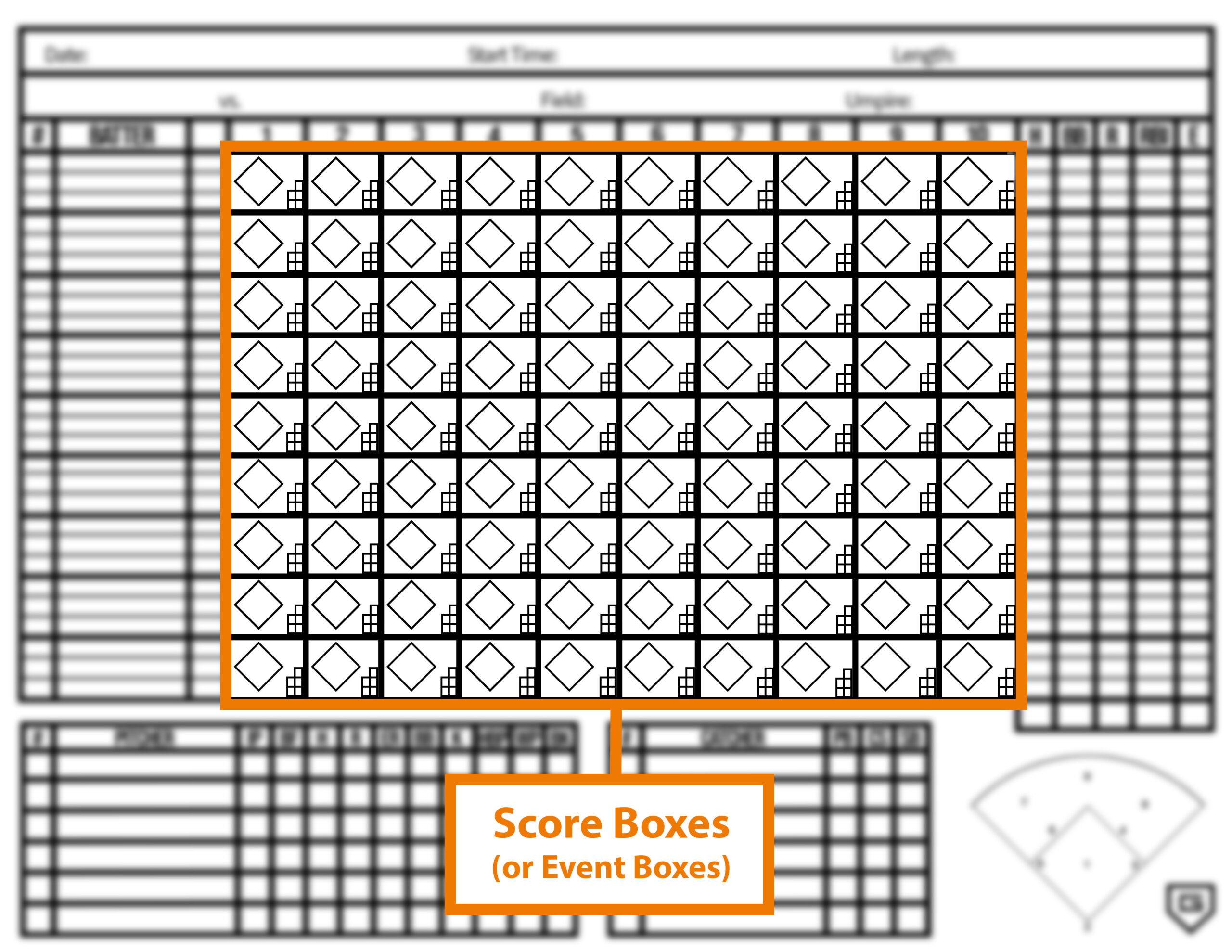
As previously mentioned, each row represents a position in the batting order. Each column in a scorebook represents one inning. Score boxes are the intersection of a player’s row and an inning’s column in a scorebook, which is used to record that specific at-bat.
A score box is typically designed to include:
- A visual diamond diagram representing the field and base paths
- Individual boxes or markers for balls and strikes
- Offensive plays listed for you to circle (or blank space for you to handwrite scoring decisions)
Balls and Strikes
Keeping records of a softball game requires documenting every single pitch in the scorebook.
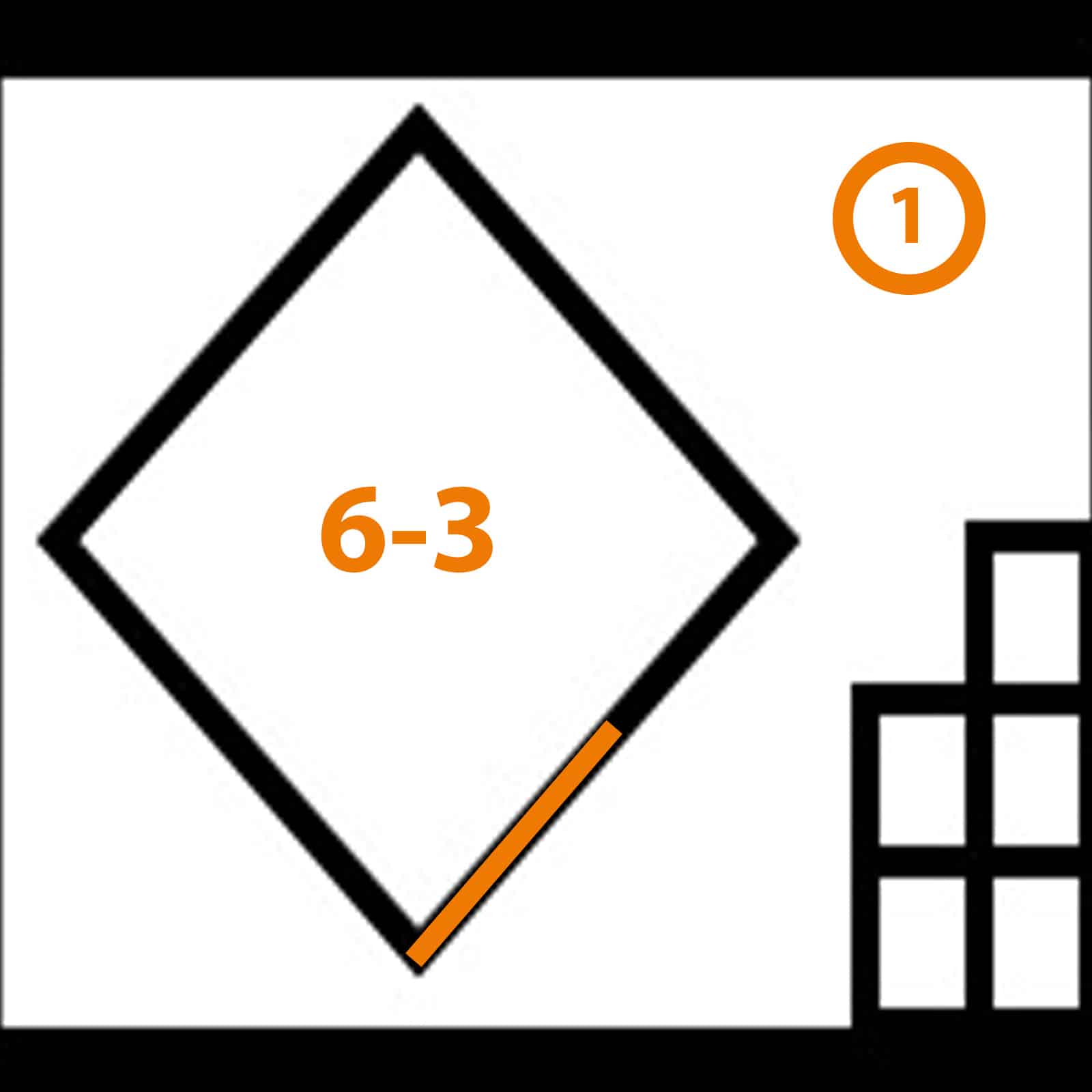
Within the score box for each at-bat, there are five smaller boxes: three for balls and two for strikes There are three primary methods to mark balls and strikes:
- Strike a line through the area
- Color the are in completely
- Numbers (marking balls and strikes by pitch number)
In some cases, tracking pitch counts involves marking small boxes with 'B' for ball, 'S' for strike, and 'F' for foul. No matter your preference, select one method for marking strikes and balls and remain consistent with it.

Hits, Outs, and Errors
One of the major responsibilities in scorekeeping for softball is documenting the result of each play. Softball scorekeeping uses standardized symbols like 1B, 2B, K, BB, E# for quick entries of results.
The outcome of an at-bat is recorded in the center of the score box, and often falls under one of three results:
- Hits
- Outs
- Errors
Hits
To score a hit, circle the hit type (if your scorebook sheet includes them), or write the abbreviation by hand, and draw a line along each basepath the batter reaches.
For example, to score a triple you:
- Write 3B in the center of the score box, or circle the 3B option if your scorebook includes them
- Draw a solid line from home plate to first base, first base to second base, and second base to third base on the diamond visual within the score box.
For runners on base, fill out the results on the basepaths in their respective score box. Using the triple as an example, let’s say there was a runner on second base at the time:
- In that runner’s score box, draw a solid line from second to third base, and from third base to home plate.
- When a runner scores, the entire diamond representing the bases is shaded in.
Walks are marked as ‘BB’ (Base on Balls) in the scorebook and a solid line drawn from home plate to first base.

Outs
Results of at-bats are recorded in the center of the score box, with outs noted by the position numbers of the fielders involved and the out number circled. Standard defensive position numbers in softball are as follows:
- 1 for pitcher
- 2 for catcher
- 3 for first base
- 4 for second base
- 5 for third base
- 6 for shortstop
- 7 for left field
- 8 for center field, and
- 9 for right field
The main types of outs include:
- Fly outs to the outfield, designated by F for fly out and the position number.
- Ex: F7 is fly out to the left fielder
- Groundouts in the infield, designated by the order in which players touched the ball starting with the player who initially fielded it.
- Ex: In scorekeeping, '6-3' indicates a ground ball fielded by the shortstop and thrown to the first baseman for an out. ‘6-4-3’ is a double play fielded by the shortstop, thrown to the second baseman at second base for the force out, and thrown from the second baseman to the first baseman for the out at first.
- Strikeouts, indicated by the letter ‘K’. A swinging strikeout is recorded as a 'K', while a called strikeout is a backward 'ꓘ'.
Errors
Errors are recorded with the letter E plus the position number of the player who committed it.
- Ex: an error by the second baseman is E4.
Other stats may be tracked like wild pitches, past balls, fielders choice, and more. You can learn more about these in our previously linked scorekeeping guide
Individual Stats
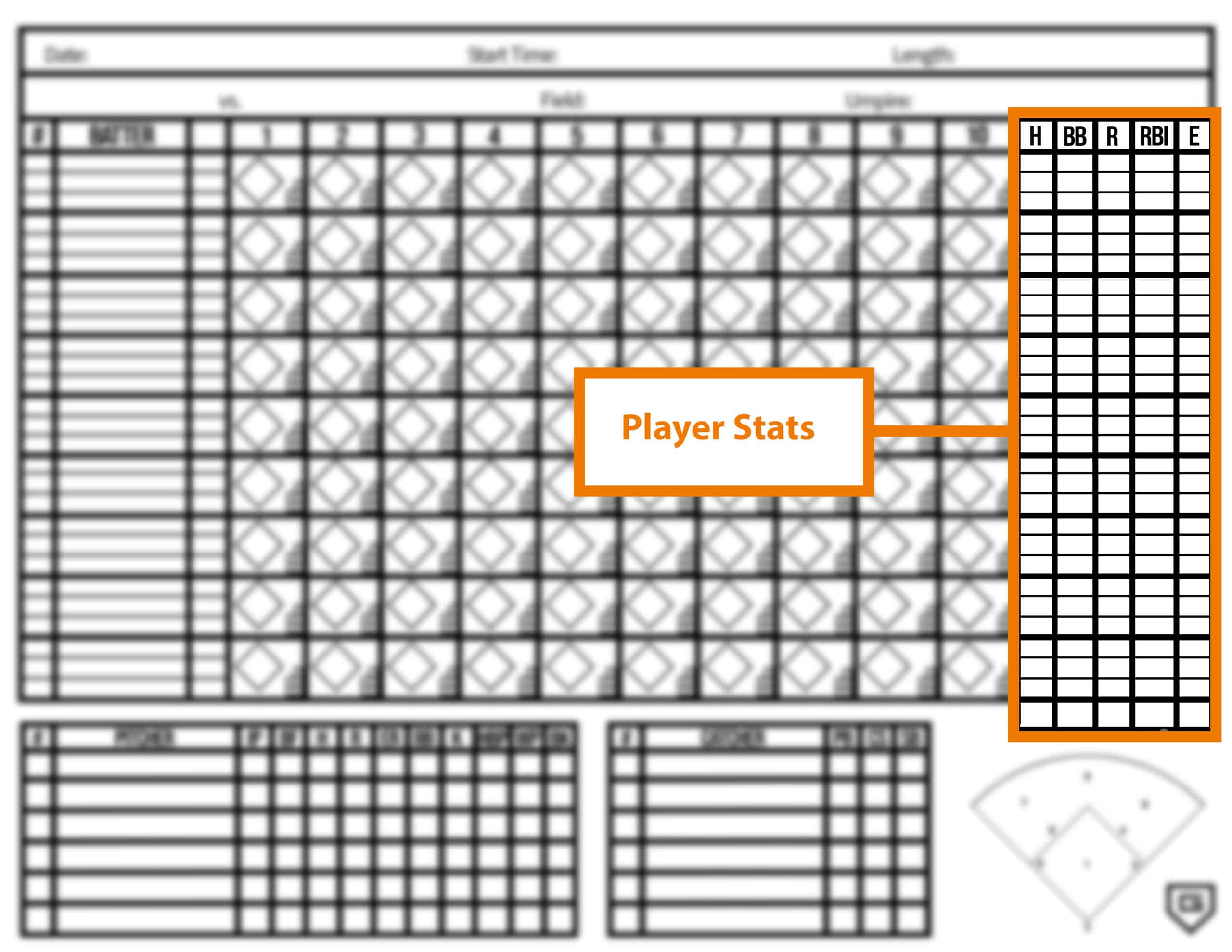
There is a table, similar to a box score, for individual stats adjacent to each player’s dedicated row in the lineup. Common stats tracked include:
- Hits
- Walks
- Runs
- RBIs
- Errors (committed in the field by the player)
To mark individual stats, you can either:
- Record the stat in the individual stats table immediately upon marking the decision in the score box, or
- Compile all of the individual stats from an inning, and mark them in the stats table in between innings
Pitcher and Catcher Stats
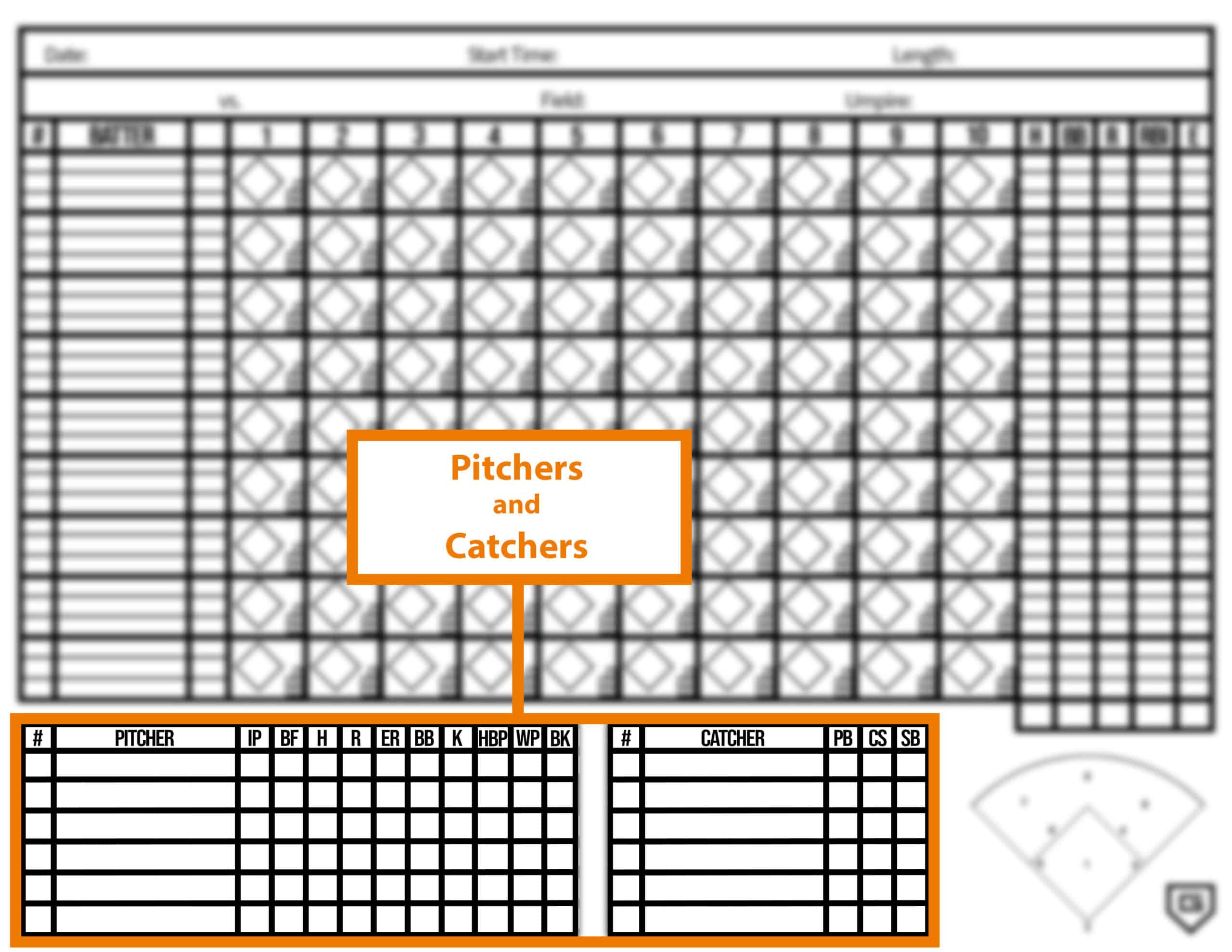
Similar to individual stats, at the bottom of the scorebook are areas for pitcher and catcher statistics.
For pitchers, tracked stats include:
- Innings pitched
- Batters faced
- Hits
- Runs
- Earned runs
- Walks
- Strikeouts
- Hit by pitch
- Wild pitches
- Balks
Catcher stats include:
- Passed balls
- Caught stealing
- Stolen bases
Team Stats
Some scorebooks have areas to compile total team stats, either by inning or game totals. At the end of each half-inning, totals for runs, hits, and errors are recorded in the summary columns of the scorebook.
Keeping a Scorebook in Softball: Tips and Tricks
While we covered the basics of keeping a scorebook in softball, we’ve provided a list of tricks and tips below from our collective real-world experience.
Here are a few recommendations to make your scorekeeping process efficient and accurate:
- Remain consistent in your shorthand notation & abbreviations. Consistency in notation style throughout the game ensures records are easy to understand later.
- Refer to guides if you’re concerned with a decision or struggling to keep up. Guides, like our scorekeeping 101 resource or scorekeeping cheat sheet, include robust information and situational circumstances to help you accurately complete your scorebook.
- Be attentive for the duration of the game. This may seem obvious, but if you lose focus you’ll miss the action. Make sure to actively watch every pitch of the game and accurately document the results.
- Double and triple check your work. Regularly reviewing your scorebook after each half-inning, and any additional breaks in action, ensures you catch any errors in scoring before the records are affected.

Softball Scorebook FAQs
How do you score a sheet for softball?
To keep a scorebook sheet for softball, you must fill out all information completely and record every pitch and play accurately.
Different parts of the process include:
- High-level game information
- Lineups and batting orders
- Balls and strikes
- Hits, outs, walks, and errors
- Individual player stats
- Team total stats
What is the Cinderella rule in softball?
The “Cinderella rule” in softball is a rule where everyone bats in the batting order. It’s typically used in recreational and youth leagues as an inclusive move where every player in uniform bats, whether or not they play in the field.
What’s the hardest position in softball?
While the question is subjective, some positions believed to be most difficult in softball are pitcher, catcher, shortstop, and third base.
- Pitchers command the game, controlling each peach and dictating the pace of play.
- Catchers have to work with the pitcher to call the game, keep the pitcher under control, and physically exhaust their bodies by squatting, blocking bad pitchers, and communicating with the rest of the team.
- Shortstop and Third base requires players to have quick reflexes as the smaller softball field challenges reaction time, range, and arm strength.
Where do you put your weakest players in softball?
Traditionally, coaches place their weakest softball players in right field. However, every position is important. Some of the highest leverage moments involve the right fielder in softball games.

Download GoRout’s Free Printable Softball Scorebook Sheet
Keep Every Inning Accountable
Our printable softball score sheet helps you track every pitch, play, and plate appearance with precision. From hits and errors to pitch counts and passed balls, this sheet keeps your team’s performance clear and organized, just the way coaches need it.
One Sheet. Every Stat.
No more flipping pages or guessing what happened in the 5th. This all-in-one score sheet gives coaches and scorekeepers an easy way to track every batter, pitcher, catcher and play. Whether you're managing a lineup or breaking down postgame stats, it’s built to keep everything in one place. Track all of your team's performances, from Jan-Dec, indoor and outdoor!
Built for Game Day Simplicity
Designed for coaches who want clarity on every pitch, this score sheet covers everything from walks and RBIs to wild pitches and strikeouts. It’s a game-tested tool that helps you stay organized and keep your team locked in from the first pitch to the final out. And no need to put it in your "cart", this resource is cost-free!