Top Youth Baseball Drills for Skill Development in 2026
Reading Time: 9 minutes


Reading Time: 9 minutes
Youth baseball drills teach skills and help kids fall in love with the game. When you’re coaching young players, running the same practice over and over doesn’t help them grow.
Practices need to be engaging while still covering the fundamentals like throwing, hitting, and fielding. The most effective youth baseball drills mix learning with fun, turning practice into games and challenges that keep kids excited and eager to improve.
In this article, we’ll break down the key drills every youth team should work on. You’ll find throwing and catching drills to build strong fundamentals, hitting drills that improve contact and power, and defensive drills that help players gain confidence in the field.
We’ll also cover base running, pitching basics, and a few creative activities to keep practices energetic and enjoyable.
The Basics Of Youth Baseball Drills

Youth baseball drills work best when they fit the age group and skill level of your players, especially for beginners in tee ball. An 8-year-old just starting needs different drills than a seasoned 12-year-old.
Every practice should cover the core skills:
- Hitting
- Throwing
- Catching
- Fielding, and
- Running
Planning drills around these basics gives young players a strong foundation.
Drills develop hand-eye coordination and reaction time. These are must-have skills in baseball, whether you’re swinging at a pitch or fielding a grounder. Simple repetition helps these movements become second nature.
| Core Skill | What It Develops |
| Hitting | Timing and power |
| Throwing | Arm strength and accuracy |
| Catching | Hand-eye coordination |
| Fielding | Quick reactions and positioning |
| Running | Speed and base awareness |
For young players, fun and engagement matter more than winning. If kids enjoy practice, they’ll want to keep coming back.
Boredom is the quickest way to lose a player’s interest. The right drills keep baseball exciting. You want kids who look forward to practice.
If you’re new to coaching, learning how to coach youth baseball can help you create better experiences.
Your equipment should match your players’ age and size. Heavy bats or hard balls can frustrate younger kids. The right baseball training equipment makes practice safer and more effective.
Throwing And Catching Fundamentals For Youth Players

Teaching kids to throw and catch correctly gives them a solid start at every position. These skills are the foundation of baseball. When you start with good techniques, kids stay safer and gain confidence.
Here are four throwing and catching drills to work on:
- Basic throwing mechanics
- Four corners throwing drill
- Target and bucket throwing drills
- Catch and glove work
Basic throwing mechanics for young athletes
To introduce basic throwing mechanics, follow this progression:
- Start by showing the proper grip. Players should hold the ball with their fingertips across the seams, not buried in their palms.
- For the throwing motion, have players point their glove at the target, turn their shoulders, and bring the ball back so their elbow forms an “L” at shoulder height.
- Begin with short throws, just 10-15 feet. It helps players focus on form instead of trying to throw hard.
- As they improve, you can slowly increase the distance. Repetition is everything.
Let your players make dozens of throws each practice, always using the right form.
Four corners throwing drill
The four corners throwing drill is a simple, effective way to work on throwing.
- Set up four cones in a square about 30-40 feet apart, with one player at each cone.
- Players throw around the square in order, focusing on their footwork as they catch and throw to the next base.
This drill teaches aim and helps them move their feet into a throwing position. If you want to spice it up, time the drill and see how fast they can complete a set number of rotations without mistakes.
Kids usually love the challenge, and it’s a sneaky way to build accuracy and balance.
Target and bucket throwing drills
Target and bucket throwing drills work on accurate throws.
- Place buckets at different distances or hang up targets on a fence.
- Players score points for hitting the targets.
- Tennis balls or a soccer ball work well for younger kids. They’re safer and less scary than hardballs.
- Use a bucket of tennis balls so players can throw several times in a row without chasing them down.
These games keep kids interested while they learn control. Worry about speed later, as accuracy comes first.
Catching and glove work fundamentals
Show players how to position their glove: fingers down for grounders, fingers up for balls above the waist.
Try the kneeling catch drill. Have players kneel on both knees while a partner tosses soft throws. It removes the need for footwork and lets them focus on glove work and hand-eye coordination.
Remind them to use soft hands and give with the catch instead of stabbing at the ball. Tell them to “catch it like an egg” to help cushion the ball in the glove. As kids get older, pitcher and catcher communication becomes important too.
Hitting Basics For Young Baseball Players
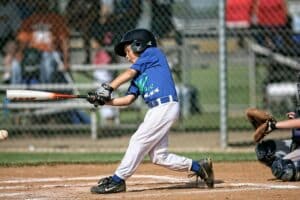
Hitting a baseball is tough, even for adults, and learning to hit the ball consistently takes time. Still, with the right approach, young players can build a solid foundation at the plate.
| Focus Area | Key Points |
| Swing Mechanics | Balanced batting stance, still head, eyes on the ball, smooth swings |
| Tee Work | Builds mechanics, provides instant feedback, develops muscle memory |
| Soft & Front Toss | Improves timing and hand-eye coordination with controlled movement |
| Power Development | Grounded back foot, firm front foot, hip rotation for power |
The best youth hitting drills focus on fundamentals before power. Tee work using a batting tee helps players get into a groove with a consistent swing while providing immediate feedback on their mechanics. Proper footwork and rotation teach them how to generate power the right way.
When young hitters focus on keeping their balance, making contact, and building their confidence, they create a solid base that helps them perform better when facing live pitching.
Essential Offensive Youth Baseball Drills

A good offense can change the outcome of a game. Young players need regular practice to grow their hitting skills. The drills below help your team build confidence at the plate and keep practice fun by turning each rep into a fun drill.
- Tee Drill Fundamentals: Allows hitters to focus on mechanics without pitch movement. Adjust tee height and position to practice different pitch locations, and emphasize a short, direct bat path.
- Soft Toss Drills: Introduce controlled movement to improve timing, barrel control, and early pitch recognition. Vary speed and location, and keep reps quick to maintain energy.
- Line Drive Competition: Turns practice into a game by rewarding hard, line-drive contact, helping players understand the value of quality hits.
These drills are great for young hitters because they help them develop solid mechanics, quicker reactions, and boost their confidence when they’re at the plate.
Essential Defensive Youth Baseball Drills

Defensive drills are the backbone of youth baseball practice. Young players need to learn the basics of fielding before they can thrive at any position.
- Ground Ball Shufflers Drill: Teaches lateral movement, balance, and staying low while fielding ground balls. Players shuffle side to side, field the ball quickly, and make quick throws to first base.
- Backhand Fielding Drills: Builds confidence and control when fielding balls on the glove side. Reaching across the body helps players handle tough grounders more comfortably.
- Infield Line Drills: Improves footwork, glove work, and throwing accuracy by having players field balls in sequence and move through the ball toward their target.
- Pop-Up Catch Drills: Helps players track fly balls, move into position, and make catches at eye level before resetting into a ready stance.
These defensive drills support proper movement, positioning, and focus. Regular practice helps young players turn difficult plays into routine outs and builds confidence across the field.
Fly Ball Drills For Youth Players
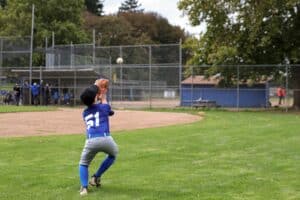
Catching fly balls is one of the most exciting parts of baseball for kids. Players need plenty of practice to learn how to track the ball, position themselves, and make the catch with confidence.
Here are three effective drills you can try:
- Fly Ball Competition Drill: Players toss a ball in the air and race to be the first to make five clean catches.
- Zig-Zag Drill: Position cones in a zig-zag pattern and have players weave through them while tracking and catching fly balls.
- Communication Drill: Two players line up an equal distance away, and have a fly ball thrown somewhere between them. Players must communicate who will catch the ball using verbal communication like “I Got It”, “Ball”, or “Mine”.
Stress reading the ball early and taking a quick first step. Keep drills competitive and fun to maintain energy and engagement.
Base Running And Agility Drills For Youth Baseball

Base running is about smart decisions, moving efficiently, and reading what’s happening on the field. Young players need to pick up good habits early so they can run the bases confidently and avoid mistakes.
| Focus Area | Drill Details |
| Base Running Fundamentals | Sprint through first base and continue into foul territory; practice rounding bases by aiming for the inside corner |
| Relay Races | Players sprint to a cone, field a ball, and throw to the next runner; vary movements such as backpedaling or lateral shuffles |
| Agility & Speed | Shuttle runs between cones set 10–15 yards apart; agility ladder drills using high knees and lateral patterns |
| Competitive Challenges | Timed base runs, team races, and individual challenges that track improvement |
Mixing repetition with a little competition makes base running practice more enjoyable and helps players develop smarter, more efficient habits on the bases.
Pitching Fundamentals For Youth Baseball
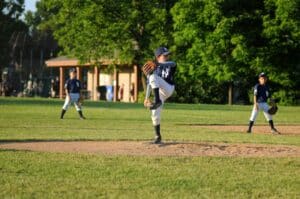
Learning to pitch takes time and patience, especially for young players. Building solid mechanics early helps prevent bad habits and reduces the risk of injury.
Young pitchers should focus on the basics before stressing about how fast they can throw, using simple drills to get a feel for how their bodies work together.
Start by teaching proper baseball pitch grips, balance over the back leg, and a smooth follow-through that highlights accuracy over speed. Pitch counts should always be age-appropriate to protect developing arms.
One effective drill is the one-knee pitching drill, which removes lower-body movement so pitchers can focus on arm path and release point.
Coach-pitch and machine-pitch drills also provide consistent reps and help players see what controlled pitching looks like.
Always watch for fatigue, wrap up sessions early if mechanics break down, and build confidence by celebrating strikes and improvement.
Bunting And Base Running Strategies For Youth Players

Bunting and base running can give youth teams a real advantage. These skills rely on technique, awareness, and effort rather than size or strength, making them ideal areas for young players to develop.
- Teach a safe bunting grip by sliding the top hand up the bat while keeping fingers behind the barrel
- Emphasize bat angle and balance, with the barrel slightly higher than the handle
- Coach players to pivot on the back foot and square quickly to the pitcher
- Use pivot-and-bunt drills to reinforce balance, footwork, and quick transitions
- Practice moving from bunt contact to the first explosive step toward first base
- Reinforce full-speed effort on every bunt, regardless of where the ball is placed
- Add targets or point-based games to keep bunting drills competitive and engaging
When coaches focus on fundamentals and repetition, bunting and base running become reliable weapons. Keeping drills structured but fun helps players build confidence, hustle, and game-ready habits that show up when it matters most.
Conclusion About Youth Baseball Drills
Youth baseball drills are most effective when they keep players engaged while building real skills. Turning drills into games or competitions helps maintain energy and focus while encouraging effort.
Focus on these core areas during practice:
- Hitting drills that develop bat control and smart swing decisions
- Fielding drills for both infield and outfield fundamentals
- Throwing drills that improve accuracy and arm strength
- Base running drills that build speed and reaction time
FAQs About Youth Baseball Drills
How do you structure a youth baseball practice?
Kick things off with a quick warm-up to get everyone moving. Then break up practice into focused chunks for hitting, fielding, pitching, and base running.
Each segment should last about 10-20 minutes, depending on how much time you have. Rotate players through different stations so everyone gets a shot at each skill. Keeps things lively, and nobody gets bored.
Wrap up with a fun game or scrimmage where players can use what they worked on. Always save a few minutes at the end for a cool-down and some quick team talk.
What is the 80/20 rule in baseball?
The 80/20 rule suggests spending 80% of practice on skill work and only 20% on games or scrimmages. That way, young athletes get their fundamentals down before worrying about live game play.
Spend most of your time on drills for throwing, catching, hitting, and fielding. Game-like situations come last, after the basics are covered.
How can I make my youth baseball practice fun?
Turn drills into games. Add some competition or keep score. Let kids compete in teams for throwing accuracy or hitting contests.
Keep the energy up and celebrate the little wins. Change activities every 10-15 minutes so nobody tunes out. Mix in relay races, target games, and timed challenges with regular skill work.
What are the 6 F’s of baseball?
The 6 F’s stand for:
- Feet
- Field
- Funnel
- Footwork
- Fire
- Follow through
They’re the core of defensive skills in baseball, especially for younger players just starting out.
Coaches usually work on each area with targeted drills. As players get the hang of things, you mix those skills together in more realistic, game-like situations.
Share This Article
Related Articles



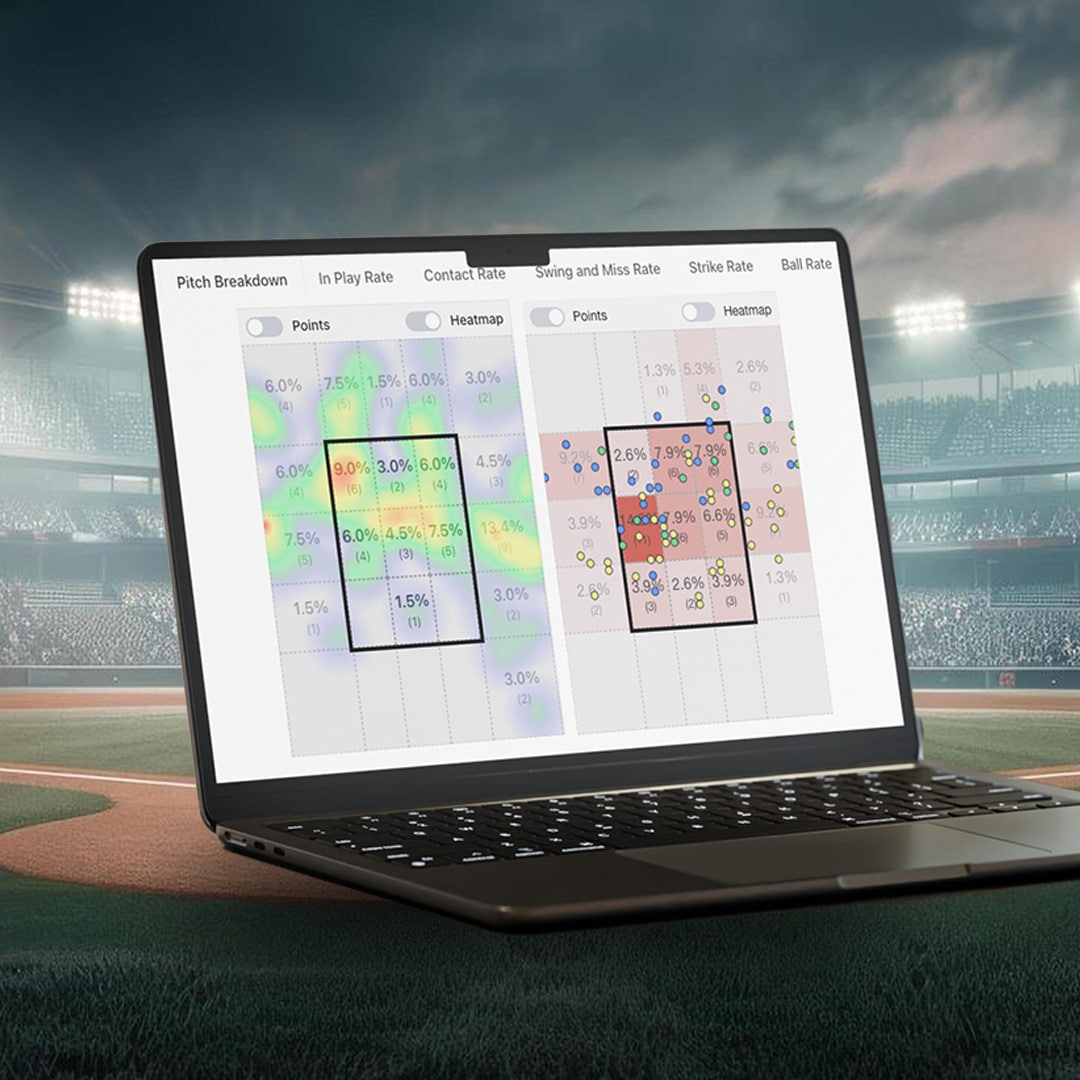
Big-League Analytics in your dugout for free
With GoRout Connect, GoRout Diamond customers receive access to AWRE Sports suite of analytics tools for free!