

Softball Practice Plans [FREE TEMPLATE]
Running an efficient practice shouldn’t mean starting from scratch every day. These softball practice plans are built to help coaches at every level organize drills, maximize reps, and keep players engaged. Download age-specific plans or use the blank template to build your own system.
Get these FREE assets delivered to your inbox by filling out the form below. Wait for 60 seconds and refresh your inbox to see an email from us with the PDFs attached.
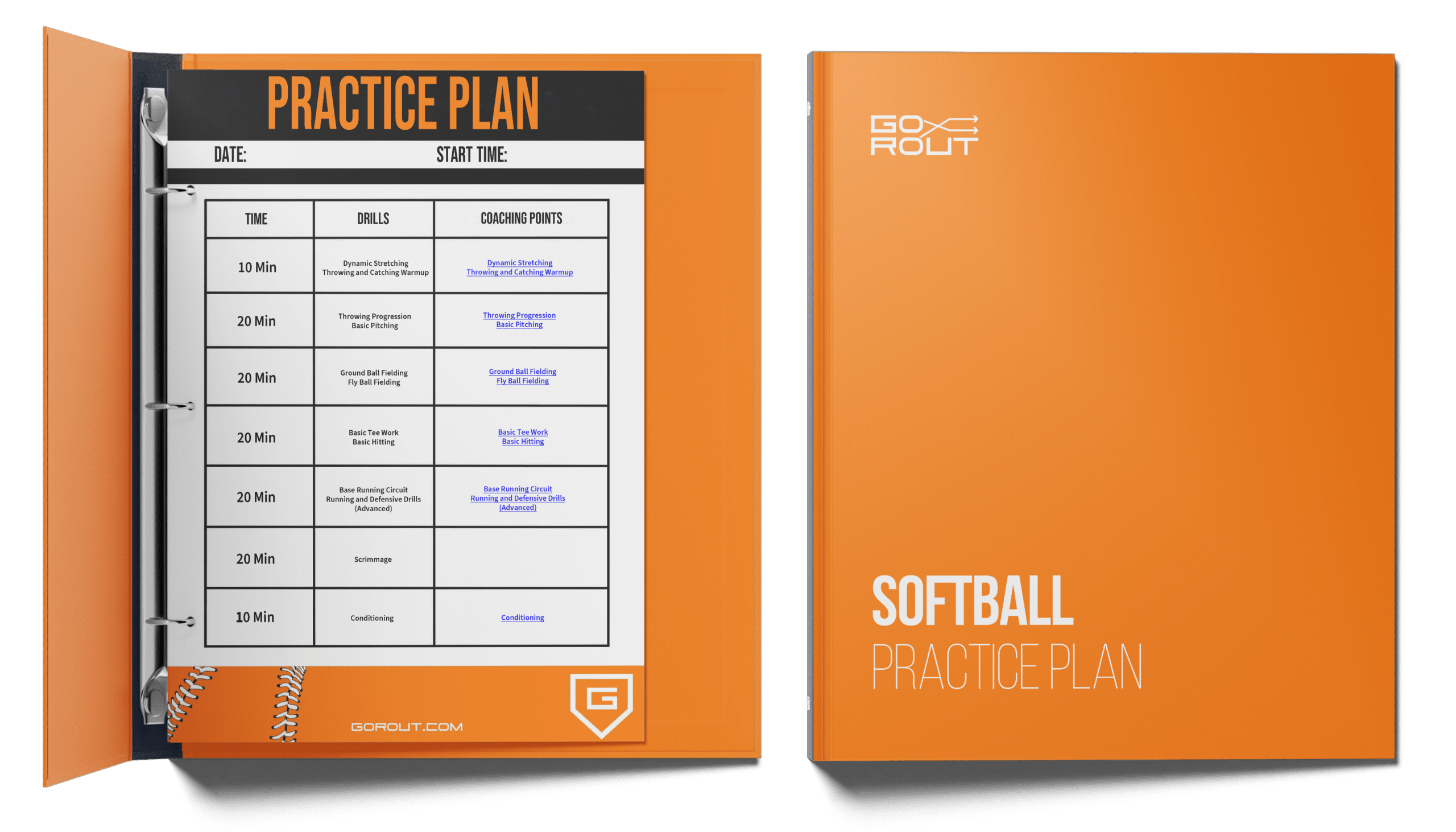
Softball practice plans are a detailed agenda of what you plan to accomplish with your allotted time as a coach. Incorporating a wide range softball drills into practice plans ensures your team covers all components of the game to become a well-rounded unit.
Planning softball practices can be difficult because you want to help players learn new skills while keeping sessions fun, and give everyone the same level of instruction.
A good practice plan helps you make the most of your time on the field and ensures your team keeps getting better as the season progresses. Some teams need two hours to accomplish what others can do in 90 minutes. It all depends on your program, players, coaching philosophy, and needs.
Well-organized softball practice plans are key for maximizing player development, maintaining energy, and cohesive unit. They cover a range of skills including fielding, hitting, and base-running drills, pulled from the wide range of drill libraries publicly available to coaches.
In this guide, we’ll show you how to make the best softball practice plans that keep your players involved and having fun, while introducing new drills and the right approach to improve your chances at success. Whether you're the head coach of a college program or running your first practice at the youth level, this guide can help structure your next practice to get the most out of your players.
Continue reading to learn:
- What softball practice plans are
- The foundation of softball practice plans
- Key components of practice plans for softball
- Fundamental drills to include
- Age-specific practice plans
- Seasonal sample practice plans
- Advanced techniques
- Equipment and resources
What Are Softball Practice Plans?
Softball practice plans are defined schedules consisting of training “blocks”, or defined time periods, that coaches use to maximize their time on the field and conduct a well-rounded, effective session.
Designing specific practice plans helps ensure teams cover both individual skills, small group work, in-game scenarios, and the full speed of inter squad scrimmages. They also include blocks for warm-ups and cool downs, preventing injuries and keeping players healthy.
What Is The Foundation of Effective Softball Practice Plans?

Effective softball practices take planning and organization to make sure your team gets the most out of every minute on the field.
Here are the foundational elements of softball practice plans:
| Element | Explanation |
| Set clear objectives | Define specific goals with measurable outcomes, and align drills and training regiment to work toward accomplishing them. |
| Balance drills with game situations | Mixing individual, focused drill work with the intensity of game situations through inter squad scrimmages establishes a fundamentally sound team that doesn’t feel the effects of in-game pressure. |
| Adapt plans regularly | Switching up pre-defined practice plans to accommodate specific age groups, attention spans, scheduling conflicts, and other reasons ensures you run an effective practice that benefits your team the most. |
Set clear objectives for each practice
Setting a clear plan with measurable outcomes keeps your practice focused and organized, while working on specific components of the game that your team needs to practice.
To set a clear plan with measurable outcomes, identify 2-3 main goals for each practice.
Examples of objectives include:
- Correcting poor batting stances to improve consistent contact
- Preparing for game situations, such as pitcher’s fielding practice (PFP), to reduce miscommunication and errors
- Reviewing batting, defensive, or pitch call signals in scrimmages to solidify communication
Write down these ideas and share them with your team at the beginning of practice to establish accountability and give the entire team a shared focus.
Many coaches break down specific drills that target their objectives. For example, if you aim to improve contact hitting, include tee work, soft toss, and live batting practice with a specific focus on making contact.
Balance skill development with game situations
Useful softball practice plans combine individual skill work with game-like scenarios, providing players a well-rounded training experience that sets them up to succeed.
To find that balance, start with fundamental drills that build technique and provide players with focused reps. Then, move to situations that players will face during games like live batting practice, simulated scenarios, or inter squad scrimmages.
This approach helps skills transfer to the level of competition they’ll experience on game day.
Here is an example of a balance in skill development that improves contact hitting:
- Begin with a coach reviewing proper mechanics so players have a focused mindset going into practice
- Set players up with partner drills like soft toss and front toss to get a high quantity of focused practice reps
- Then, split the team into two squads for an inter squad soft toss scrimmage
- Set a rule that players have to hit line drives or hard ground balls, focusing on contact. Every fly ball, even if it lands for a “hit”, can result in an out.
This sequence takes the concept, applies it to a partnered drill, and incorporates it into game-like scenarios to prepare your players for important situations.
Adapt plans regularly
While you need structure, remain flexible and adapt plans depending on factors surrounding your team, schedule, and performance.
- Create appropriate plans based on your team’s age and skill level.
- For youth team’s, keep it simple and focus on the basics with shorter activities to keep them interested.
- Advanced programs like travel softball, high school, and college-level teams handle longer, more complex drills and benefit from more intense game-situation training.
- Be flexible with your plans.
- If you notice the team struggling with a particular skill, be ready to adjust your schedule to address it.
- When there’s an intense week with more than 2 games on the schedule, establish a more relaxed, lower level of intensity in your practice plans to reserve energy for the games.
The best coaches know when to stick to the designed practice plan and when to adapt to help their team get the most out of their training sessions.
Key Components of Softball Practice Plans
Softball practice plans involve several key components to ensure your team covers a complete range of training from individual skills to game-speed reps.
Here are the most important components of an effective softball practice plan:
- Timed segments or practice blocks
- Warm-up and cool down
- Individual station-based drill work
- Competition-based drills
- Game scenarios
Timed Segments or Practice Blocks
Use timed segments for different fundamentals to ensure you cover all phases of the game and accomplish your goals.
Time management is crucial for successful softball practices. Most coaches find 60-90 minute sessions work best, with clear goals for each segment.
Here is a sample of timed practice blocks for different skillsets:
- Fielding [individual position work]: 15 minutes
- Hitting [individual] : 20 minutes
- Base running: 10 minutes
- Team defense: 15 minutes
Warm-Up and Cool Down
Every practice should begin with a 10-15 minute warmup to prepare the body for activity, and a cool down session to safely recover. A proper warm up before practice, and cool down after, keeps players loose and reduces the risk for injury.
Sample warm-ups include:
- Foul pole jog
- Arm hugs
- Wrist circles
- Arm circles
- High kick
- Lunge
- Toe touches
- High knees and butt kickers
Cool down exercises include:
- Hamstring stretches
- Forearm stretches
- Butterfly stretches
- Toe touches
- Triceps stretches
Individual Station-Based Drill Work
During individual sessions, for both fielding by position and hitting, break up different skills into stations so players have more reps and work in smaller groups. One group works on a specific drill, and then moves on to the next station without standing around.
Including station-based training where players rotate through different skill areas maximizes repetitions and keeps everyone moving. It also gives players more one-on-one or small group instruction. It's important you plan out station rotations so no players are left standing around and can move from one to the next station.
Make sure players get enough reps to build muscle memory through consistent practice. Concentrate on quality over quantity because precise, focused, and well-executed drills are more valuable than a ton of sloppy reps.
Competition-Based Drills
Incorporate competition into your softball drills whenever possible. Players tend to perform at full speed and give a higher level of effort when competing. That simulates game conditions better and prepares them to play with a competitive edge.
Whether it’s a fielding drills where the player who commits the least errors wins, or a hitting competition to see who can hit the most hard line drives, adding that competitive edge prepares your team for high-pressure scenarios.
Game Scenarios
Running hypothetical game scenarios, in both individual and team sessions, gives your players the closest taste of the speed and intensity they experience in games.
That can include any of the following:
- Batting practice with specific situations, like hitting with less than two outs, to build both technical skills and situational awareness.
- Fielding drills to cover different scenarios, like double plays, bunts, 1st and 3rd situations, rundowns (try to limit to two throws maximum), and other situations.
- Base running scenarios like first-to-third reads to improve decision making on the bases.
- Adding drills that target weak spots from recent games to work on the skills that need the most improvement.
- Inter squad scrimmages with live pitchers (either coach or player) so hitters get reps against live pitching.
Fundamental Drills to Include in Softball Practice Plans

The core purpose of softball practice is to build and hone fundamental skills that help players, and the team as a whole, grow and improve.
Great softball programs are built on strong fundamentals. The goal is to help your players improve while keeping it fun, especially at the youth level.
Drill progressions for hitting, fielding, and pitching practice blocks
The three most important components of softball are hitting, fielding, and pitching.
Below is a sample drill progression for each focus area:
Hitting:
- Tee work (use three tees at different heights for progressions)
- Soft toss (front toss drills help develop pitch recognition skills)
- Live batting practice (coach pitches or pitching machine)
- Targeted scenarios (contact drills, hit and run, sacrifice fly with runner on 3rd, etc.)
Fielding:
- Stationary ground balls (coach rolls grounders or uses a fungo bat)
- Lateral ground balls (backhand and forehand)
- Slow rollers (charging with control)
- Four-corner throwing drill (builds arm accuracy and communication)
- Communication drills (calling pop ups to make sure no fielders run into each other, covering bases on double plays, and other communication needs)
Pitching:
- Reviewing mechanics without a ball
- Partnered target throwing drills
- Game situations (bullpen or fielding)
Team practice segments: defensive and offensive simulations
Team practice segments, both offensive and defensive, involve bringing groups of players together to run drills or situational scrimmages that simulate the atmosphere of a game.
While individual team work is essential to building fundamentals, team practice segments bring everyone together and put the fundamentals into game-speed, high-intensity scenarios.
Here are two strong examples of team practice segments:
- Situation Scrimmages. Place a full defensive unit on the field and have all other players act as baserunners. Call out different scenarios, like “runner on second with one out”, and have a coach hit the ball to simulate a play.
- 21 Out Drill. The defense remains on the field until they make 21 outs. Encourage clean fielding and no errors, holding your team accountable and teaching them to lock in.
Players must communicate loudly during defensive infield-outfield drills to properly execute and avoid injuries and miscommunication.
Age-Specific Softball Practice Plans
Every softball team needs its own tailored practice plans. One of the most important factors to consider is the age and experience level of your team.
Young athletes have different practice needs than older, more experienced programs. It’s important to structure practices accordingly to best suit your team and set your players up for success. One team with younger players may require certain focuses, while other drills are more suited for teams with advanced players only.
Below, we break down specific plans by age group, including:
- 8U, 10U, & 12U
- High School
- College
8U, 10U & 12U practice plans
When working with youth and travel softball teams in the 8U through 12U range, it’s important to keep the drills simple.
- For 8U, focus on fundamental mechanics and learning the game. Teach the basics of fielding positions, work on hitting fundamentals with some tee drills, and go over simple base running rules. Base running is often the most under-coached skill in youth softball.
- Coaching tip: Keep drills short. 10-15 minutes per activity helps maintain focus. Young players need lots of repetition and positive feedback.
- For 10U and 12U, incorporate situational plays and focus on more advanced skills. Players are still young and learning, so keep that in mind. However, they’re reaching the age where you can incorporate more strategic softball IQ into practice, along with higher levels of competition.
High school practice plans
At the high school level, competition becomes a priority over playing time. Structure your practices accordingly and instill that mindset into players. It’s still about having fun and learning, but this is the age where serious players separate themselves from the rest.
High school players can handle longer drills, around 15 to 20 minutes at a time. Dive into more intense concepts like defensive situations, advanced hitting techniques, more complex strategies/softball IQ, and competitive scrimmages.
Adding competitive elements helps mimic game pressure, and one-on-one, focused position-specific training is key at this level.
College-level practice plans
College-level practices take it up another notch with higher intensity and more specialized training.
Players need to be ready for physically demanding practice sessions with a focus on improving techniques, but also preparing for upcoming opponents with specific game plans. These practices often include video breakdowns and advanced metrics.
Regularly incorporating advanced hitting drills and defensive strategies is key.
Seasonal Sample Softball Practice Plans
Practice plans change depending on the time of year. You don’t want to train with the same physical intensity leading up to the playoffs as you would in the pre-season. The point of focus shifts throughout the year as well.
Below are sample softball practice plans for the following seasons:
- Pre-season
- Mid-season
- Tournament and playoffs
Pre-season softball practice plan
| Time | Focus | Explanation |
| 15 minutes | Dynamic warm-up | Jogging, stretching, partner throwing progressions, and other activities to warm up the body. |
| 25 minutes | Throwing progressions and fielding basics | Build arm strength & reinforce proper mechanics through focused individual sessions. |
| 30 minutes | Batting practice | Live batting practice with a coach throwing, where batters work on their swing and other players field balls while working on individual defensive skills when the ball is hit to them. |
| 20 minutes | Conditioning | Sprints and agility ladder work, base running, and other conditioning drills to get players in shape and prepare them for the season. |
| 10 minutes | Cool down | `Static stretches to reduce muscle soreness and lower the heart rate. |
Mid-season softball practice plan
| Time | Focus | Explanation |
| 15 minutes | Dynamic warm-up | Jogging, stretching, partner throwing progressions, and other activities to warm up the body. |
| 30 minutes | Station work | Rotate through progressions including fielding drills, tee work, soft toss, bunting, and anything else you need to work on. |
| 45 minutes | Live game situations | Place the full defense on the field and have all other players serve as baserunners. Set up different scenarios and have the coach hit the ball to various positions. Alternatively, you can integrate game-speed reads during live batting practice. |
| 20 minutes | Team competition | Drills that split the team into two smaller teams, competing against one another in various drills or scrimmage scenarios. |
| 10 minutes | Cool down | Static stretches to reduce muscle soreness and lower the heart rate. |
Tournament and playoff practice plans
Tournament and playoff prep requires focus on game-like intensity.
| Time | Focus | Explanation |
| 15 minutes | Dynamic warm-up | Jogging, stretching, partner throwing progressions, and other activities to warm up the body. |
| 20 minutes | Defensive situations | Set up simulated high-pressure scenarios for players to practice focus and attention to detail as they prepare for tournaments/playoffs |
| 25 minutes | End of game scenarios | Practice the highest pressure moments: those at the end of the game when it matters the most. Some examples include tie games and last inning situations where your team needs to defend or score a run to stay in the game. |
| 15 minutes | Mental prep | Use this time to prepare the mentality of your players to handle the pressure of tournaments and/or the post season. |
| 10 minutes | Cool down | Static stretches to reduce muscle soreness and lower the heart rate. |
Advanced Softball Practice Techniques
| Technique | Explanation |
| Create a practice blueprint | Work backwards from your season goals, starting with what your team needs the most. Build your plan around those priorities and break down each practice into clear segments that target those goals with specific time limits. |
| Use station-based practice structures | Maximize your time with players by separating the team into small groups. Rotate through different skill stations to work on multiple skills simultaneously and give players more game-speed reps. That way, no two fielders are standing around just holding their gloves without improving. |
| Add competitive elements | Make drills more engaging and game-like by setting up competitive challenges, contests, and relay races to practice skills while fueling the competitive spirit. |
| Recruit/manage assistant coaches and/or parent volunteers | Additional coaches or volunteers help you accomplish more and give players additional one-on-one instruction. Assign specific responsibilities before practice begins and provide them with written drill instructions. |
| Break your team into appropriate groups | Splitting players into groups based on positions or abilities helps players improve faster since they’re working on skills that are specific to their needs. Alternatively, pairing experienced players with beginners can enhance confidence and skill development through peer mentoring. |
Equipment and Resources for Effective Softball Practice
Having the right softball training equipment makes your practices more productive and fun.
Some of the most important softball equipment for practice plans include:
| Equipment | Context |
| Balls |
|
| Bats |
|
| Protective gear |
|
| Bases |
|
| Training aids |
|
| Field equipment |
|
| Record-keeping |
|
Conclusion About Softball Practice Plans
Effective softball practice plans are the foundation of team success. A well-orchestrated practice promotes concentration and fundamental development that benefits players throughout the season and beyond.
Remember that your plans can be team-focused or small-group centered. The best coaches mix up their approach with a variety of drills, rotations, and competitions to keep practices engaging.
Keys to success:
- Be prepared and organized before practice starts
- Set clear goals and expectations for each session
- Focus on fundamental skill development
- Include variety to maintain player interest
FAQs About Softball Practice Plans
What is the 3 2 1 drill in softball?
The 3 2 1 drill in softball splits the team into two groups: offense and defense.
Three balls are set 5–7 feet apart from third base toward home plate. The first defensive player, starting on third base, sprints to retrieve each ball and throws it to a teammate at second base.
Meanwhile, an offensive player runs from home plate toward first and second base. The goal is for the defense to complete all throws before the offensive runner reaches second.
What are the top 3 hardest positions in softball?
The three most challenging positions in softball are typically catcher, shortstop, and pitcher.
Catchers need exceptional game awareness, quick reactions, and physical endurance. Shortstops require elite fielding skills and arm strength.
Pitchers face intense pressure and need consistent technique.
Each position demands unique skills that you should address in your practice planning.
How long should softball practice be?
Effective softball practices typically last 1.5 to 2 hours. Youth teams might practice for 60-90 minutes, while high school and college teams might go longer.
Quality matters more than quantity. Well-organized practice plans with station-based drills help you maximize time without exhausting players.
Include water breaks and various activities to maintain focus.
What drills to run at a softball tryout?
For softball tryouts, include the following:
- Fielding: Ground balls, pop flies, and throwing accuracy tests
- Hitting: Batting practice, bunting, and tee work
- Base running: Timed sprints between bases
- Position-specific: Catching drills and pitching evaluation
Use station-based practice formats to evaluate multiple skills efficiently. It helps you assess each player’s abilities while keeping everyone active and engaged.
Download GoRout's Free Softball Practice Plans [PRINTABLE PDF]
Practice Plans Built for Every Age Group
From beginner fundamentals to advanced team execution, each plan is tailored to match player development at every level. Whether coaching 6U athletes learning basics or 18U players preparing for competition, these plans provide structure without overcomplicating your workflow.
Organize Practice for Maximum Efficiency
Each plan is structured by time, drills, and coaching points to help eliminate downtime and keep practice moving. Instead of explaining what’s next, simply follow the plan and focus on coaching and player development.
Customizable for Your Program
Every program runs differently. These templates allow you to adjust drills, timing, and priorities so you can build practices around your team’s needs while maintaining a consistent structure.


