Football Playbooks Guide: Build, Teach, and Execute in 2026
Reading Time: 8 minutes


Reading Time: 8 minutes
Every winning program starts with a playbook that players can actually execute under pressure. An American football playbook is the complete operational document for a team with offensive formations and plays, defensive schemes and assignments, and special teams packages.
Done right, it’s both a teaching tool and a game-planning reference that keeps every player aligned from the opening snap to the last.
This guide covers everything you need to build, organize, and teach football playbooks from scratch, including how GoRout Scout (for practice) and GoRout Gridiron (for game day) bring it to life on the field.
What Is a Football Playbook and Why Does It Matter

Before you draw a single diagram, it helps to understand what a playbook is supposed to do and what separates one that teaches from one that holds your team back.
The purpose of a football playbook
A football playbook aligns every player on the team with assignments, formations, terminology, and situational responsibilities. Without one, even talented rosters fall apart when a defense does something unexpected or a play call comes from the sideline that half the huddle doesn’t recognize.
Beyond game planning, a playbook is the foundation for teaching. Coaches use it to install a system at the beginning of the season, build on it week by week, and give players something to study on their own. The best football playbooks don’t just tell players what to do on each football play. They explain why.
What every playbook must include
Strong football playbooks are built on five non-negotiables. The offensive section covers formations, runs, and passes. The defensive section covers fronts, coverages, and stunts. Special teams get their own chapter, as they are an essential component of your team.
| Component | What It Contains | Why It Matters |
| Formations | Base alignments for offense and defense | Sets pre-snap positioning for every player |
| Play Diagrams | Xs and Os with routes, blocks, and assignments | Translates concepts into visual instructions |
| Terminology | Team glossary for calls, shifts, and motions | Ensures everyone speaks the same language |
| Assignments | Position-specific role on every play | Eliminates confusion about responsibilities |
| Situational Plays | Red zone, two-minute, goal line packages | Prepares players for high-leverage moments |
How to Build a Football Playbook From Scratch

Building a football playbook isn’t about volume. It’s about deliberate decisions early, so every play you add has a purpose.
Define your offensive and defensive identity first
Before drawing anything, decide what kind of team you’re building. Are you a run-first power offense or a spread attack? Do you run multiple defenses that disguise coverages?
Your identity drives every play you put in the book.
The most common mistake is adding too many plays too early. Players can’t execute what they can’t remember. A lean football play calling system built around 10 to 15 core plays beats a 200-page book that never gets opened.
How to organize plays by formation and situation
Clear structure means players can find the right play fast, whether they’re reviewing film on Tuesday or lining up on Friday night. Organize by:
- Down and distance: short yardage, third and medium, third and long
- Field position: red zone, goal line, backed-up territory
- Game situation: two-minute drill, prevent, opening script
- Special teams: kickoff, punt, field goal, and return packages
How to draw and diagram football plays
Clear diagrams are half the battle. Use standard Xs and Os notation: solid lines for blocking assignments, curved lines for routes, arrows for motion direction. Color-code by unit so the eye immediately knows where to look.
Digital tools are faster and easier to update than hand-drawing. If you’re using GoRout Connect, plays push directly to players’ wrist devices with no file management needed. Here’s a five-step process:
- Choose your base formations for both offense and defense
- Select 10 to 15 core plays you can rep every day before adding depth
- Draw each play with clear assignments for every position
- Organize by section: run game, pass game, red zone, and special teams
- Review and cut anything players can’t execute consistently by mid-season
Offensive Playbook Fundamentals

Your offensive football playbooks succeed when formation choices, run game concepts, and passing schemes work as a cohesive system. Here are the building blocks every offensive coordinator needs.
Common offensive formations and when to use them
Formation choice should reflect your personnel first.
I formation is built for power football: a lead fullback, a strong running back, and a tight end give you the numbers to run between the tackles and set up play-action.
The spread offense pulls defenders into space and creates one-on-one matchups on the perimeter.
A Wing-T offense relies on misdirection: pulling guards, reverses, and counters attacking the opposite side of where the defense is flowing.
Other formations like the Pro Set, pistol, and single-back sets round out most offensive playbooks with additional flexibility. The pistol, for example, keeps a back behind the QB while still spreading the field.
Of course, formation choice ultimately comes down to what your players can execute.
Run game concepts: zone blocking and power schemes
A strong run game gives your entire offense credibility. Here’s how the primary concepts compare:
| Run Scheme | Blocking Style | Key Concept | Best For |
| Inside Zone | Combo blocks | RB reads backside cut | Physical lines, patient backs |
| Outside Zone | Lateral stretch | RB bounces or cuts back | Athletic backs, spread teams |
| Power | Gap blocking, pulling guard | Double-team at point of attack | Short yardage, goal line |
| Counter | Misdirection, two pullers | Attacks opposite of flow | Defenses that over-pursue |
| Draw | Pass set, delayed hand-off | Freezes rushing linebackers | Passing situations |
The offensive line has specific gap assignments on every snap, and how they move the ball forward defines your run game’s identity. Draw plays, counters, and traps punish defenses that over-pursue.
A cornerstone of any football offensive scheme is balancing these concepts, and if you want to go deeper, the football running plays guide covers every concept in detail.
Passing game: play action, RPOs, and spread concepts
Play action works best when the run game is working. A convincing fake freezes linebackers, holds safeties, and gives receivers an extra step on the post route and other vertical concepts. It makes every pass more dangerous when paired with a credible run threat.
RPOs are now used at every level of college and NFL football. They require a quarterback who reads a leverage defender post-snap and decides:
- If the read defender crashes on the run, throw the attached route
- If the read defender widens, hand off and let the back work
| Formation | Offensive Style | Run or Pass Heavy | Best Suited For |
| I-Formation | Power run | Run heavy | Physical teams with strong backs |
| Spread | Space and speed | Balanced to pass | Athletic QBs, perimeter playmakers |
| Wing-T | Misdirection | Run heavy | Teams that want to confuse defenses |
| Shotgun | Pass-heavy | Pass heavy | High-volume passing attacks |
| Pro Set | Multiple | Balanced | Teams with versatile backfields |
Defensive Playbook Fundamentals
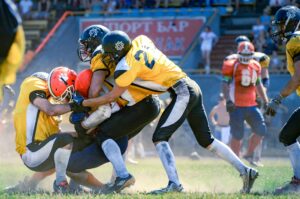
Image courtesy of Victoria Prymak on Unsplash
A well-built defensive section gives players clarity on their gaps, coverage keys, and responsibilities before the snap. Start with your base, then layer in complexity as your players are ready.
Base defensive schemes to build around
The three most common base defenses are the 4-3, the 3-4, and the 4-2-5 nickel:
- 4-3: Four defensive linemen, three linebackers. Strong against the run and straightforward to teach.
- 3-4: Three-man front, four linebackers. Creates confusion about who’s blitzing from the edge.
- 4-2-5 (Nickel): Replaces a linebacker with a fifth defensive back. Effective when offenses spread the field with more receivers on the perimeter.
Check the full range of football defensive schemes and defensive football formations before committing to one.
Organizing defensive assignments and alignments
Teach your base defense until every player executes gap assignments and coverage responsibilities without thinking. Then build in this sequence:
- Base front and gap assignments
- Cover 2: two-deep safety shells, flat coverage by corners
- Cover 3: three-deep zones, corners carry vertical routes
- Cover 4: quarters coverage against spread sets
- Blitz packages and stunts built off the base alignment
Football linebacker drills, defensive line drills, and football tackling drills should all reinforce playbook concepts directly and not exist as generic technique work.
Youth defensive playbook considerations
For youth football programs, simple and executable beats sophisticated every time. A base 4-4 or 6-2 gives young players clear gap responsibilities and keeps the number of coverage checks manageable.
Build football IQ alongside physical fundamentals first.
Youth and Flag Football Playbooks

Youth and flag football coaches face a different challenge: a system simple enough for developing players to learn quickly while still being effective on the field.
Designing a playbook for young players
Youth football playbooks should be lean. Limit formations to two or three and select plays every player can understand without significant prior experience. Avoid schemes requiring multiple pre-snap adjustments early in the season.
Football agility drills and football running back drills should reinforce the plays your team runs most. They shouldn’t exist in isolation from the playbook.
Flag football plays and modified formats
Flag football playbooks work differently from tackle versions. Without blocking schemes, the system shifts toward routes, spacing, and creating separation for receivers. You need to identify mismatches quickly and attack them before the defense adjusts.
Key design principles for flag football:
- No blocking means route concepts must create their own separation
- Three to five core plays are enough at entry level
- Routes should prioritize speed and precision over complexity
- Coaches who prefer to add concepts should implement them only after base plays are automatic
Templates and resources for youth coaches
Most youth coaches should start with a template and create their own plays within it. A good football playbook template gives you pre-labeled diagrams and situational sections ready to fill in.
Every youth football playbook should include:
- No more than three offensive formations
- Eight to 12 core plays with simple diagrams
- A glossary of terms in plain language
- Color-coded assignments by position group
- A short defensive section covering gap and coverage basics
Football Playbook Templates and Free Resources
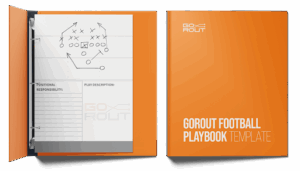
Having the right starting point saves hours of work, whether you’re building your first playbook or updating an existing one.
Printable diagrams and digital drawing tools
Every time a new play gets added or a concept changes mid-season, printed copies need updating. Digital playbooks solve that: edit and redistribute in minutes.
The right tools depend on your league and budget. Football play cards offer a lightweight alternative to full binders, while digital platforms draw and organize full play libraries with filtering by formation, situation, and personnel.
How to use a football playbook template
A template gives you a pre-built system structure to fill with your own plays rather than starting from scratch. Look for:
- Pre-labeled formation diagrams for offense and defense
- Blank play diagrams with position markers
- Sections for red zone, two-minute drill, and special teams
- Space for terminology and coaching notes
- Printable and editable format options
The free football playbook template from GoRout covers all of the above.
Conclusion About Football Playbooks
A strong football playbook is the foundation on which everything else is built: your practice structure, your game-day communication, and your players’ ability to execute under pressure.
Whether you’re building offensive playbooks for a varsity program, simplifying a youth football system, or designing flag football playbooks for entry-level leagues, the principle is the same. Start lean, teach clearly, cut what players can’t run.
FAQs About Football Playbooks
What should every football playbook include?
Every football playbook needs base formations, play diagrams with position assignments, a terminology glossary, situational packages for red zone and two-minute scenarios, and a special teams section. Keep it lean: 10 to 15 core plays executed consistently beat a bloated system players can’t remember.
How many plays should a youth football playbook have?
Eight to 12 core offensive plays built around two or three formations. Simplicity and repetition beat complexity at the youth level. Young players improve fastest when they can run the same plays until execution becomes automatic.
What’s the difference between a flag football playbook and a tackle playbook?
Flag football playbooks focus on routes, spacing, and receiver separation since there’s no blocking. Tackle playbooks add run game concepts, blocking schemes, gap assignments, and defensive fronts. Three to five reliable flag concepts are enough for most entry-level leagues.
How does GoRout improve playbook installation at practice?
GoRout Scout lets coaches push plays to players’ wrist devices through a cellular network. Players see their assignments in real time without paper cards or delays. This speeds up install periods, reduces confusion, and gives teams more quality reps every session.
Share This Article
Related Articles




Free Playbook Template
Our downloadable template offers a sleek, detailed design with space for positional roles, play descriptions, and any play notes that you want to include.