Scout Team Football: A Guide For Coaches & Players
Reading Time: 10 minutes


Reading Time: 10 minutes
Every football program depends on players most fans never learn the names of. Without reserves and practice squad players, no team can fully prepare for their upcoming opponent.
Scout team football is the practice-week system where a group of players imitates future opponents so the defense and offense can prepare against realistic looks. Without it, a coaching staff is guessing at what Friday night, or any other game day, holds.
This article provides a comprehensive breakdown of football scout teams, including:
- What a scout team is and how it differs from a practice team or practice squad
- How the role works at the high school and college level
- How coaches turn film into practice reps for their own athletes
- How scout team performance can open doors to college or pro exposure
- Digital tools that aid and enhance the effectiveness of scout teams
What Is a Scout Team in Football?
A scout team in football is the group of players who run upcoming opponents’ plays so the starters can prepare their specific game plan over the course of a normal practice week. Football scout teams are made up of backups and reserves.
What Is The Purpose of a Scout Team in Football?
The purpose of a scout team is to simulate the other team’s offensive and defensive formations, tendencies, and personnel groupings. They allow starters to practice against situations and scenarios they’re likely to face in the game. Scout players help the coaching staff prepare answers for what the opposing team tends to do in specific situations on both sides of the ball.
Though the scout team is made up of players least likely to see game action, it gives them meaningful snaps and offers an opportunity to showcase their abilities to coaches. Many players on scout team are excited for the opportunity to compete and have fun in their role.
Scout Team vs. Practice Squad: What’s The Difference?
The scout team is a practice function and unofficial designation that doesn’t show up on the depth chart. Practice squad is an official roster designation, most commonly used in the NFL, where a player signs a contract to develop with the team without appearing on the active roster.
| Scout Team | Practice Squad | |
| What it is | A weekly practice role | An official roster status |
| Found at | High school, college, pro | Primarily NFL |
| Pay | Not a paid position (college/high school) | Contracted weekly salary |
In the NFL, the scout team is often made up of practice squad players. College and high school programs don’t have practice squads. Their scout teams are made up of walk-ons, underclassmen, and reserve players working their way up the depth chart.
The Role of Scout Team Players in Football
Playing scout team is one of the most demanding, least recognized jobs on a football roster. These players absorb physical punishment from the first unit all week, while receiving none of the credit for the team’s successes on game day.
A scout team player has to learn a new opponent’s playbook every week and execute it convincingly enough for the starters to get a true look.
That repetition builds football IQ and scheme diversity. Guys who commit to the role develop a broader understanding of offensive and defensive schemes than players who only run their own.
The “thankless job” narrative around the scout team is largely misleading. Coaches who run strong programs treat it as a development pipeline and acknowledge the scout team’s impact in team meetings.
Effective scout team players share a few common traits, including:
- Consistent effort and the same energy on every rep
- Coachability and quick adjustment to new assignments each week
- Film awareness and the ability to mimic an opponent’s tendencies
The quality of scout team reps shapes how ready the starters are.
What Do Coaches Expect From Scout Team Members?
Coaches expect scout team players to run the assigned look at full speed, with the correct assignment, every rep. Every scout period is also a teaching opportunity, and a strong staff of assistants watch scout reps as closely as first-team snaps.
Staffs that use football coaching software find it easier to introduce opposing schemes to the scout team and hold every position group to that standard.
How Do Scout Team Reps Build Long-Term Value?
Consistent scout-team participation builds habits that translate directly into game reps if and when a player earns a bigger role. That carryover is why time on the scout team shapes a player’s athletic development.
The traits that make a scout team player effective include:
- Willingness to learn a new scheme every week without complaint
- Physical toughness across a full season of high-rep practices
- Attention to detail on opponent-specific tendencies
- A competitive mindset that treats every rep as an audition
The life of a scout team player is far from glorious. From spring ball and fall camp through the regular season and playoffs, scout players grind in practice without seeing time during games.
It’s important for coaches to emphasize the impact of scout team players come game day. As a coach, it’s helpful to encourage scout team players to keep working hard and provide a legitimate opportunity to earn more playing time.
Scout Team in High School Football Programs
At the high school level, a scout team has to function with a fraction of the roster depth college programs or NFL teams enjoy. A varsity program with 40 or 50 players often has the same weekly opponent-prep workload as a college roster three times that size.
Multi-position players who start on offense and defense may have to serve scout team reps somewhere in the practice plan, depending on the program’s size.
Smart high school staffs use the scout team as a pipeline. JV players and Varsity reserves who participate on scout reps and have hopes of moving up often do. Since they don’t see time in Varsity games, scout team performance is one of the clearest signals a coach has for a player’s progression and game-readiness.
How To Run an Effective Scout Team with a Small Roster
Programs with limited numbers need a weekly system starting as early as spring or summer camp. A basic scout team prep checklist for high school coaches includes:
- Assigning scout team roles by Monday, based on film breakdown from the weekend
- Cross-training multi-position players so they can rotate scout reps without fatigue
- Distributing cards or digital scripts before Tuesday’s practice
Scout Team in College Football
College football scout team preparation involves a level of coaching-staff coordination that high school programs rarely need. Graduate assistants and quality-control coaches spend more hours building the week’s scout plan than any other task.
The scout team in college football is also a competition. Players on the two-deep and three-deep chart use scout reps to push for a starting job.
How Do College Coaching Staffs Organize Scout Team Periods?
Most staffs assign scout team install by Sunday night, based on the film grade from the prior game and the report on next week’s opponent. The point is to keep everyone’s focus on that opponent.
A typical week for a well-run organization is as follows:
- Sunday: staff reviews film and builds the opponent injury report
- Monday: QC coaches finalize scout cards by position
- Tuesday to Thursday: team periods run full scout installs
- Friday: walkthrough confirms every look
How To Get The Most Out Of Scout Team Reps
A scout team rep only has value if it gets reviewed. Coaches who tag and clip scout reps for the next day’s film session get far more developmental return than those who don’t.
That’s the point where digital systems can enhance an otherwise manual process.
Programs at any level run into the same bottleneck college staffs face with scout teams: getting the install from the whiteboard to the field.
Table 1: Scout team workflow by program level
| Level | Staff Involved | Primary Tools | Key Challenge |
| High School | Head coach, 1-2 assistants | Whiteboard, paper sheets | Roster depth |
| Small College | Position coaches, GAs | Printed cards, basic video | Alignment accuracy |
| Major College | QC coaches, analysts | Digital systems, film rooms | Volume of installs |
Scouting and Film Evaluation: The Backbone of Scout Team Preparation
Film evaluation turns a scout team period from generic reps into an accurate simulation of the upcoming opponent. Coaching staffs break down the prior game or two of an opponent’s film to identify exactly what to build scout cards around.
Staffs prioritize four tendencies almost every week:
- Base personnel grouping, including how often the opponent deploys running backs in the passing game
- Formation shifts and motion before the snap
- Down-and-distance tendencies on early downs
- Blitz packages or safety rotations tied to specific coverage looks
Someone still has to convert those tendencies into an executable scout card. That’s where the staff can lose valuable time to a manual process.
What Do Coaches Look for When Breaking Down An Opponent’s Film for Scout Periods?
Coaches look for patterns that repeat across multiple games. Certain one-off calls or trick plays are noted, but a look that shows up once doesn’t equate to a tendency. Tendencies that appear time and time again, such as in three of the last four games, is worth building a scout period around.
How To Plan Scout Team Periods in Football
The traditional scout period path, from film breakdown to practice execution, runs through paper. Let’s take a look at the various steps of scout team planning and execution.
- Film Breakdown: Coaches take manual notes when reviewing film, and may mark notes or draw diagrams on the whiteboard in their office or meeting rooms.
- Card Creation: Staff creates and prints paper cards to use for install and reference during scout team periods.
- Distribution: Coaches physically handout cards to players.
- Player Review: Scout team players review cards to learn their role for the week each night before practice.
- In-Practice Recall: During scout-team periods, coaches shout the play to players. Both players and coaches also refer to the physical card in-between plays or during breakdowns.
Table 2: Planning Scout Team Periods Manually
| Step | Method |
| Film breakdown | Manual notes, whiteboard |
| Card creation | Printed paper cards |
| Distribution | Physical handout |
| Player review | Night before practice |
| In-practice recall | Coach shouts the play |
How To Run More Effective Football Scout Team Periods with GoRout Football Practice Devices
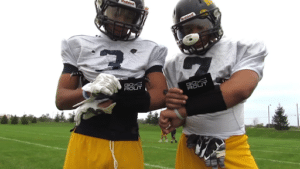
A digital play-calling system closes the film-to-field gap and enhances scout team every step of the way. GoRout Scout, GoRout’s digital scout card platform, lets the coaching staff turn film breakdown into scout cards and push them to players instantaneously.
In comparison to traditional paper-based methods, let’s take a look at the scout team process using GoRout.
- Film Breakdown: Instead of spending time writing notes, coaches can digitally tag plays and export clips for additional review.
- Card Creation: Digital systems like GoRout features in-app card builders. GoRout Connect provides integrations with popular play-drawing tools including Pro Quick Draw, Football Play Card, and FirstDown Playbook. These integrations seamlessly transfer pre-existing play cards into the GoRout coaching app.
- Distribution: Cards are instantly distributed through digital delivery to each player’s device.
- Player Review: Players review the card and their specific responsibility on-demand via their device.
- In-Practice Recall: Rather than relying on memorization, players can review each play in real-time on their wristband or the coaching device display during practice.
Table 3: Planning Scout Team Periods With GoRout
| Step | Method |
| Film breakdown | Digital tagging and clip export |
| Card creation | In-app card builder |
| Distribution | Instant digital delivery |
| Player review | On-demand via app |
| In-practice recall | Wristband or device display |
Preparing Scout Team Players for the Next Level
Consistent scout team participation can translate into college or pro interest, but only if someone documents it. A player who dominates every scout period can showcase legitimate talent without extensive game film to prove it.
Scout team players don’t accumulate eye-catching stats in box scores, so it’s up to them and their coaches to create a reel of practice film. The next generation of prospects for smaller programs or NFL practice squads don’t always consist of players with extensive in-game performance.
Practice film and effort grades fill that gap, leaning on qualitative data over game-day production alone.
| Evaluation Method | What It Captures | Limitation |
| Game stats only | On-field production in live snaps | Misses non-starters entirely |
| Practice film and effort grades | Consistency, IQ, and habits across a full generation of reps | Requires a staff willing to track it |
Why Does Practice Film Matter for Player Evaluation?
Practice film shows a scout team player’s habits under repeated, high-volume reps. When there’s not a ton of game film, the importance of practice tape is far greater to a player.
Coaches can share practice film to help backups, reserves, and scout team players have a better chance of playing at the next level.
What Do Football Scouts Look for in Non-Starters?
Scouts evaluating non-starters can’t rely on box scores or past game film. The traits that matter most include:
- Consistency of effort across a full practice week
- Football IQ shown through correct assignment execution
- Physical tools that translate regardless of current role
- Coachability and how quickly a player adjusts within a single practice
Players who treat every scout rep like game day tend to have a better chance at progressing to the next level than those who approach the role negatively.
Pathways to Pro Exposure: Senior Bowl, Combines, and Beyond
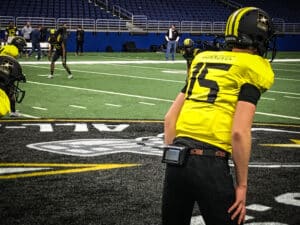
The Senior Bowl, regional combines, and various all-star games give overlooked players a stage to compete against players who started every game of their college career. These events exist because game stats alone miss NFL-caliber talent, and NFL scouts know it.
Scout team players are often passed over for these invitations despite combine-caliber athleticism, simply because no one outside the building saw them play. Advocacy from a coaching staff, backed by documentation, is often the only thing standing between a talented player and that stage.
How Does the Senior Bowl and All-Star Games Help Coaches Discover Overlooked Talent?
These events rely heavily on coaching staff nominations and regional scouting networks across the country to surface names that never showed up in a national rankings. The football coaching world is a community and a coach’s recommendation goes a long way.
Some college rosters or recruiting classes are so talented that highly-skilled players never see the field. Coaches who take note of reserve and scout team players that deserve an opportunity to chase their dream can help find all-star games and other opportunities for them to be discovered.
Conclusion About Scout Team Football
Scout teams are the foundation of success for every program, whether that’s a small-town high school team or a major college program with a full analytics staff. The players who take their role seriously make everyone else better, even when nobody outside the building notices.
Digital tools help bridge the gap between practice prep and player development, giving coaches a modern way to run scout team and providing deserving players a shot at recognition.
FAQs About Scout Team Football
How much do scout team NFL players make?
NFL practice squad players earn a weekly salary set by the league’s collective bargaining agreement, typically in the low thousands per week, well below active roster minimums. Annual figures depend on how many weeks a player stays on the squad. Active roster pay is much higher, since it includes full game checks and bonuses.
What is the difference between scout team and practice squad?
Scout team describes a practice function, simulating an upcoming opponent for the starters. Practice squad is an official NFL roster designation with a signed contract and weekly pay.
A player can serve a scout team role while holding practice squad status, but the terms aren’t interchangeable.
What is a scout in football?
A scout in football usually refers to a professional evaluator working for an NFL front office, responsible for assessing college and pro talent. A scout team player, by contrast, is a practice-squad-level participant simulating an opponent. Both share the word “scout” but describe different jobs.
How much does a scout for an NFL team make?
Area scouts typically earn a mid-five-figure to low six-figure salary; national scouts earn more, and a director of player personnel or vice president of player personnel role can reach six figures.
Share This Article
Related Articles



Free Playbook Template
Our downloadable template offers a sleek, detailed design with space for positional roles, play descriptions, and any play notes that you want to include.