Football Defense Positions: A Complete Guide
Reading Time: 13 minutes


Reading Time: 13 minutes
Football defense positions are the individual specialized roles that make up a complete defensive unit. Each position requires a specific set of skills, abilities, physical traits, and mental capacity.
Coaches can help identify defensive players that are suited for specific positions, though many players settle into their preferred role some time around high school level of play. Understanding the different positions and how they work together to combat the offensive positions and strategy is a key component in coaching football.
This resource is a deep dive into the specifics of each defensive position in football. It’s a useful guide for anyone invested in the game, from youth football coaches, players, and parents, all the way up through the pros and casual enthusiasts.
Continue reading to learn:
- What the defensive football positions are, and
- How they fit into various formations.
What Are The Defensive Positions in Football?
Defensive positions in football are the specific, specialized roles within a defense that players are assigned to based on skillset, preference, ability, and other factors.
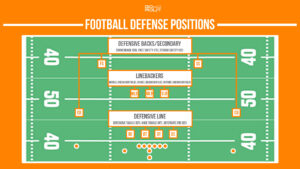
Refer to the table below for a complete breakdown of defensive positions by position group.
| Position | Abbreviation | Position Group |
| Defensive tackle | DT | Defensive line |
| Nose tackle | NT | Defensive line |
| Defensive end | DE | Defensive line |
| Edge rusher | EDGE | Defensive line/linebacker |
| Middle linebacker (inside linebacker) | MLB (ILB) | Linebacker |
| Outside linebacker | OLB | Linebacker |
| Cornerback | CB | Secondary (Defensive backs) |
| Nickelback | NB | Secondary (Defensive backs) |
| Dimeback | DB | Secondary (Defensive backs) |
| Free safety | FS | Secondary (Defensive backs) |
| Strong safety | SS | Secondary (Defensive backs) |
In American football, defensive positions are primarily responsible for stopping the other team’s offense from advancing the ball and scoring points. The defensive team consists of three main position groups (defensive line, linebackers, and defensive backs), all working together to shut down the offensive team and regain possession of the football.
Defensive linemen, linebackers, and defensive backs each have unique roles. For example, defensive linemen focus on pressuring the quarterback and stopping runs, while linebackers cover short passes and tackle running backs.
In the sections below, we’ll break down the following defensive position groups and specific roles for players positioned within each:
- Defensive line
- Linebackers, and
- Secondary (defensive backs)
Defensive Line
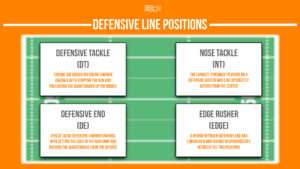
Defensive linemen, also known as rushers, line up directly on the line of scrimmage. There are three main defensive line positions:
- Defensive tackles
- Nose tackles
- Defensive ends
Defensive linemen by position
| Position | Abbreviation | Description/Responsibilities |
| Defensive tackle | DT |
|
| Nose tackle | NT |
|
| Defensive end | DE |
|
Defensive tackles (DT)
Defensive tackles (DT) play at the center of the defensive line and are responsible for rushing the passer and stopping running plays directed at the middle of the field. They’re the largest players on the defense, and sometimes on either side of the ball.
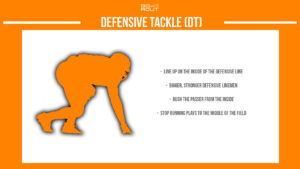
Tackles are larger, stronger defensive linemen who line up opposite the offensive line on the line of scrimmage.
Defensive tackles serve three main responsibilities:
- Closing up gaps and holes in the line on running plays
- Collapsing the pocket and rushing the quarterback from the inside of the line of scrimmage in pass defense
- Holding the point of attack
There are three distinct types of defensive tackles in football, determined by their technique alignment:
- 0 Tech. Big, physical tackles that line up opposite of the center and are responsible for controlling both of the A gaps between the offensive guards and center. These are typically Nose Tackles (NT).
- 1 Tech. Larger, dominant players expected to command a double team from the offensive line, allowing other linemen and linebackers to get through the line.
- 3 Tech. Smaller players whose main job is rushing the passer and sacking the quarterback.
The best DTs combine size, strength, athleticism, and speed to disrupt the offensive game plan and cause a nightmare for the opposing coordinator. They serve as a hybrid between multiple of the different types of DTs listed above.
There’s significant variance in defensive tackles depending on team needs and defensive schemes. Some are larger and excel at plugging holes in the line, while others are athletic and specialize in rushing the passer.
Scheme plays a major role in how many DTs are on the field:
- 4-3 calls for two defensive tackles
- 3-4 incorporates one defensive tackle, typically a nose tackle.
Nose tackles (NT)
Nose tackles (NT), often the largest players on the roster, line up directly in front of the offense’s center and are tasked with clogging the middle of the offensive line to stop run plays.
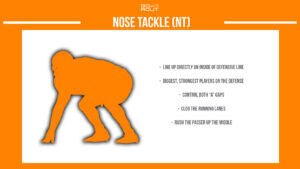
The biggest, strongest player on the defense, nose tackles are a specialty subset of defensive tackle, serving many of the same responsibilities. They’re also referred to as nose guards, middle guards, defensive guards, or 0-technique tackles, in charge of controlling both of the A gaps.
NTs specialize in 3-4 defensive formations, where they are the lone defensive tackle on the field.
Defensive ends (DE)
Defensive ends (DE) line up outside of the defensive tackles and are primarily responsible for attacking the passer or stopping offensive runs to the outer edges of the line of scrimmage. There are typically two defensive ends in any given base defensive formation.
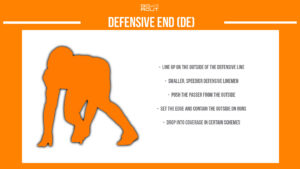
At the end of the defensive line, therefore the name, a defensive end requires three main abilities:
- Pass rushing moves to pressure the quarterback, get sacks, and force turnovers or poor decisions
- Set the edge and keep the outside contained on running plays and other trick plays like end arounds and jet sweeps
- Dropping into coverage in certain defensive schemes
Defensive ends can change the game as pass rushers. An elite, dominant defensive end requires opposing coordinators to design a game plan specifically tailored to combat their impact on the line. Whether it’s skillful moves or pure speed and power, an athletic DE with a robust repertoire at the line is a nightmare for opposing offensive linemen.
A defensive end’s build and responsibilities differ depending on the formation:
- 3-4 requires bigger defensive ends to line up over offensive tackles, where they’re responsible for controlling their gaps.
- 4-3 values defensive ends that are a bit smaller and can serve a variety of roles. Depending on the scenario, DEs in a 4-3 scheme may need to take on the offensive tackle and tight end, set the edge against the run, beat their blocker to rush the passer, or drop back into coverage
Edge Rushers (EDGE)
A hybrid player between defensive end and linebacker, EDGE is a position that lines up on the outside of the defensive line. The core responsibilities of an EDGE is rushing the quarterback and setting the edge on run plays.
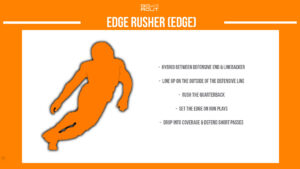
Occasionally, coaches use their EDGE to drop into coverage and defend short passing routes.
Linebackers
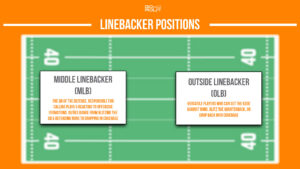
Linebackers serve as the middle of the defense, protecting against the pass while containing running plays that get past the defensive line. They typically line up a few yards behind the defensive line and are responsible for stopping the run, covering receivers on short passes, and sometimes rushing the passer.
There are two main types of linebacker:
- Middle linebacker
- Outside linebacker
| Position | Abbreviation | Description |
| Middle linebacker (Inside linebackers) | MLB (ILB) |
|
| Outside linebacker | OLB |
|
Middle Linebacker (MLB)
The middle linebacker, often referred to as the ‘Mike’ linebacker, is considered the quarterback of the defense responsible for calling plays and reacting to offensive formations.
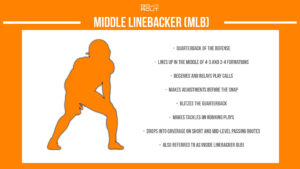
Middle linebackers serve multiple roles and responsibilities, including:
- Blitzing the quarterback
- Making tackles on running plays and short pass plays
- Dropping into pass coverage for short and mid-range routes
- Receiving play calls from coaches and communicating them to the defense
- Making adjustments before the snap
Because they serve as the quarterback of the defense and are vital to the success of the defense, MLBs typically stay on the field for all three downs.
Middle linebackers are sometimes referred to as inside linebackers (ILB), specifically in 3-4 defensive formations. The role of the MLB varies slightly depending on the formation:
- 4-3. Line up in the middle, serving as the sole MLB.
- 3-4. Line up as the middle two of the four linebackers in the formation. One fills the role of the “Mike”, while the other serves as the “TED” and is tasked with taking on blocks to free up the “Mike” to make tackles.
Outside Linebacker (OLB)
Outside linebackers (OLB) are versatile players who can set the edge against runs, blitz the quarterback, or drop back into coverage, making them crucial for both run defense and pass protection.
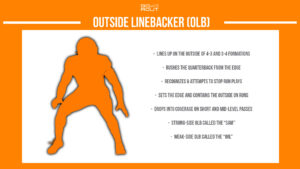
Two OLBs typically line up on defense, regardless of formation, and serve distinct roles:
- The strong side OLB, typically referred to as the “SAM”, lines up on the tight end’s side of the line of scrimmage.
- Weak side OLBs, referred to as the “WIL”, line up on the other side of the line of scrimmage where there’s no tight end.
OLBs have three main responsibilities:
- Rush the quarterback from the edge
- Recognize and attempt to stop running plays while setting the edge and containing the outside
- Drop back to defend against short passes and additional receivers
Outside linebackers are strong and fast. They are known to have great bend, which is the ability to “bend” around offensive tackles and turn a tight corner to get into the pocket and sack the quarterback.
Defensive Backs (Secondary)
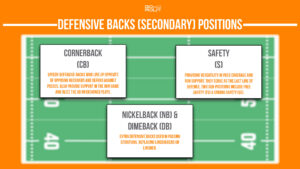
Defensive backs, also known as the secondary, play either behind the linebackers or outside near the sidelines and are primarily used to defend against pass plays. Players in the secondary also tend to contribute to special teams, including kicking plays and extra points.
The secondary is comprised of:
- Cornerbacks
- Safeties (Strong Safety & Free Safety)
- Specialty defensive backs (Nicklebacks and Dimebacks)
| Position | Abbreviation | Description |
| Cornerback | CB |
|
| Nickelback | NB |
|
| Dimeback | DB |
|
| Strong safety | SS |
|
| Free safety | FS |
|
A normal defensive lineup includes two cornerbacks and two safeties, but specialty defensive backs like nickelbacks and dimebacks can be used for covering wide receivers or additional pass catchers/eligible receivers.
Cornerback (CB)
Cornerbacks (CB) are speedy defensive backs who line up opposite of opposing receivers and defend against passes. They’re typically some of the fastest players on defense, enabling them to keep up with speedy wide receivers trying to catch passes.
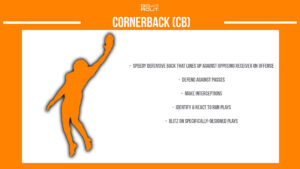
Cornerbacks attempt to prevent successful passes by either swatting the airborne ball away from the receiver or by catching the pass themselves, and they also have responsibilities in rushing situations.
A cornerback’s role is more granular and specific than simple “pass coverage”, including:
- Sticking closely to their assigned receiver
- Anticipating routes
- Defending against passes
- Locating the ball in the air
- Making interceptions
- Breaking up passes intended for receivers
- Reading the QBs eyes in zone coverage
- Identifying and reacting to run plays
- Blitz the quarterback on designed plays
- Helping teammates make tackles on plays that get past the defensive line and linebackers
In pass responsibilities, cornerbacks play two different types of coverage:
- Man. The cornerback sticks with an assigned receiver and follows them where they go. They keep their receiver as close as possible, and remain in a good position to defend passes.
- Zone. Cornerbacks cover an assigned area of the field. They keep track of and follow receivers who enter their “zone”, and pass off receivers as they leave the zone.
Specifically in zone coverage, cornerbacks have to communicate with other defensive backs and linebackers to make sure the call is clear and everyone knows their responsibility.
Safety
Safety (S) is a position that plays a critical role in the defensive backfield, providing versatility in pass coverage and run support. They serve as the last line of defense, preventing big plays from turning into touchdowns.
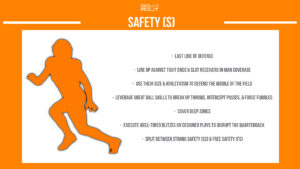
Acting as the quarterback of defensive backs, safeties make pre-snap adjustments, call out coverages, and ensure the other DBs are in good position. They adjust their positioning and coverage responsibilities based on the offensive formation.
Safeties are responsible for covering the deep parts of the field, and must have speed and range to protect such large areas. They read the QBs eyes, anticipate the throw, and position themselves to make a play on the ball or support fellow DBs.
In pass coverage, safeties play multiple roles including:
- Lining up against tight ends and slot receivers in man coverage
- Using their size and athleticism to defend the middle of the field
- Leveraging great ball skills to break up throws, intercept passes, and force fumbles
- Covering deep zones
- Executing well-timed blitzes on designed plays to disrupt the quarterback
Most safeties also offer run support, filling gaps and making tackles near the line of scrimmage. Some play closer to the line of scrimmage as a box safety. Regardless of pass or run, safeties must be great tacklers capable of bringing down running backs, tight ends, and receivers in open space.
Safeties are broken down into two specific designations:
- The strong safety (SS) is traditionally the larger and stronger of the two safeties, providing protection against run play by standing closer to the line of scrimmage, while
- The free safety (FS) is typically the smaller and faster of the two, positioned deeper to help with long pass coverage.
Strong Safety (SS)
Strong safety (SS) is a position that features some of the most exciting players on the field who are tasked with critical roles in the pass and run game. They’re typically built like large cornerbacks, with a combination of speed and strength.
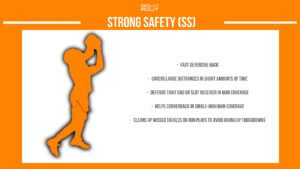
Strong safeties play a cerebral role in the defense. Before the snap, they read the formation, personnel groupings, and other tells to predict or determine the offense’s play. From there, they put themselves in the best position to make a play.
On running plays, strong safety has the following responsibilities:
- Follow the linebackers and assist with tackling the ball carrier
- Wrap up the running back before they can break free for a big gain or score
For pass plays, strong safety may:
- Blitz to rush the passer
- Provide valuable zone coverage
- Cover individual receivers
- Read the QBs eyes and serve as additional support for cornerbacks
Free Safety (FS)
Free safety (FS) often lines up farthest away from the line of scrimmage, and acts as the true last line of defense for the defense. Because of the distance they have to cover in short amounts of time, free safeties are some of the fastest players on the field.
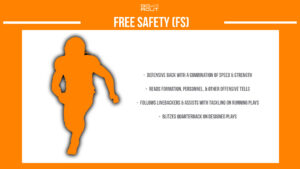
In passing situations, free safety has the following responsibilities:
- Cover the tight end or slot receiver in man
- Cover a zone in the secondary in zone
- Help the cornerback in the deep secondary in single-high man
- Work alongside the other defensive backs and linebackers to make sure all receiving targets are covered
On run plays, the free safety:
- Reads the entire play while keeping an eye on the ball and the ball carrier
- Cleans up missed assignments and poor tackles, making sure the running back doesn’t break loose for a touchdown
Free safeties are known as ballhawks, as they excel at reading the eyes of the quarterback, anticipating their decisions, and intercepting passes.
Extra defensive backs
Nickelbacks (NB) and Dimebacks (DB) are extra defensive backs used in passing situations, replacing linebackers or linemen.
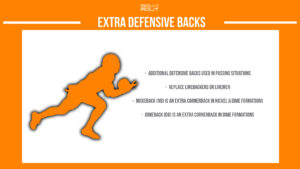
Nickelbacks are additional defensive backs that play in nickel and dime packages. They’re the fifth defensive back on the field. Dimebacks are another additional defensive back that plays in dime packages. They’re the sixth defensive back on the defense.
How Do Defensive Positions in Football Impact Strategic Decisions?
Defensive positions in football don’t often directly impact strategic decisions. Instead, specific formations and schemes dictate which positions are required on the field.
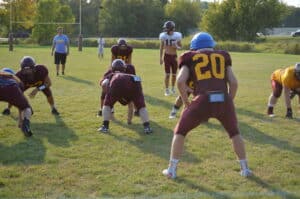
Defensive formations are often identified by a numerical code that indicates the number of defensive linemen, and linebackers, such as the 3-4 defense or the 4-3 defense.
- 4-3 defenses include four defensive linemen, three linebackers, and four defensive backs
- In a 3-4 defense, there are three defensive linemen, four linebackers, and four defensive backs, while
- A 3-3-5 defense consists of three defensive linemen, three linebackers, and five defensive backs (a variation of Nickel formation run by many coaches).
Nose tackles, nickelbacks, and dimebacks typically only play in specific formations and certain plays that call for them. Defensive formations can vary significantly based on the strategy employed by the defense, such as focusing on stopping the run or defending against the pass.
FAQs About Defensive Football Positions
Who takes down a quarterback on a football team?
Any player on the defensive side of the football can sack the quarterback. That includes:
- Defensive tackles
- Defensive ends
- Edge rushers
- Linebackers
- Cornerbacks
- Safeties
What is the hardest position on defense in football?
The hardest position on defense in football is either middle linebacker or cornerback.
- Cornerbacks have the most physically demanding roles, as they’re often left one-on-one to defend against a speedy receiver without knowing the route the receiver plans to run.
- Linebackers serve as the quarterback of the defense, relaying the call from the coordinator to their teammates. The role requires critical thinking and communication skills, on top of the physical demands of the position.
What are the defensive line positions in American football?
The defensive line positions in American football include:
- Defensive tackle (DT)
- Nose tackle (NT)
- Defensive end (DE)
- Edge rusher (EDGE)
What are the 11 positions on defense in football?
The 11 positions on defense in football consist of a combination of the following:
- Defensive tackle (DT)
- Nose tackle (NT)
- Defensive end (DE)
- Edge rusher (EDGE)
- Middle linebacker (MLB)
- Outside linebacker (OLB)
- Cornerback (CB)
- Nickelback (NB)
- Dime back (DB)
- Free safety (FS)
- Strong safety (SS)
The specific players that are on the field depend on coaching style, formation, situation, and other factors.
Share This Article
Related Articles



Free Playbook Template
Our downloadable template offers a sleek, detailed design with space for positional roles, play descriptions, and any play notes that you want to include.