Football Defensive Line Techniques: A Complete Guide
Reading Time: 10 minutes


Reading Time: 10 minutes
In football, defensive line technique can get confusing. For starters, the term technique can be used for two distinct meanings:
- Specific positioning and alignment against the opposing offensive linemen
- Fundamentals and details like stance, hand fighting, and get-off time
Proper alignment techniques teach defensive linemen to engage offensive linemen and maintain gap control properly. A well-coached, disciplined defensive line knows where they need to be to make a play.
In this resource, we’ll break down football defensive line techniques as they relate to alignment and performance.
Continue reading to learn about:
- Defensive line positions in football
- Responsibilities of defensive linemen in football
- Defensive line techniques in football
- Football defensive line gaps
- Stance and approach
- Defensive line strategies
- Fundamentals of defensive line
What Are The Defensive Line Positions in Football?
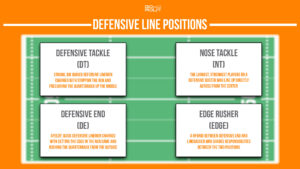
| Position | Abbreviation | Description |
| Defensive tackle | DT | Strong, big bodied defensive linemen charged with stopping the run and pressuring the quarterback up the middle. |
| Nose tackle | NT | The largest, strongest players on a defensive roster who line up directly across from the center. |
| Defensive end | DE | Speedy, quick defensive linemen charged with setting the edge in the run game and rushing the quarterback from the outside. |
| Edge rusher | EDGE | A hybrid between defensive end and linebacker who shares responsibilities between the two positions. They’re typically linebackers in 3-4 defensive football formations and defensive ends in 4-3 alignments. |
In American football, the defensive line includes the defensive tackle and defensive end positions.
- Defensive tackles (DT) are often larger, heavier, and stronger defensive linemen tasked with stopping the run and pressuring the quarterback up the middle. Some tackles also specialize as Nose Tackles (NT) who line up directly against the center.
- Defensive ends (DE) are speedy, quick defensive linemen tasked with setting the edge on rushing plays and pressuring the quarterback from the outside.
EDGE is a position used to describe hybrid edge rushers who line up both as linebackers and defensive linemen.
What Are The Responsibilities of the Defensive Line?
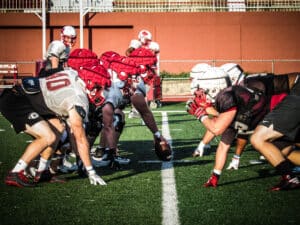
As the frontline of the defense, the defensive lineman is in charge of controlling the line of scrimmage. They’re the biggest bodied, strongest defensive players and use their size to impact the offensive line, quarterback, running back, and any other additional blockers.
Defensive linemen must control the line of scrimmage to:
- Stop the run, and
- Pressure the quarterback
Run Responsibilities
In stopping the run, defensive linemen have two primary jobs:
- Impact and disrupt the offensive line
- Tackle the running back as close to the line of scrimmage as possible
If the running back makes it past the line of scrimmage, defensive linemen are to run downfield to assist in stopping their forward progress.
Pass Responsibilities
When defending the pass, defensive linemen have two core responsibilities:
- Impact and disrupt the offensive line
- Pressure the quarterback, with the ultimate goal of a sack
Some defensive schemes call for defensive linemen to drop back in pass coverage.
What Are Defensive Line Techniques in Football?
In American football, defensive line techniques include specific numbering systems that designate alignment relative to the offensive line. Players are positioned in specific gaps and techniques to ensure they can maintain their gap integrity.
Defensive linemen align in numbered techniques from 0 to 9 based on their position relative to the offensive linemen to execute their assignments. Proper alignment techniques help defensive linemen maintain gap control effectively.
Defensive Line Technique Numbers
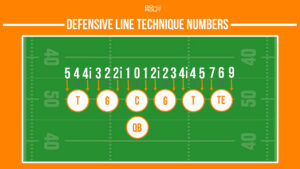
The numbered techniques and their respective alignment are as follows:
| Technique | Alignment |
| 0 | Head up on center |
| 1 | Either edge of center |
| 2 | Head up on offensive guard |
| 2i | Inside eye of offensive guard |
| 3 | Outside edge of offensive guard |
| 4 | Head up on offensive tackle |
| 4i | Inside eye of offensive tackle |
| 5 | Outside edge of offensive tackle |
| 6 | Head up on tight end |
| 7 | Inside eye of tight end |
| 9 | Outside edge of tight end |
How Does the Defensive Line Technique Numbering System Work?
Numbers are tied to specific alignment responsibilities in defensive line technique using the following system:
- Odd-number techniques identify as outside alignments
- Even-number techniques identify as head up alignments
- Inside alignments are head-up numbers but with an ‘i’ attached
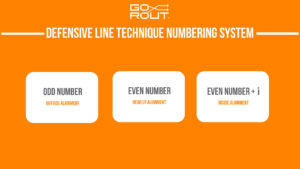
| Type of Number | Alignment |
| Odd | Outside |
| Even | Head up |
| Even + “i” | Inside |
Football Defensive Line Gaps
Football gaps are the spaces between the offensive linemen. Gaps are designated as A, B, C, and D, corresponding to specific positions relative to the offensive line.
| Gap | Location |
| A | Space between C and OG |
| B | Space between OG and OT |
| C | Space between OT and TE (or space to the outside shoulder of OT, if there’s no tight end) |
| D | Space to the outside shoulder of blocking TE |
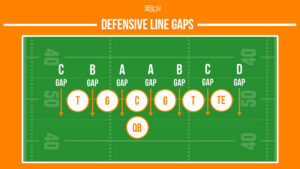
The specific gaps in football include:
- A Gap = Space between center and guard
- B Gap = Space between guard and tackle
- C Gap = Space between tackle and tight end, or simply space to the outside shoulder of the tackle (if there’s no tight end)
- D Gap = Space to the outside shoulder of the blocking tight end
To control the line of scrimmage, defenses need to defend gaps.
Defensive Line Stance & Approach
A defensive lineman’s stance is the most vital fundamental because it is what will start every play. With proper technique, a player’s stance can put them in a position to make a play. The player has some room to make minor changes in their stance based on their evaluation of the situation.
A good stance is low and balanced, with weight distributed on the balls of the feet. Defensive linemen should maintain control in a low body position to win leverage against offensive linemen.
Key techniques for defensive linemen in their stance include:
- Low-pad level
- Proper alignment
- Hand separation for control, and
- Leveraging hip/ankle mobility to penetrate gaps
There are a couple different approaches when setting up your stance at defensive line:
- The attack stance is used for passing situations and involves narrowing the width of the feet
- The attack read stance is the base stance for a run situation
Strategies for Defensive Line Play
There are two core strategies when it comes to defensive line technique in football:
- Man control
- Gap control
Man Control
Man control is when teams have defensive linemen play through certain linemen to control more than one gap. Defensive linemen use techniques like two-gapping to control more than one gap.
The defensive techniques and alignments that are often played when playing man control are 0, 2, 4, and 6 techniques.
Gap Control
Gap control involves maintaining responsibility for a specific gap in the offensive line to clog rushing lanes. It’s also referred to as 1-Gap defense. 1-Gap defense means the defender is responsible for one gap, while 2-gap defense means occupying both adjacent gaps on an offensive lineman.
Gap control is essential for defensive linemen to stop an effective rushing attack, and the most common way teams control the line of scrimmage.
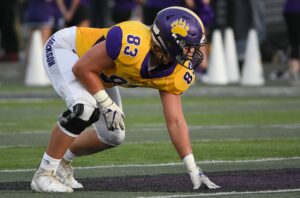
Image courtesy of Chris Chow on Unsplash
Fundamentals of Defensive Line
Teams that control the line of scrimmage on either side of the ball typically win the game. Therefore, the defensive line’s number one priority is to dominate the line of scrimmage.
To gain an advantage at the line of scrimmage, defensive linemen need sound fundamentals and physical technique.
The core fundamentals of defensive linemen include:
- Knowledge
- Basic fundamental technique
- Pass rush techniques, and
- Run-stopping techniques
Knowledge
Knowledge is essential for defensive linemen to succeed and make the most of their snaps. It’s first because it’s what allows for fundamentals to be used at their maximum potential and allows the player to make adjustments to get themselves into the best position possible pre-snap.
There are two primary types of knowledge for defensive linemen:
- Situational awareness, and
- Positional responsibilities
Situational Awareness
The first step of knowledge is understanding the situation, which refers to what is going on in the game. There are several factors for linemen to consider as they prepare for each play. Some situational knowledge includes:
- Where the offense is positioned on the field
- Personnel groupings and offensive personnel in the game
- Score
- Time remaining
- Down and distance
- Weather/field conditions
Positional Responsibilities
The next step of using knowledge is understanding what your assignment is, which is crucial for a sound defensive unit. It’s knowing your responsibility at your position on any given play as it relates to the defensive strategy as a whole.
Basic fundamental technique
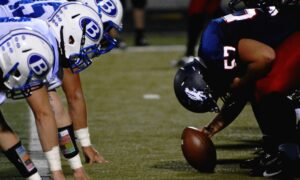
Photo by Nathan Shively on Unsplash
A defensive lineman’s foundation is built upon basic physical and mental techniques. This reference to technique is different from the earlier use as it relates to alignment.
Players must focus on key fundamentals like stance position, alignment, hand combat, and an explosive get-off to dominate the opposing team’s offensive linemen.
Stance position and alignment
As discussed previously, the stance is the most vital fundamental because it is what will start every play. The previous section dedicated to stance and approach covers all the specifics you need to know.
We also covered alignment in great detail earlier in this resource. But it was important to include both stance position and alignment when covering basic fundamental technique. Without them, defensive linemen don’t stand a chance against their opposing offensive counterparts.
Hand combat
Defensive linemen must use hand combat techniques to gain leverage and create separation from blockers. Hand fighting requires linemen to keep their hands separated and avoid getting their hands swatted together.
To succeed in this area of the game, defensive linemen need precise hand placement. In a right-handed stance, the left hand is crucial to create initial separation before the down hand comes into play. The same holds true for the right hand in a left-handed stance.
Explosive get-off
Effective football defensive line techniques focus on explosive low-stance “get-offs” to immediately pressure opponents and utilize specific hand-fighting moves to shed blockers. The first two steps can separate a defender from their opponent and create explosive plays for the defense.
An explosive get-off, which is the ability to explode off the line at the snap, is key to gaining an advantage over the offensive line.
BONUS: Effort
Effort is crucial for defensive linemen to succeed on the field. It’s a crucial part of defensive line play in general, as it is between the player and himself.
A player can possess all the skill and proper technique. Without effort, they’ll get beat by their opponent 9 times out of 10.
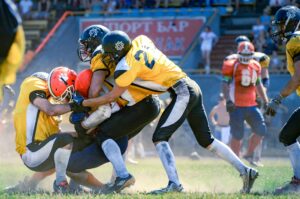
Image courtesy of Victoria Prymak on Unsplash
Pass Rush Techniques
Specific techniques apply solely to pass rush scenarios. The various goals of a pass rush range from pressuring the quarterback to protecting against the scramble and confusing the offensive line.
An explosive get-off can lead to immediate pressure on the passer, which is the best way to force a mistake or sack the quarterback. Certain pass rush moves and techniques are used to beat offensive linemen off the snap.
Specific pass rushing techniques
Pass rush techniques include moves like the swim, rip, and spin to maintain speed and balance.
Here are a few specific pass rush techniques explained:
- Dip and Rip: Dropping (or dipping) the inside shoulder low, then violently swinging (or ripping) the same arm up to move the blocker’s arm.
- Swim Move: Knocking away the blocker’s hand, then swinging the opposite arm around (like a freestyle swimmer) to gain leverage.
- Bull Rush: Driving directly into the blocker, using leverage and strength to push them backward.
- Stemming/Inside Move: Faking an outside rush before cutting back to the inside.
- Spin Move: Driving toward the blocker, then abruptly spinning in either direction to get around them and into the backfield.
Stunts and slants
Coordinators use coordinated movements, referred to as “stunts” and “slants”, to confuse offensive line blocking schemes. Stunts and slants involve linemen switching assigned gaps at the snap to confuse offensive blockers.
Pass lane integrity
Maintaining pass rush lane integrity is crucial for defensive linemen to prevent the quarterback from escaping after the initial rush pressure. Defensive linemen must also react quickly to screens and draws by retracting their steps to the offensive linemen.
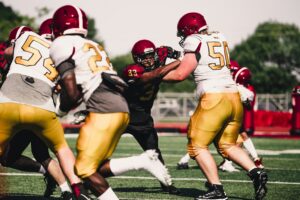
Image courtesy of Alora Griffiths on Unsplash
Run Stopping Techniques
Run defenses focus on gap integrity and setting the edge to control the rushing lanes. There are numerous run stopping techniques.
- Stack and Shed is a technique where the defender engages the blocker and uses quick hand maneuvers to disengage and tackle. It often involves jolting the blocker with a punch.
- Attack-React is a technique where linemen penetrate a gap to disrupt the play immediately.
Drills for Defensive Line Technique
Teaching fundamentals and technique on the defensive line depends on repetitions at practice. Certain football defensive line drills focus specifically on technique and fundamentals to ensure players perfect the basics. Though two drills may cover similar coaching points, all defensive line drills should focus on specific 1-on-1 games that happen during their football game and incorporate fast reps.
Here are a few types of drills to improve technique and fundamentals on the D-Line include:
- Hand combat drills teach defensive linemen how to use their hands to strike, fight off blockers, gain leverage and create separation.
- Block-shedding drills help defensive linemen disengage from blockers quickly and make plays on the ball carrier.
- Run-stopping drills teach defensive linemen to hold their ground and control their gaps when defending running plays.
Defensive Line Technique FAQs
What are the different techniques on the defensive line?
Defensive line techniques refer to player alignment against opposing offensive linemen. The different techniques on the defensive line are:
- 0 = heads up on center
- 1 = either edge of center
- 2 = heads up on offensive guard
- 2i = inside eye of offensive guard
- 3 = outside edge of offensive guard
- 4 = heads up on offensive tackle
- 4i = inside eye of offensive tackle
- 5 = outside edge of offensive tackle
- 6 = outside edge of offensive tackle
- 7 = inside eye of tight end
- 9 = outside edge of tight end
What is a 3 technique defensive lineman?
A 3 technique defensive linemen is a defender who lines up on the outside edge of the offensive guard. They’re typically defensive tackles or defensive ends.
What is a 5 technique defensive lineman?
A 5 technique defensive lineman is a defender who lines up on the outside edge of the offensive tackle. They’re often defensive ends or edge rushers.
Share This Article
Related Articles




Free Playbook Template
Our downloadable template offers a sleek, detailed design with space for positional roles, play descriptions, and any play notes that you want to include.