

Football Terms: A Glossary of American Football Terminology
Football terms are the words, phrases, concepts, and ideas that make it possible for players, coaches, officials, and general enthusiasts to communicate the game of American football.
Gridiron football (American or Canadian football) ranges anywhere from flag and youth leagues, where kids are introduced to the basics of the game, all the way up to the National Football League (NFL), where the world’s most elite talent play at the highest level. In between, high school and college football make the game more accessible to anyone who wants to play at a competitive level.
Why Is Football Terminology Important?
Football terminology enables people to better understand the game and its strategy, and communicate with others about the sport. Whether it's tactical coach-to-player communication, or casual fans discussing their favorite team's strengths and weakness, football terms are essential to knowledgable conversations about the game.
There is an entire language of football terminology, starting with the most basic concepts and expanding into highly nuanced, strategic terms. This resource serves a comprehensive dictionary of the most important and commonly used terms you’ll come across at any level of American football.
GoRout's Glossary of Football Terms
GoRout’s Glossary of Football Terms breaks down into the following sections:
Use GoRout’s glossary of football terminology to find a specific phrase you’re uncertain about, identify new concepts to incorporate into your game plan, or simply gain a better understanding of the game and its language used on broadcasts, game analyses, or anywhere it's discussed.

Basic Football Terms
The words, phrases, ideas, and concepts within this section are the most basic, rudimentary terms in football games and form the foundation of its language. Consider this section a Football 101 for the American/Gridiron version of the game.
Within the basic football 101 terms and rules section of the glossary, you’ll find:
General Football 101 Terms
| Term | Definition |
| Coin toss | A coin flip to determine who receives first possession and which end each team defends in a game or overtime period. |
| Dead ball | The time period between downs when the ball is not in play. |
| Down | The period of action that begins when the ball is put in play, and ends when the ball is declared dead. |
| Flag | A colored piece of fabric that indicates either a penalty or coach’s challenge. |
| Foul | An infraction of a playing rule which results in a penalty |
| Gridiron | Another term to describe the playing field in American football. |
| Halftime | An extended break between the second and third quarters where play is suspended and teams may leave the field. |
| Live ball | The time period between when the ball is legally put in play and when the down ends. |
| Official time | Timer clock that dictates the official pace of the game, including when a game begins and ends. |
| Out of bounds | Any time the ball, or any part of a player’s body while in possession of the ball, touches a boundary line (not including a goal line or pylon). |
| Overtime | An extra period of play immediately following the fourth quarter when the score is tied at the end of regulation. |
| Penalty | The punishment imposed upon a team that commits a foul. |
| Play | The period of action between when the ball is put in play and when it is declared dead. |
| Play clock | The time between when one play ends and the ball must be snapped for the next to begin. |
| Quarter | One period of play in a football game. |
| Scoring play | Any play where a team scores points. |
| Series (set) of downs | The four consecutive charged scrimmage downs allotted to the offensive team. |
| Snap | When the team with possession puts the ball in play, officially establishing a live ball. |
| Spot | The exact physical location on the field where the ball is placed by referees to start the next play. |
| Timeout | Any interval during which the game clock is stopped. |
| Touchback | A ball that’s ruled dead on or behind the goal line a team is defending, provided their opponent forced the ball on or through the goal line via any act other than a touchdown or incomplete pass. |
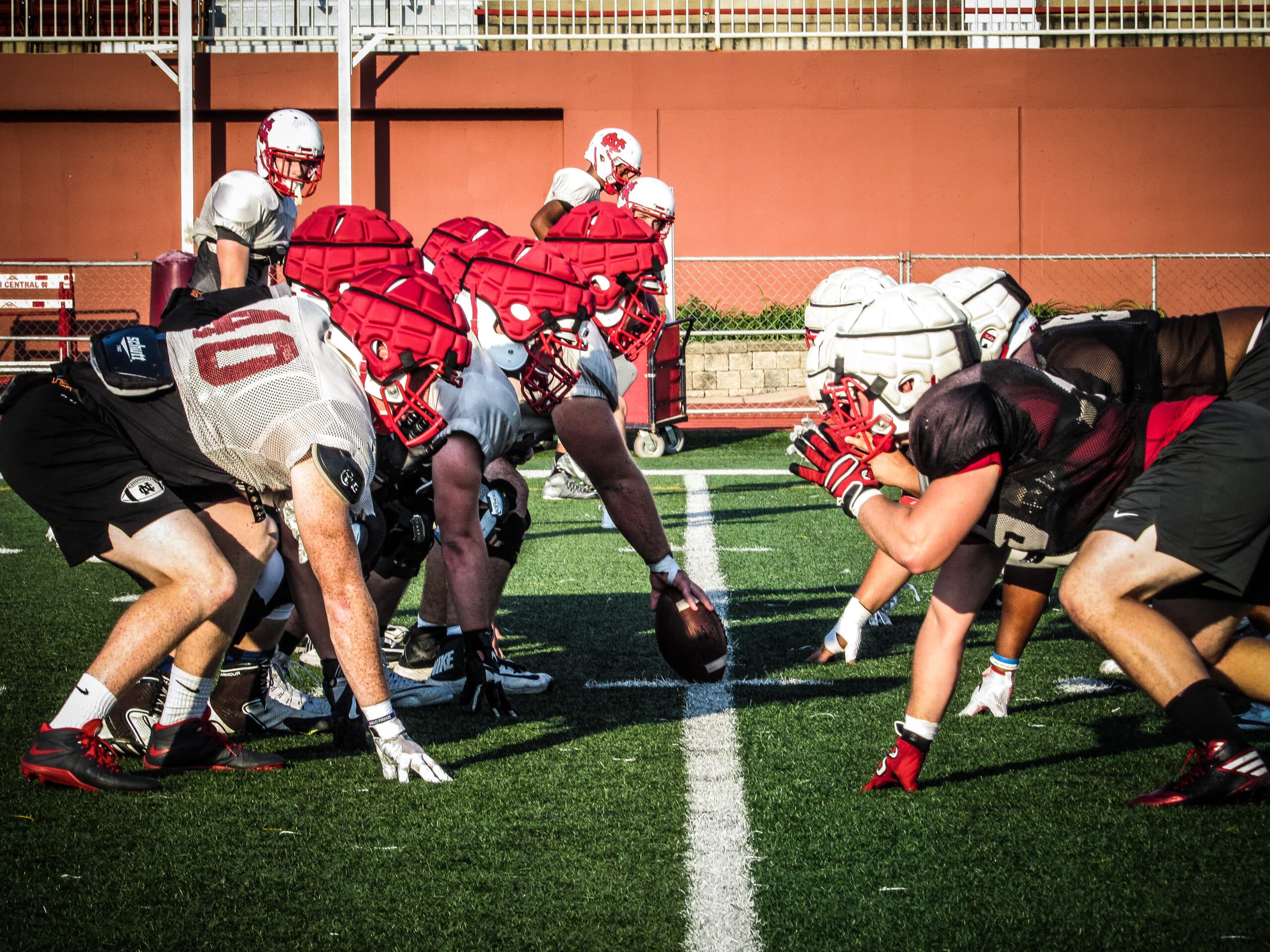
| Trenches | The area where offensive and defensive linemen play. |

Coin Toss
The referee flips a coin to determine who receives first possession and which end each team defends in a game or overtime period.
Context: At the beginning of a game, the referee gathers the captains of both teams at midfield and tosses a coin to determine who receives first possession. Visiting team captains must call either “Heads” or “Tails” when the referee flips the coin. The coin toss determines who receives the ball first and which side each team will defend.
Dead Ball
The time period between downs when the ball is not in play. This includes timeouts, intermission, and other stoppages.
Context: Dead ball periods are used to communicate game plan adjustments or reinforce strategy with players, as well as giving them a break from the physical action.
Down
The period of action that begins when the ball is put in play, and ends when the ball is declared dead. This term is synonymous with play.
Context: Downs are named by number in sequential order (first, second, third, and fourth). The offense gets four downs to move the ball 10 yards downfield and gain a first down, which resets the four-down sequence.

Flag
A colored piece of fabric that indicates either a penalty or a coach’s challenge.
Context: The different types of flags are designated by color, with yellow for a penalty and red for a coach's challenge.
Types of Flags in American Football
- Penalty flag: A yellow piece of fabric (or other material) thrown by the official to indicate a penalty.
- Coach’s challenge flag: A red piece of fabric (or other material) thrown by the head coach to indicate a coach’s challenge.
Foul
An infraction of a playing rule which results in a penalty
Context: A foul is the technical term used to describe the illegal act for which a penalty is prescribed. Often, the term penalty is used by players, coaches, fans, and broadcasters to describe a foul. When broadcasters say “that player committed a costly penalty”, they mean "the act of committing a foul led to a costly penalty (or punishment) for that player’s team."
Gridiron
Another term to describe the playing field in American football.
Context: Gridiron is also used to describe the playing field in Canadian football, flag football, and other variations of American football.
Halftime
An extended break between the second and third quarters where play is suspended and teams may leave the field.
Context: Coaches use halftime to make adjustments to their game plan, while players regroup mentally and physically.
Live ball
The time period between when the ball is legally put in play and when the down ends.
Context: As long as it’s a live ball, any player can take possession and try to score points.
Official time
Official timer clock that dictates the pace of the game, including when a game begins and ends.
Context: The stadium’s clock is used as the one true source for a game’s official time.
Out of bounds
Any time the ball, or any part of a player’s body while in possession of the ball, touches a boundary line (not including a goal line or pylon).
Context: A ball that crosses over the boundary line in the air while a player has possession and keeps all body parts from touching the line is considered in bounds. Receivers leverage this and avoid going out of bounds on passes where the ball crosses the boundary line in the air by keeping one foot (or both feet, depending on the league) in bounds.

Overtime
An extra period of play immediately following the fourth quarter when the score is tied at the end of regulation.
Context: Specific overtime rules vary by league, experience level, and time of year.
Penalty
The punishment imposed upon a team that has committed a foul.
Context: Football penalties range anywhere from loss of down, yardage, or playing time, to an automatic first down, charged time out, withdrawal or disqualification of a player, extension of a period, award of a score, or any combination thereof. A penalty is the response to a foul, not the illegal act itself.
Play
The period of action between when the ball is put in play and when it is declared dead. This term is synonymous with down.
Context: The term play is also used to describe specific play calls or designs. For example, HB draw is considered a football running play.
Play Clock
The time between when one play ends and the ball must be snapped for the next to begin
Context: There are two types of play clocks in football: a 40-second play clock and a 25-second one.
Types of Play Clocks in American Football
- 40-second play clock: Interval of time allotted to a team in possession of the ball between when one play is whistled dead (without any stoppages or other delays) and the next must begin.
- 25-second play clock: Interval of time allotted to a team in possession of the ball between plays disrupted by an administrative stoppage or other delay. The clock starts on the referee’s whistle, and the ball must be snapped or kicked within 25 seconds of the whistle.
Quarter
One period of play in a football game.
Context: A standard game consists of four quarters. The length of each quarter varies by league and experience level.

Scoring play
Any play where a team scores points.
Context: Scoring plays include touchdowns, extra points, two-point conversions, field goals, and safeties. Extra point attempts and two-point conversions are lower-scoring opportunities immediately following a touchdown, while a touchdown or field goal typically serves as the scoring play dictating a drive's success.
Series of downs (Set of downs)
The four consecutive charged scrimmage downs allotted to the offensive team.
Context: Within those four consecutive downs, the offensive team must advance the ball to a specific marker (the line to gain) to earn another series of downs and retain possession.
Snap
When the team with possession puts the ball in play, officially establishing a live ball.
Context: Snaps come from directly under center or through longer tosses including shotgun and punt formation. The term snap is also used to describe a play where someone saw game action.
Spot
The exact physical location on the field where the ball is placed by referees to start the next play.
Context: The spot indicates where the previous play was blown dead and serves as the line of scrimmage when the next play begins.
Timeout
Any interval during which the game clock is stopped.
Context: There are two main types of timeouts in football: charged team timeouts and official timeouts.
Types of Timeouts in American Football
- Charged team timeout: When the game clock is stopped and play is suspended at the request of one of the teams. Each team gets three charged team timeouts per half.
- Official timeout: Any time the game clock is stopped by an official. This includes injury timeouts, measurements, equipment issues, or other delays.
Touchback
A ball that’s ruled dead on or behind the goal line a team is defending, provided their opponent forced the ball on or through the goal line via any act other than a touchdown or incomplete pass. The defending team's offense takes possession of the ball on their own 20-yard line to start the next play.
Context: Touchbacks occur in various ways. One of the most common is a punt that goes through the back of the end zone, resulting in the receiving (or defending) team starting their offensive drive at the 20-yard line. Other ways include the defense recovering a fumble in their own end zone when the offense is near a touchdown, or when the offense fumbles through the goal line and out of the end zone.
Trenches
A term used to describe the area where offense and defense line up. Offensive and defensive linemen make up the trenches.
Context: Because of the aggressive play required for offensive and defensive lines, the trenches are known for excessive physicality and hard contact.
Football Game Terminology
| Term | Definition |
| Defense | The side of the ball where players attempt to stop their opponent’s offense from gaining yards and scoring points. |
| First down | The initial down in each series, or set, of downs. |
| Huddle | Two or more players in the field of play who form a group to receive instructions for the next play or communicate other information. |
| Kick | Intentionally striking the ball with the knee, lower leg, or foot. |
| Kickoff | A free kick that puts the ball in play at the start of each half, at the start of overtime, after a try, and after a successful field goal. |
| Loose ball | A live ball that is not in player possession. |
| Offense | The side of the ball where players utilize skillsets to gain yards and move the ball downfield through a combination of pass and run plays. |
| Pass | The movement caused by a player intentionally throwing or shoveling/pushing (via shovel pass) the ball through the air. |
| Run | When a player moves the ball by holding it and running. |
| Special teams | A specialized part of the game that consists of kickoffs, punts, field goals, extra points, kick returns, and punt returns. |
| Tackle | Bringing a player who has possession of the ball to the ground or halting their forward progress. |
| Turnover | When the team with possession of the ball loses it, turning possession over to the opposing team who gains it. |

Defense
The side of the ball where players attempt to stop their opponent’s offense from gaining yards and scoring points.
Context: The ultimate goal on defense is to take possession away from the opposing team, whether through a turnover or forced punt.
First down
The initial down in each series, or set, of downs. The term first down is also used to describe the action of earning a new series of downs.
Context: When a running back crosses the line to gain on a second-down run, they gain a first down. The subsequent play is then first down.
Huddle
The act of two or more players in the field of play who form a group, typically a circle- or oval-shaped alignment, to receive instructions for the next play or communicate other information.
Context: Coaches also huddle their players on the side of the field, in the locker room during breaks, or any other time before or after their game and in practice, to communicate strategy, messaging, feedback, criticism, inspiration, or other information to large groups at once.
Kick
Intentionally striking the ball with the knee, lower leg, or foot.
Context: Any kick ends when a player of either team possesses the ball, or when the ball is whistled dead.
Kickoff
A free kick that puts the ball in play at the start of the first and second half, at the start of overtime, after a try, and after a successful field goal.
Context: Kickoffs are most often a standard place kick downfield toward the landing zone, kick returners, and/or end zone. Some less common formations occur with specific strategy, like an onside kick.
Loose ball
A live ball that is not in player possession.
Context: Although it’s not physically in any player’s possession, a loose ball is considered in possession of the team that kicked, passed or fumbled it until a player secures possession or the ball becomes dead. Until it hits the ground, a loose ball is in flight. That means a player who recovers a ball that crosses a boundary line through the air still gains possession, as long as they fully control the ball with two feet on the ground in the field of play and no other part of their body touches ground.

Offense
The side of the ball where players utilize skillsets to gain yards and move the ball downfield through a combination of pass and run plays.
Context: The ultimate goal on offense is to score points. Every offense aims to score touchdowns and maximize each possession, though many settle for field goals on fourth-downs within kicking range instead of risking a turnover on downs by going for it.
Pass
The movement caused by a player intentionally throwing or shoveling/pushing (via shovel pass) the ball through the air.
Context: “Pass” is typically used to describe a forward or backward pass by the offensive team.
Run
When a player moves the ball by holding it and running.
Context: “Run” is typically used to describe an offensive attempt to move the ball through the running back, fullback, wide receiver, or tight end position via direct handoff, pitch, or toss. Quarterbacks and other players also run immediately upon receiving the snap during QB-designed run plays or wildcat formations.
Special Teams
A specialized part of the game that consists of kickoffs, punts, field goals, extra points, kick returns, and punt returns.
Context: Special teams units are made up of several specialists alongside primarily offensive and defensive backups and reserves. Some starters also play special teams, though doing so puts key players at greater risk for injury.
Tackle
The act of bringing a player who has possession of the ball to the ground or halting their forward progress.
Context: This typically refers to a defensive player tackling an offensive player, but offensive players may tackle defensive players (ex. Tackling a defender who recovered a fumble to prevent them from getting any better field position or scoring). Tackling is also a major component of special teams play.
Turnover
When the team with possession of the ball loses it, turning possession over to the opposing team who gains it.
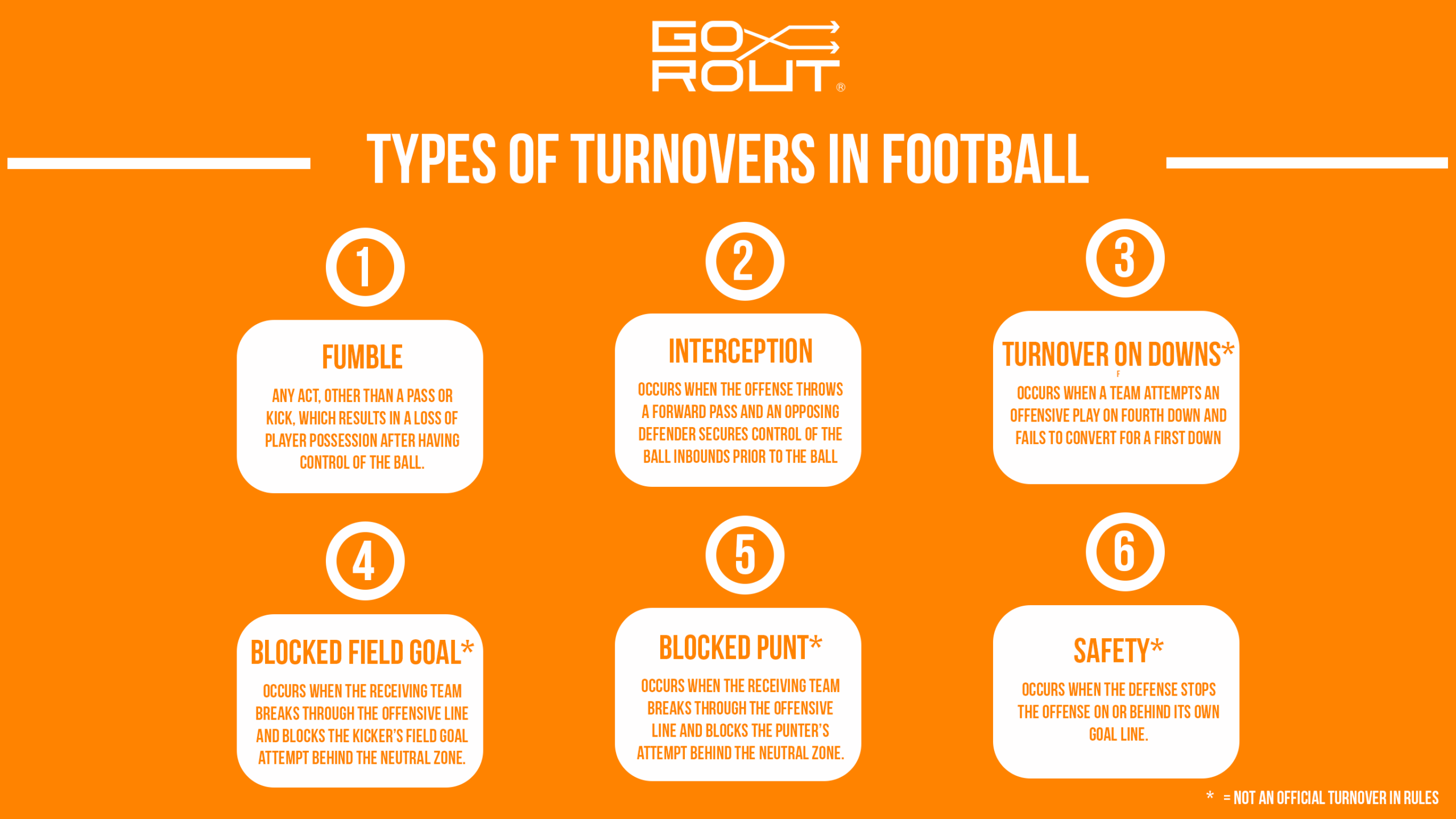
Context: The only official football turnover statistics are fumbles lost and interceptions, though safeties and turnover on downs also result in loss of possession. A defense gaining possession through a turnover serves as a momentum swing as their offense takes the field.

Gridiron Football Field Markings and Terminology
| Term | Definition |
| Boundary lines | The end lines and sidelines which enclose the field where the game is played. |
| Downfield | The area of the field ahead of the line of scrimmage and before the goal line and end zone. |
| End lines | The lines at each end of the field, perpendicular to the sidelines. |
| End zone | The rectangular zone of space formed by the goal line, end line, and sidelines. |
| Field of play | The rectangle formed by the goal lines and sidelines. |
| Goal lines | The lines between the sidelines that separate the end zone from the field of play, parallel to and 10 yards from the end lines. |
| Hash marks | Short lines on the field of play that serve unique purposes as both inbound lines and yard markers. |
| Line-of-scrimmage | The vertical plane of the yard line that passes through the forward point of the ball after it has been made ready for play. |
| Line to gain | The spot 10 yards downfield from the initial first down spot in a series (or set) of downs. |
| Neutral zone | The space between the forward and backwards points of the ball, extending from sideline to sideline. |
| Sidelines | The lines on each side of the field that are perpendicular to the end lines and separate the field of play from the area that is out of bounds. |
| Yard lines | Any line and its vertical plane parallel to the end line, marked or unmarked, named by number in yards from a team’s goal line to the center of the field. |
| Yard line markers | Line markings in the field of play that are parallel to the goal line and marked at intervals of 5 yards. |

Boundary lines
The end lines and sidelines which enclose the field where the game is played.
Context: Boundary lines DO NOT define the field of play (which is defined by the goal lines).
Downfield
The area of the field ahead of the line of scrimmage and before the goal line and end zone.
Context: The offense tries to move the ball downfield, progressing past the line of scrimmage to gain yards and get closer to scoring opportunities.
End lines
The lines at each end of the field, perpendicular to the sidelines.
Context: End lines are 10 yards away from the goal line and mark the back boundary of the end zone.
End zone
The rectangular zone of space formed by the goal line, end line, and sidelines. A standard American football end zone, including the NFL, measures 10 yards by 53 1/3 yards.
Context: Teams strive to enter the opposing team’s end zone with possession of the ball for a touchdown, while defending their own end zone from their opponent.
Field of play
The rectangle formed by the goal lines and sidelines.
Context: End zones are not considered within the field of play.
Goal lines
The lines between the sidelines that separate the end zone from the field of play, parallel to and 10 yards from the end lines.
Context: When teams are within a few yards of the goal lines, they’ll run specially designed plays from their goal line package. Many goal line packages consist of condensed formations, extra blockers, and either brute force or creative play design to open up scoring opportunities.
Hash marks
Short lines on the field of play that serve unique purposes as both inbound lines and yard markers.
Context: There are two different types of hash marks on a football field: inbound lines and yard markers.
Types of Hash Marks in American Football
- Inbound lines: Hash marks on the field of play that are parallel to each sideline and intersect each yard line marking at right angles. The specific distance from the sideline varies by league/experience level and is typically defined within a specific organization’s rule book.
- Yard markers: Hash marks on the playing field at 1-yard intervals between each distance of 5 yards. Yard markers consist of two corresponding hash marks for each 1-yard interval on each side of the field, continuing for the entire length from one goal line to the other.

Line-of-scrimmage
The vertical plane of the yard line that passes through the forward point of the ball after it has been made ready for play.
Context: This is the yard line (or spot) where the offense begins its next play, based upon where the previous play was whistled dead. The line-of-scrimmage is marked by a member of the chain crew on the field and a digital blue line on television broadcasts.
Line to gain
The spot 10 yards downfield from the initial first down spot in a series (or set) of downs.
Context: The offense has to reach the line to gain to earn a first down and fresh set of downs.
Neutral zone
The space between the forward and backwards points of the ball, extending from sideline to sideline.
Context: When the ball is made or declared ready for play, the neutral zone is established.
Sidelines
The lines on each side of the field that are perpendicular to the end lines and separate the field of play from the area that is out of bounds.
Context: Players need to be aware of the sidelines at all times, especially if their position or assignment takes them toward the playing field’s perimeter.
Yard Lines
Any line and its vertical plane parallel to the end line, marked or unmarked, named by number in yards from a team’s goal line to the center of the field.
Context: Yard lines are separate and distinct from yard line markers.
Yard line markers
Line markings in the field of play that are parallel to the goal line and marked at intervals of 5 yards.
Context: Yard line markers make it easier for players, coaches, officials, and spectators to gauge a team’s specific field position at any given time.

American Football Equipment Terms
| Term | Definition |
| Film review and analytics technology | Software and technology allowing coaches and players to review game and practice video, along with advanced analytic tracking to analyze and maximize performance. |
| Football | An elongated, pointed sphere (prolate spheroid) typically made of leather, rubber, or plastic with an inflatable bladder inside and laces on top. |
| Goal posts | Metal or heavy plastic structure consisting of a crossbar and two vertical uprights used for field goals and extra points. |
| Helmet | Safety equipment worn on a player’s head protecting from risk of unnecessary head injuries. |
| In-game playcalling technology | Devices that allow coaches to send play calls electronically to players during games. |
| Pads | Protective equipment used to cushion and lessen the impact of contact to vulnerable parts of the body. |
| Pigskin | A slang term for the football, based on the initial design of the ball which used inflated pig bladders to create the rounded shape. |
| Play drawing software | Digital software where coaches draw plays on electronic devices instead of manual hand drawings. |
| Practice device | Electronic systems that allow coaches to upload and send digital play cards to players during practice. |
| Uniform | The outfit that football players wear during games. |

Film Review and Analytics Technology
Software and technology allowing coaches and players to review game and practice video, along with advanced analytic tracking to analyze and maximize performance.
Context: A combination of film review and analytics technology provides teams the necessary tools for advanced game planning and performance evaluation. Players and coaches can review film and analytical data to self-assess on-field performance and create a practice plan, or study an opponent’s previous game footage to prepare a game plan.
Football
An elongated, pointed sphere (prolate spheroid) typically made of leather, rubber, or plastic with an inflatable bladder inside and laces on top.
Context: This is the ball the entire game of football is centered around. Specific sizes and materials vary by league, experience level, age group, and use case.
Goal posts
Metal or heavy plastic structure consisting of a crossbar and two vertical uprights used for field goals and extra points.
Context: Goal posts can become a major factor during key moments of the game. A field goal that bounces off the post at the wrong angle is sometimes the lasting memory of a devastating loss as time expires.
Helmet
Safety equipment worn on a player’s head protecting from risk of unnecessary head injuries.
Context: Helmets consist of a protective, padded shell around the head and a face mask to protect the eyes, nose, mouth and other facial features.
In-Game Playcalling Technology
Devices that allow coaches to send play calls electronically to players during games.
Context: In-game playcalling technology varies from radio communication systems in helmets to electronic in-game playcalling wristband systems.

Practice Device
Electronic systems that allow coaches to upload and send digital play cards to players during practice.
Context: Electronic football practice devices increase reps during practice and reduce the amount of time spent studying off the field.

Uniform
The outfit that football players wear during games.
Context: A standard uniform consists of a helmet, jersey, and pants that are branded to a team's color and/or logo.
Scoring Terminology in American Football
| Term | Definition |
| Extra point / Point after touchdown (PAT) | A field goal attempt worth 1 point immediately following a touchdown. |
| Field goal | A scoring play where a player kicks the ball from the field of play through the plane of the opponent’s goal post. |
| Safety | An instance where the ball is whistled dead in possession of a team on or behind its own goal line, when the force stopping forward progress comes from the team defending the goal line. |
| Two-point conversion | A scoring play worth 2 points, immediately following a touchdown, where the offense attempts to score a touchdown in the end zone from a predetermined distance. |
| Touchdown | A scoring play where any part of the ball is on, above, or behind the opponent’s goal line while legally in possession of an inbounds player. |

Extra Point/Point After Touchdown (PAT)
A field goal attempt worth 1 point immediately following a touchdown. The specific line of scrimmage and distance for PATs vary by league.
Context: Historically, extra points (or PATs), have been the most common type of try after a touchdown. With an increase in analytics-focused decision-making, more teams are risking it with two-point conversions over PATs.
Field Goal
A scoring play where a player kicks the ball from the field of play through the plane of the opponent’s goal post.
Context: As long as the ball is kicked between the goal posts and above the crossbar, or between the outer edges of the goal posts (if above the physical posts), the field goal is good. Players can either make a drop kick or a place kick from on or behind the line on a play from scrimmage. Teams usually attempt field goals within 40 yards of the goal post, though exceptional kickers (like those in high-level college or the NFL) extend their range well beyond that.
Safety
An instance where the ball is whistled dead in possession of a team on or behind its own goal line, when the force stopping forward progress comes from the team defending the goal line.
Context: The defensive team is awarded 2 points and possession of the ball via a safety kick. A safety can also be called if the offensive team commits a penalty behind its own goal line and the defense elects to enforce the penalty at the spot.
Two-point conversion
A scoring play worth 2 points, immediately following a touchdown, where the offense attempts to score a touchdown in the end zone from a predetermined distance.
Context: Two-point conversions also occur when the field goal unit fakes a kick and crosses the goal line in possession of the ball.
Touchdown
A scoring play where any part of the ball is on, above, or behind the opponent’s goal line while legally in possession of an inbounds player.
Context: Touchdowns are worth 6 points and the most impactful scoring play in football.

Terms to Describe Turnovers in Gridiron Football
| Term | Definition |
| Fumble | Any act where a player loses possession of the ball, other than passing, successful handing, or legally kicking the ball. |
| Interception | When an opponent who is inbounds catches a forward or backward pass, or a fumble that has not touched the ground, made by the team in possession. |
| Turnover on downs | When the offense fails to earn a first down within a four down series, given that they attempted a play from scrimmage on fourth down. |
Fumble
Any act where a player loses possession of the ball, other than passing, successful handing, or legally kicking the ball.
Context: A fumble lost is when the opposing team recovers possession of the ball on a fumble. If the defense recovers a fumble, it's a turnover. The team in possession of the ball remains in possession of the ball if it’s recovered by them or goes out of bounds, given it doesn’t touch or cross either goal line.
Interception
When an opponent who is inbounds catches a forward or backward pass, or a fumble that has not touched the ground, made by the team in possession.
Context: As long as the player secures control of the ball prior to it touching the ground, and control is maintained during and after the ball has touched the ground, the play is ruled an interception. An interception occurs most commonly when a defensive player catches a pass from the opposing quarterback, intended for an offensive player.
Turnover on Downs
When the offense fails to earn a first down within a four down series, given that they attempted a play from scrimmage on fourth down. The team on offense turns possession over to their opponent, who begins their series at the spot where the last play ended.
Context: Technically, a turnover on downs occurs when the offense fails to gain 10 yards net total over a four-down set. If a team loses 25 yards on first down and gains 24 yards back over the next three plays, but still fails to reach the line to gain, it's a turnover on downs.

General Football Strategy Terms
| Term | Definition |
| Field position | Proximity of the line of scrimmage in relation to the goal line. |
| Formation | An alignment of the 11 players on offense, defense, or special teams that abides by all rules set by the league or organization. |
| Signals | Number and worded codes called in the huddle or at the line of scrimmage by the quarterback on offense and the linebacker (or other signal caller) on defense. |
| Substitution | A player who enters the field of play or end zone when the ball is dead, taking the place of a teammate who leaves the playing area. |
Field position
Proximity of the line of scrimmage in relation to the goal line.
Context: Field position typically refers to the offensive team’s position on the field of play.
Formation
An alignment of the 11 players on offense, defense, or special teams that abides by all rules set by the league or organization.
Context: Formations vary by play design, strategy, coaching philosophy, roster construction, and other factors.
Signals
Number and worded codes called in the huddle or at the line of scrimmage by the quarterback on offense and the linebacker (or other signal caller) on defense.
Context: The term signals may also relate to verbal or non-verbal communication from the sideline to players on the field, like hand signals or sideline signs.
Substitution
A player who enters the field of play or end zone when the ball is dead, taking the place of a teammate who leaves the playing area.
Context: In American football, substitution is constant. A player that’s subbed out of the game may re-enter as soon as the next play. One team may run a different back out for each down, meaning a three-down sequence may feature three different substitutions at the running back position.
Football Offensive Terminology
This section of the GoRout football glossary covers a wide range of terms and definitions on the offensive side of the ball. From the foundational concepts of passers and rushers to higher level ideas like pre-snap audible or run-pass option (RPO), it serves as a dictionary for offensive terminology any casual football enthusiast can use to better understand this component of the game.
GoRout’s Glossary for Offense in Football includes:

Football Offense 101 Terms
| Term | Definition |
| Ball carrier | A player in possession of the ball, moving in any direction on foot. |
| Blocking | Obstructing or impeding an opponent by contacting them with a part of the blocker’s body. |
| Catch | Securing possession of a pass, kick, or fumble that is in flight while in bounds. |
| Down by contact | When a player who possesses the ball touches the ground with any part of the body (other than hands, feet, or arms), directly caused by contact with a player on the opposing team, and the play is whistled dead. |
| Drive | The sequence of offensive plays while a team has possession of the ball. |
| Eligible receiver | Players eligible to catch a forward pass that’s thrown from behind the line of scrimmage. |
| Forward pass | Any pass that initially moves forward, closer to the opponent’s goal line, after leaving the passer’s hand. |
| Handoff | Transferring possession of the ball from one teammate to another without passing or kicking it. |
| Ineligible receiver | Players that are not eligible to catch a legal or illegal forward pass thrown from behind the line of scrimmage. |
| Lateral | A version of a pass where one player tosses the ball sideways or backwards to a teammate. |
| Offensive backfield | The area behind the offensive line, and all players within that area including running backs, fullbacks, halfbacks, and usually the quarterback. |
| Offensive formation | The pre-snap alignment the offensive team lines up in. |
| Offensive team | The unit that possesses the ball and is trying to score. |
| Offensive player | Any athlete lined up on the offensive side of the ball. |
| Offensive plays | The full menu of pass calls and running plays a coordinator or coach scripts. |
| Pass play | An offensive play that attacks the defense by passing the ball through the air. |
| Passer | A player who makes a legal forward pass during a play. |
| Personnel grouping | Set combination of players, designated by the position types included in each respective package, that coaches send to the field. |
| Pitch | A type of pass that moves sideways or backwards. |
| The area between the outside edges of the normal tackle positions on either side of the center, extending backward to the offensive team’s end line. | |
| Route | The path or pattern a receiver takes to get open on a passing play. |
| Run play | An offensive play that attacks the defense through a handoff or any method that does not involve a pass. |
| Runner | An offensive player who is in possession of a live ball, holding the ball or carrying it in any direction. |
| Scramble | When the quarterback runs outside of the pocket, either looking for a receiver downfield or keeping the ball and running themselves. |
| Shotgun | An offensive formation where the quarterback lines up a few yards behind the center to receive a thrown snap. |
| Tackle box | The area of the offensive backfield between the two offensive tackles. |
| Under center | An offensive formation where the quarterback lines up directly behind the center, with their hands placed underneath the center’s rear for a hand-to-hand snap transfer. |

Ball carrier
A player in possession of the ball, moving in any direction on foot.
Context: This typically refers to the running back on running plays and receivers running with the ball after securing the catch. Ball carriers are also referred to as runners.
Blocking
The act of obstructing or impeding an opponent by contacting them with a part of the blocker’s body.
Context: Blocking is an essential component of offensive strategy and play design. When an offensive player blocks, it open lanes for ball carriers and creates time for the quarterback to pass.
Catch
When a player secures possession of a pass, kick, or fumble that is in flight while in bounds.
Context: This is most often used to describe the actions of players that catch passes on offense, which is defined as securing control of the ball prior to it touching the ground, and maintaining control during and after the ball has touched the ground.
Down by contact
When a player who possesses the ball touches the ground with any part of the body (other than hands, feet, or arms), directly caused by contact with a player on the opposing team, and the play is whistled dead.
Context: Depending on the league, a player may be down by contact if any part of the body (aside from hands, feet, or arms) touches the ground regardless of what caused it.
Drive
The sequence of offensive plays while a team has possession of the ball.
Context: A successful drive varies depending on the side of the ball. Successful offensive drives result in a scoring play. The success of a defensive drive relies on stopping the opposing offense from scoring.
Eligible Receiver
Players eligible to catch a forward pass that’s thrown from behind the line of scrimmage.
Context: Wide receivers, running backs, fullbacks, quarterbacks, and tight ends are all eligible receivers on most offensive plays. Offensive lineman must report themselves as eligible to officials before each play to become an eligible receiver.

Forward Pass
Any pass that initially moves forward, closer to the opponent’s goal line, after leaving the passer’s hand.
Context: A forward pass is the foundation of a passing offense. Quarterbacks with strong, accurate arms use forward passes to attack the defense’s weaknesses.
Handoff
Transferring possession of the ball from one teammate to another without passing or kicking it.
Context: Handoffs are most often used on running plays, where the quarterback (or other offensive player who takes the snap) hands the ball off to another offensive player.
Ineligible Receiver
Players that are not eligible to catch a legal or illegal forward pass thrown from behind the line of scrimmage.
Context: If an ineligible receiver catches a pass, or a quarterback throws to an ineligible receiver when avoiding a sack, the offense is penalized.
Lateral
A version of a pass where one player tosses the ball sideways or backwards to a teammate.
Context: Lateral is often used as the transition of possession on a toss running play. It’s also used on trick plays and to extend the final play of a game when the clock has run out.
Offensive backfield
The area behind the offensive line, and all players within that area including running backs, fullbacks, halfbacks, and the quarterback.
Context: Offensive linemen try to protect the offensive backfield while the defense aims to overtake it and force a loss of yardage.
Offensive formation
The pre-snap alignment the offensive team lines up in.
Context: Offensive formations vary depending on a team’s roster construction, experience level and competitiveness, league rules, coaching philosophy, and many other factors.
Offensive team
The unit that possesses the ball and is trying to score.
Context: Offensive teams are led by an offensive coordinator, or a combination of a head coach and senior offensive coach. They use a combination of pass and run plays, amongst additional and more complex strategic designs, to move the ball downfield.

Offensive player
Any athlete lined up on the offensive side of the ball.
Context: Offensive players have a slight advantage on any given play, as they know when the ball will be snapped based on their quarterback’s cadence and snap count.
Offensive plays
The full menu of pass calls and running plays a coordinator or coach scripts.
Context: A coach’s offensive plays can range anywhere from basic concepts to highly innovative and creative designs.
Pass play
An offensive play that attacks the defense by passing the ball through the air.
Context: Quarterbacks and receivers often take credit or face blame for the result of a pass play. While they are the primary ball handlers, successful passing offenses depend on a number of contributing factors. Blocking scheme, route combinations and design, misdirection, and execution are just a few of the factors that go into a pass play.
Passer
A player who makes a legal forward pass during a play.
Context: The most common passer is the quarterback, who throws the ball on offense.
Personnel grouping
Set combination of players, designated by the position types included in each respective package, that coaches send to the field.
Context: Personnel groupings are most often impacted by a team’s roster, specifically the traits of their running backs and tight ends.
Pitch
A type of pass that moves sideways or backwards. Another term for toss or lateral.
Context: Even though it’s a pass, pitch is used to describe the quarterback’s motion on certain run plays.
The area between the outside edges of the normal tackle positions on either side of the center, extending backward to the offensive team’s end line.
Context: Offensive linemen are tasked with creating a clean pocket by controlling defenders at the line of scrimmage. Quarterbacks with strong arms, vision, and accuracy who prefer to complete passes from the pocket are often called pocket passers.
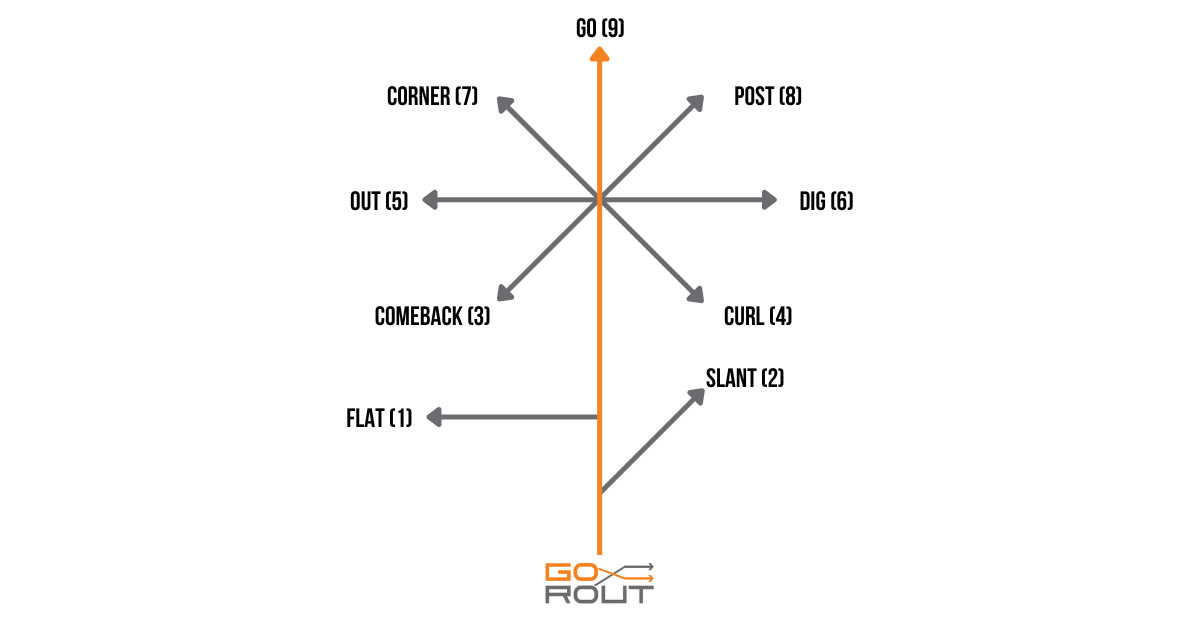
Route
The path or pattern a receiver takes to get open on a passing play.
Context: Each route has a distinct path, part of the football route tree.
Run play
An offensive play that attacks the defense through a handoff or any method that does not involve a pass.
Context: Run plays are typically designed for running backs, full backs, half backs, quarterbacks, and wide receivers lined up in the backfield or in motion.
Runner
An offensive player who is in possession of a live ball, holding the ball or carrying it in any direction.
Context: Runners can be designated specifically before a play or somewhat spontaneously upon receiving possession of the ball. A running back is definitively the runner on designed run plays to the position, but the third receiving option on a pass play can also become the runner if a pass is completed to them and they begin moving downfield.
Scramble
When the quarterback runs outside of the pocket, either looking for a receiver downfield or keeping the ball and running themselves.
Context: Quarterbacks with speed and agility who scramble, and excel at passing outside of the pocket and running themselves, are called scrambling quarterbacks.
Shotgun
An offensive formation where the quarterback lines up a few yards behind the center to receive a thrown snap.
Context: Shotgun formation is common in spread offenses and passing scenarios.
Tackle box
The area of the offensive backfield between the two offensive tackles.
Context: On offense, tackle box and pocket are similar but distinct terms.
Under center
An offensive formation where the quarterback lines up directly behind the center, with their hands placed underneath the center’s rear for a hand-to-hand snap transfer.
Context: Under center formations open opportunities for downhill run concepts that can be duplicated as play action pass designs.

Football Offensive Players
| Term | Definition |
| Center (C) | The centermost player on the offensive line, tasked with beginning each play from scrimmage by snapping the ball. |
| Fullback (FB) | A larger, stronger player in the offensive backfield who primarily blocks on run and pass plays, though they also receive carries in the run game and catches in the pass game. |
| Offensive guard (OG) | Interior offensive linemen who line up directly next to the center, tasked with blocking on run and pass plays. |
| Offensive tackle (OT) | Offensive linemen who line up outside of the guards, tasked with blocking on run and pass plays. |
| Quarterback (QB) | The player who receives the snap to start each play and disperses the ball by either handing it off, throwing it, or holding it and running. |
| Running back (RB) | A key player in the offensive backfield who receive handoffs (and other laterals) on rushing plays, and serve as blockers or receivers on passing plays. |
| Tight end (TE) | A hybrid offensive position with blocking and receiving responsibilities. |
| Wide receiver (WR) | An offensive skill player who specializes in pass-catching. |
Center (C)
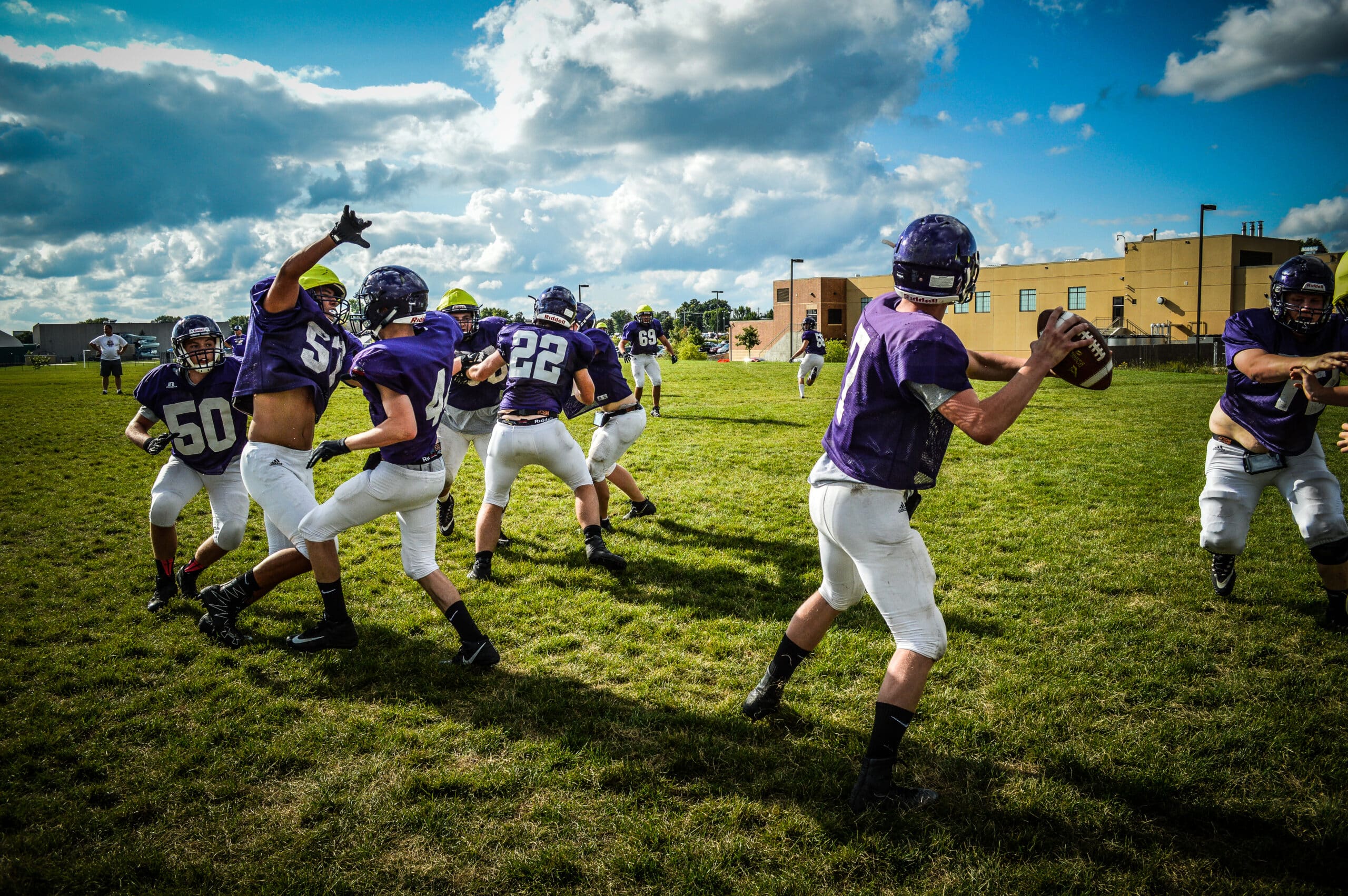
The centermost player on the offensive line, tasked with beginning each play from scrimmage by snapping the ball.
Context: Center is an essential position, with blocking responsibilities on every play after the snap.
Fullback (FB)
A larger, stronger player in the offensive backfield who primarily blocks on run and pass plays, though they also receive carries in the run game and catches in the pass game.
Context: Fullbacks are less common in spread offenses, and more often seen in condensed looks under center.
Offensive Guard (OG)
Interior offensive linemen who line up directly next to the center, tasked with blocking on run and pass plays.
Context: Offensive guards have to be versatile, as some blocking schemes call for them to pull away from their starting position and block players while on the move.
Offensive Tackle (OT)
Offensive linemen who line up outside of the guards, tasked with blocking on run and pass plays.
Context: Offensive tackles have to keep outside pass rushers under control to protect the quarterback, especially the blind side tackle.
Quarterback (QB)
The player who receives the snap to start each play and disperses the ball by either handing it off, throwing it, or holding it and running.
Context: Quarterbacks serve as the commander of the offense, receiving and relaying play calls from the coordinator to offensive players in the huddle. They also read defenses and make pre-snap audibles and other changes at the line of scrimmage.
Running Back (RB)
A key player in the offensive backfield who receive handoffs (and other laterals) on rushing plays, and serve as blockers or receivers on passing plays.
Context: A team’s rushing offense centers around their running backs.
Tight End (TE)
A hybrid offensive position with blocking and receiving responsibilities.
Context: Tight ends play a combination of offensive line, H-back, and receiver. On run plays, they line up next to offensive linemen, or in creative formations, to block. Tight ends are dual threat offensive weapons in the pass game, either stepping in to pass block or running a route as a target through the air. Such a player can be a true weapon for a skilled offensive coordinator who knows how to coach football.
Wide Receiver (WR)
An offensive skill player who specializes in pass-catching.
Context: The position serves the foundational role of a passing offense: running routes, making catches, and gaining yards after receptions. Wide receivers come in many body types, though all have some combination of speed, quickness, range, and strength. Receivers primarily block in the running game, though many creative modern offenses incorporate their faster wideouts as ball carriers on the ground.

Pre-Snap Terminology
| Term | Definition |
| Audible | Changing the offensive play entirely at the line of scrimmage from what was called in the huddle. |
| Cadence | The rhythm and sequence of words and sounds a quarterback calls out prior to the snap. |
| Hot route | Adjusting a receiver’s route at the line of scrimmage to combat a blitz. |
| Motion | Sending an offensive player from the backfield moving either parallel to or away from the line of scrimmage while the ball is being snapped. |
| Shift | Sending any offensive player into motion before the snap, so long as they come to a complete stop and be in a set position for at least one full second. |
| Snap count | The specific cue that tells the offensive team to snap the ball and begin a play. |

Audible
Changing the offensive play entirely at the line of scrimmage from what was called in the huddle.
Context: The quarterback is responsible for calling audibles in response to pre-snap reads of the defense.
Cadence
The rhythm and sequence of words and sounds a quarterback calls out prior to the snap.
Context: A quarterback’s cadence can be used to throw off the defense with false snap counts, or hard counts.
Hot Route
Adjusting a receiver’s route at the line of scrimmage to combat a blitz.
Context: A hot route is often short and quick, making it easy for the quarterback to get the ball off.
Motion
Sending an offensive player from the backfield moving either parallel to or away from the line of scrimmage while the ball is being snapped.
Context: Motion is used to confuse defensive players as the ball is snapped and create open looks for the offense.
Shift
Sending any offensive player into motion before the snap, so long as they come to a complete stop and be in a set position for at least one full second.
Context: Coaches can send two or more players shifting in motion multiple times as long as they come set for a full second before the snap.
Snap count
The specific cue that tells the offensive team to snap the ball and begin a play.
Context: This is often a number, color, word, motion, or other cue. Snap counts give the offense a slight advantage, as they know what indicates a snap while the defense doesn’t.

Offensive Strategy Terms
| Term | Definition |
| Bootleg | A play action pass where the quarterback fakes a handoff to the running back, then scrambles in the opposite direction to either throw or run the ball. |
| Buttonhook | A pass route where the receiver runs straight, then quickly turns and cuts back in to catch the ball. |
| Draw | A running play initially disguised as a pass to confuse the defense. |
| Dead zone (4-down territory) | An area of the field where the offense attacks on their opponent’s side of the field, but they’re out of field goal range and too close for an effective punt. |
| Explosive play | A successful, high-yardage offensive play. |
| Flea flicker | A trick offensive passing play where the running back receives a handoff, takes a few steps, turns, and “flicks” (or tosses) the ball back to the quarterback who looks for an open receiver. |
| Gap | The spaces between the offensive linemen that offenses protect and design running plays toward. |
| Hail mary | A passing play where all receivers run go routes and the quarterback heaves the ball as far as they can. |
| Moving the chains | A slang term to describe the offense gaining a first down and new series. |
| No-huddle | Operating an offensive play call or game plan without a pre-snap huddle. |
| Pancake block | A block where the offensive lineman knocks a defender flat on their back. |
| Play action | A passing play initially disguised as a run. |
| Pulling | When an offensive lineman or tight end leaves their pre-snap alignment, “pulling” out of their initial positioning into motion behind the line of scrimmage, and running toward a new blocking assignment. |
| Quarterback (QB) Sneak | A running play designed for the quarterback as the ball carrier. |
| Read | Assessing and identifying some component of the defense while on the field during an offensive possession. |
| Reverse | An offensive play utilizing motion, multiple handoffs or possession transfers, and change of direction to create space for ball carriers. |
| Run-pass option (RPO) | An offensive play designed with the option to either pass or run, depending on the quarterback’s read of the defense. |
| Screen | A short, lateral passing play designed for a running back or receiver to follow pulling blockers. |
| Second-level | Referring to linebackers as the second level of the defense (between the defensive line and safeties) that the offense attacks. |
| Sweep | A running play that stretches the field laterally and attacks the outside with speed. |
| Trick play | A deceptive play design intended to fool the opposing team. |
| Victory formation | A condensed offensive formation where the quarterback kneels on the ground to give themself up and run out the clock. |

Bootleg
A play action pass where the quarterback fakes a handoff to the running back, then scrambles in the opposite direction to either throw or run the ball.
Context: Bootleg utilizes misdirection to deceive the defense, since all of the passing routes are designed to the side of the scrambling quarterback.
Buttonhook
A pass route where the receiver runs straight, then quickly turns and cuts back in to catch the ball.
Context: The full route resembles the shape of a buttonhook, therefore its name.
Draw
A running play initially disguised as a pass to confuse the defense.
Context: After the snap, the quarterback pretends to drop back for a pass before either handing off to a ball carrier or keeping the ball to run themselves.
Dead zone (4-Down Territory)
An area of the field where the offense attacks on their opponent’s side of the field, but they’re out of field goal range and too close for an effective punt.
Context: It’s called 4-Down Territory because teams often go for it and keep their offense on the field for fourth down plays in this field position.
Explosive play
A successful, high-yardage offensive play.
Context: Also known as a chunk play, explosive plays can shift a game’s momentum in a single snap.
Flea Flicker
A trick offensive passing play where the running back receives a handoff, takes a few steps, turns, and “flicks” (or tosses) the ball back to the quarterback who looks for an open receiver.
Context: While the defense bites on the initial run look, receivers run routes designed to capitalize on open space and big play potential.
Gap
The spaces between the offensive linemen that offenses protect and design running plays toward.
Context: Each gap is identified by a specific letter:
- A (between center and guard)
- B (between guard and tackle)
- C (between tackle and tight end), and
- D (outside the tight end)

Hail Mary
A passing play where all receivers run go routes and the quarterback heaves the ball as far as they can.
Context: Hail Mary plays are typically called at the end of the half or when teams are on their last play of the game.
Moving the chains
A slang term to describe the offense gaining a first down and new series.
Context: Moving the chains is named after the chain crew’s movement to establish the new line of scrimmage after a first down.
No-huddle
Operating an offensive play call or game plan without a pre-snap huddle.
Context: No-huddle offense relies on quick alignment and play calls from the line of scrimmage. It can be used to save time, catch the defense off guard, set the pace of the game, or any other purpose.
Pancake block
A block where the offensive lineman knocks a defender flat on their back.
Context: The overwhelming force leaves the defender laying like a pancake on the ground, which is where the block gets its name.
Play Action
A passing play initially disguised as a run.
Context: The quarterback fakes a handoff or tossing motion, but retains possession of the ball and drops back to pass. Play action uses deception to trick defenses into biting on the run and create space for receivers.
Pulling
When an offensive lineman or tight end leaves their pre-snap alignment, “pulling” out of their initial positioning into motion behind the line of scrimmage, and running toward a new blocking assignment.
Context: Pulling linemen creates confusion on the defensive line and gives the offense a numbers advantage when blocking toward a specific area.
Quarterback (QB) Sneak
A running play designed for the quarterback as the ball carrier.
Context: QB sneak is also used to specifically describe a short-yardage run where the quarterback receives the snap and immediately dives to the line of scrimmage in hopes of reaching the first down marker.

Read
Assessing and identifying some component of the defense while on the field during an offensive possession.
Context: Reads are common on option plays, where the quarterback reads a defender before making the decision to hand off or keep the ball.
Reverse
An offensive play utilizing motion, multiple handoffs or possession transfers, and change of direction to create space for ball carriers.
Context: Teams often incorporate reverse plays to utilize speedy wide receivers as ball carriers in the run game.
Run-Pass Option (RPO)
An offensive play designed with the option to either pass or run, depending on the quarterback’s read of the defense.
Context: RPO has become a common term heard in meeting rooms, broadcasts, and casual conversation. Run-pass options are used to get the ball out quickly, whether it’s handing off or keeping and making a quick throw.
Screen
A short, lateral passing play designed for a running back or receiver to follow pulling blockers.
Context: Screen plays allow versatile backs to play a role in the passing offense.
Second-Level
Referring to linebackers as the second level of the defense (between the defensive line and safeties) that the offense attacks.
Context: Offensive linemen get to the second-level when their assignment involves blocking a linebacker.
Sweep
A running play that stretches the field laterally and attacks the outside with speed.
Context: Sweep can be designed for either a running back or a receiver.
Trick play
A deceptive play design intended to fool the opposing team.
Context: Trick plays are most often used on offense (or kick returns), with creative calls designed to throw off the defense.

Victory formation
A condensed offensive formation where the quarterback kneels on the ground to give themself up and run out the clock.
Context: Victory formation is another name for a QB kneel, specifically at the end of the game by the winning team.
Football Defensive Terminology
This section of GoRout’s football glossary hones in on the defensive side of the ball. Here, you’ll find everything from different position names to strategic terms like cover 2 and gap responsibility.
GoRout’s defensive glossary includes:
General Football Defense Terms
| Term | Definition |
| Blitz | A defensive play design that sends a combination of defenders on a pass rush to pressure the quarterback. |
| Defensive backfield | The group of defensive players furthest away from the ball, behind the defensive line and linebackers. |
| Defensive line | The collection of defensive players lined up directly on the line of scrimmage. |
| Defensive player | Any athlete lined up on the defensive side of the ball. |
| Defensive team | The unit of 11 players that is trying to stop the opposing team from advancing the ball and gaining yards. |
| Man-to-man defense (Man coverage) | A defensive scheme where defenders line up directly against a specific player on the opposing offense, assigned to follow and cover them the entire play. |
| Pass breakup | When a defensive player causes the offense to drop a pass by impacting the flight path. |
| Sack | When a defender tackles the quarterback behind the line of scrimmage on a passing play. |
| Strip | When a defender forces the ball directly out of a ball carrier’s hands for a fumble. |
| Zone defense (Zone coverage) | A defensive scheme where defenders are assigned a zone, or specific area of space on the playing field, to defend. |

Blitz
A defensive play design that sends a combination of defenders on a pass rush to pressure the quarterback.
Context: Oftentimes, a blitz is designed so more defenders rush the quarterback than the offensive team has players assigned to pass protection blocking.
Defensive backfield
The group of defensive players furthest away from the ball, behind the defensive line and linebackers.
Context: Often referred to as the secondary, the defensive backfield is composed of cornerbacks and safeties.
Defensive line
The collection of defensive players lined up directly on the line of scrimmage.
Context: The defensive line features larger, stronger players whose primary goal is to rush the quarterback on passing plays and clog the gaps to stop running plays at the line of scrimmage.
Defensive player
Any athlete lined up on the defensive side of the ball.
Context: Defensive players tend to be more reactive and twitchy, since they don’t know the snap count and react to what the offense does.
Defensive team
The unit of 11 players that is trying to stop the opposing team from advancing the ball and gaining yards.
Context: A defensive team’s ultimate goal is to take possession away from the opposing offense.
Man-to-man defense (Man coverage)
A defensive scheme where defenders line up directly against a specific player on the opposing offense, assigned to follow and cover them the entire play.
Context: Man-to-man defense allows lockdown cornerbacks and safeties to control the pass game, while offenses with skilled receivers can exploit mismatches or weaknesses against man coverage.
Pass Breakup
When a defensive player causes the offense to drop a pass by impacting the flight path.
Context: Pass breakups range from a defender tipping or swatting the ball with their hands, to hitting the receivers hands or dropping an interception. As long as the defender makes contact with an attempted catch, it’s considered a pass breakup.
Sack
When a defender tackles the quarterback behind the line of scrimmage on a passing play.
Context: Sacks benefit a defense in several ways.
- They move the line of scrimmage in the defense’s favor as the offense loses yards.
- Quarterbacks are physically impacted depending on the nature of the sack, and mentally impacted regardless. If the pass rush gets through for a sack, the quarterback may have flashbacks and make a poor decision the next time faced with a rush.
- Defensive ends and edge rushers make their living sacking the quarterback.
Strip
When a defender forces the ball directly out of a ball carrier’s hands for a fumble.
Context: Strips are distinct from inadvertent fumbles. When a defender forces a fumble while simultaneously sacking the quarterback, it’s referred to as a strip sack.
Zone defense (Zone coverage)
A defensive scheme where defenders are assigned a zone, or specific area of space on the playing field, to defend.
Context: Zone defense requires players to understand their assignment and communicate as the play evolves.

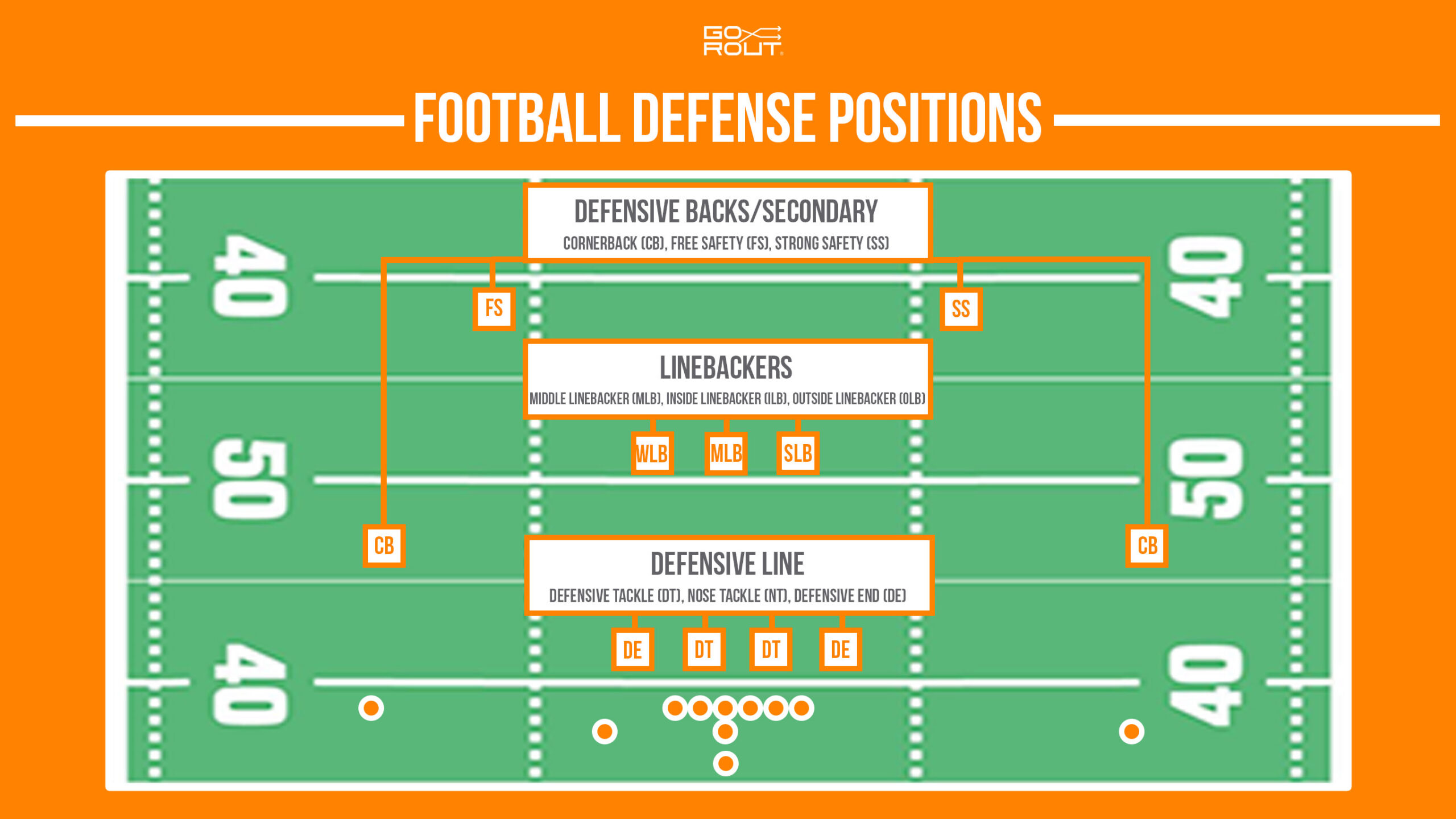
Football Defensive Players
| Term | Definition |
| Cornerback (CB) | Speedy defensive backs who line up opposite of opposing receivers and defend against passes. |
| Defensive end (DE) | Players who line up on the outside of the defensive tackle, and on the end of the defensive line, who attack the quarterback on passing plays and stop runs to the outer edges on running plays. |
| Defensive tackle (DT) | Players who line up on the inside of the defensive line, responsible for rushing the passer and stopping running plays directed at the middle of the field. |
| Edge rusher (EDGE) | Hybrid player that bridges the gap between defensive end and linebacker. |
| Linebacker (LB) | Players who line up in the middle of the defense, protecting against the pass while containing running plays that get past the defensive line. |
| Nose tackle (NT) / Nose Guard (NG) | A specialized defensive tackle who lines up directly across from the center. |
| Safety (S) | Defensive backs who serve a critical role in the defense, providing versatility in pass coverage and run support. |
Cornerback (CB)
Speedy defensive backs who line up opposite of opposing receivers and defend against passes.
Context: Primary cornerbacks most often line up on the outside receivers, while Nickleback (NB) and Dimeback (DB) corners cover slot and inside receivers in Nickel and Dime defensive formations.
Defensive End (DE)
Players who line up on the outside of the defensive tackle, and on the end of the defensive line, who attack the quarterback on passing plays and stop runs to the outer edges on running plays.
Context: Defensive ends occasionally drop into pass coverage in creative schemes.
Defensive tackle (DT)
Players who line up on the inside of the defensive line, responsible for rushing the passer and stopping running plays directed at the middle of the field.
Context: Defensive tackles are bigger bodied, strong defenders.
Edge Rusher (EDGE)
Hybrid player that bridges the gap between defensive end and linebacker.
Context: Edge rushers line up on the outside of the defensive line, rushing the quarterback on pass plays and setting the edge on run plays.
Linebacker (LB)
Players who line up in the middle of the defense, protecting against the pass while containing running plays that get past the defensive line.
Context: Linebackers are split into three sub-categories. The three types of linebackers are:
- Middle linebacker (MLB): Player positioned in the middle or inside alignment of the linebacking core. Middle linebackers serve as the “quarterback of the defense”, responsible for relaying play calls to the defense and reacting to offensive formations. They’re referred to as the “Mike” linebacker.
- Inside linebacker (ILB): Player positioned inside the linebacker core alignment, in tandem with the middle linebacker. Inside linebacker is most common in defensive formations with four linebackers.
- Outside linebacker (OLB): Versatile players positioned on the outside edge of the linebacking core, crucial to both run and defense and pass protection.
Nose tackle (NT)/Nose Guard (NG)
A specialized defensive tackle who lines up directly across from the center.
Context: Nose tackles are often the largest, strongest players on the defense and primarily play in odd-man defensive fronts.
Safety (S)
Defensive backs who serve a critical role in the defense, providing versatility in pass coverage and run support.
Context: Safeties are the last line of the defense, preventing big plays from turning into touchdowns. They also serve as quarterbacks of the defensive backs, making pre-snap adjustments, calling out coverages, and making sure other defensive backs are in good position.
Safety is split into two sub-groups:
- Strong Safety (SS): Cerebral defensive back who makes pre-snap reads on offensive formations and personnel groupings, helping other defensive players predict or determine the offense’s play.
- Free Safety (FS): Speedy, strong defensive backs who line up farthest away from the line of scrimmage. Known as ballhawks, free safeties excel at reading the eyes of the quarterback and making plays on the ball.
Defensive Strategy Terms
| Term | Definition |
| Base | The most basic, primary formation a defense uses as its foundation. |
| Cover 2 | A zone defensive scheme that splits two deep safeties to cover deep passing threats, while five other defenders cover intermediate zones for short passes. |
| Cover 3 | A zone defensive scheme that splits the field into thirds with three defensive backs deep, each responsible for one-third of the zone. |
| Cover 4 | A zone defensive scheme that splits the field into four equal zones. |
| Four-man defensive line | Defensive alignment with four defensive players on the line of scrimmage. |
| Front seven | The group of seven players on defense who make up the defensive line and linebackers. |
| Gap responsibility | The specific gap that a defensive player is responsible for on any given play. |
| Hitstick | A high-impact tackle that abruptly stops a ball carrier in motion. |
| Pass rush | A defensive team’s attempt to pressure the quarterback on passing plays. |
| Pick | Another term for interception, when a pass is caught by a player from the opposite team, turning over possession of the ball. |
| Pick six | An interception returned for a touchdown, resulting in six points for the defensive team. |
| Scoop and score | A fumble recovered by the defense and returned for a touchdown, resulting in six points for the defensive team. |
| Strip sack | When a defensive player forces a fumble while in the act of sacking the quarterback. |
| Three-man defensive line | Defensive alignment with three defensive players on the line of scrimmage. |

Base
The most basic, primary formation a defense uses as its foundation.
Context: A team’s base defense often consists of either 4-3 or 3-4.
Cover 2
A zone defensive scheme that splits two deep safeties to cover deep passing threats, while five other defenders cover intermediate zones for short passes.
Context: Cover 2 is one of the most commonly used zone coverages, which offers run support while disrupting timing routes.
Cover 3
A zone defensive scheme that splits the field into thirds with three defensive backs deep, each responsible for one-third of the zone.
Context: One single-high safety covers the middle zone, reading the quarterback's eyes and the last line of defense against deep routes. Cover 3 offers the balance and run support of cover 2 while protecting against the deep ball.
Cover 4
A zone defensive scheme that splits the field into four equal zones.
Context: Cover 4 has four defensive backs split the deep coverage into those four zones, or “quarters”, while the remainder of the defense covers the short and intermediate area.
Four-man defensive line
Defensive alignment with four defensive players on the line of scrimmage.
Context: This is one of the most common alignments found in formations like 4-3, 4-2-5 nickel, 4-4, and others. Four-man defensive lines often consist of two defensive tackles and two defensive ends.
Front seven
The group of seven players on defense who make up the defensive line and linebackers.
Context: Together, the front seven make up the first and second levels of a defense. Many defensive formations use the alignment of the front seven as a name or numerical identifier (ex. 4-3 is four defensive linemen and three linebackers, and the front seven for that given alignment).
Gap responsibility
The specific gap that a defensive player is responsible for on any given play.
Context: Gap responsibility is essential for an effective run defense.

Hitstick
A high-impact tackle that abruptly stops a ball carrier in motion.
Context: Hitsticks are less common as more rules have been incorporated to protect player safety.
Pass rush
A defensive team’s attempt to pressure the quarterback on passing plays.
Context: A pass rush consists of the players and tactics assigned to chase the quarterback in hopes of forcing them into a bad throw, an interception, or sacking them in the backfield for a loss. The defensive line’s primary responsibility on passing plays is a three- or four-man pass rush. Pass rush is different from a blitz, which is a defensive play that sends additional pass rushers or switches up which positions rush the quarterback.
Pick
Another term for interception, when a pass is caught by a player from the opposite team, turning over possession of the ball.
Context: Pick and picked off are used similarly when referring to an interception.
Back to Defensive Strategy Terms
Pick six
An interception returned for a touchdown, resulting in six points for the defensive team.
Context: A pick six is one of the biggest momentum shifts in the sport, with the defense starting the play protecting against their opponent’s offense and ending with a touchdown of their own.
Scoop and score
A fumble recovered by the defense and returned for a touchdown, resulting in six points for the defensive team.
Context: Along with the pick six, a scoop and score shifts momentum entirely with a potential 12 point swing.
Strip sack
When a defensive player forces a fumble while in the act of sacking the quarterback.
Context: A strip sack often requires a punching or ripping motion while tackling the quarterback, “stripping” the ball from their hand.
Three-man defensive line
Defensive alignment with three defensive players on the line of scrimmage.
Context: This is found in formations like 3-4 and 3-3-5 nickel, amongst others.

Football Special Teams Terminology
This section of GoRout’s football glossary delves into special teams terms and definitions. You’ll find fundamental ideas like free kick and scrimmage kick, all the way to newer concepts such as the landing zone.
GoRout’s special teams terminology glossary includes:
Basic Special Teams 101 Terms
| Term | Definition |
| Drop kick | When a player drops the ball and kicks it as, or immediately after, it touches the ground. |
| Fair catch | An unhindered catch of a scrimmage kick that has crossed the line of scrimmage and has not touched the ground, or of a free kick that has not touched the ground, by a player of the receiving team who has given a valid fair catch signal. |
| Free kick | Any kick that puts the ball in play without a snap. |
| Kicking team | The unit of 11 players, including the placekicker, who kick the ball to the receiving team and try to stop them from advancing/gaining yards. |
| Kickoff | A free kick that puts the ball in play to start a free kick down. |
| Onside kick | A free kick that the kicking team attempts to legally recover to retain possession. |
| Place kick | A kick made by a player while the ball is in a fixed position on the ground. |
| Pooch kick | An intentionally short and high-arcing kickoff. |
| Receiving team | The unit of 11 players who receive the ball from the kicking team and try to advance it as far as possible for starting field position. |
| Safety kick | A free kick that puts the ball in play after a safety. |
| Scrimmage kick | Any kick from on or behind the line of scrimmage, in a formation where no player is in position to receive a hand-to-hand snap. |
| Squib kick | A kickoff intentionally driven low and on a straight line, intended to reduce the likelihood of a big return. |

Drop Kick
When a player drops the ball and kicks it as, or immediately after, it touches the ground.
Context: A drop kick can be used on any free kick or scrimmage kick, though it is rare in today’s game.
Fair catch
An unhindered catch of a scrimmage kick that has crossed the line of scrimmage and has not touched the ground, or of a free kick that has not touched the ground, by a player of the receiving team who has given a valid fair catch signal.
Context: A valid fair catch is signaled by waving one arm above the head, and most often called on punts where the returner is facing immediate contact.
Free kick
Any kick that puts the ball in play without a snap.
Context: Kickoffs, safety kicks, and onside kicks are all examples of free kicks, which only take place on free kick downs. Free kicks take place at the start of each half and overtime (if applicable), and after any of the following:
- Extra point or two point conversion try
- Successful field goal
- Safety
Kicking team
The unit of 11 players, including the placekicker, who kick the ball to the receiving team and try to stop them from advancing/gaining yards.
Context: A kicking team’s makeup varies depending on the situation. If a team attempts an onside kick, they send out a different group of players than a standard kickoff.
Kickoff
A free kick that puts the ball in play to start a free kick down.
Context: Kickoffs occur at the start of each half, at the start of overtime, after a try (extra point or two-point conversion), and after a successful field goal.
Onside kick
A free kick that the kicking team attempts to legally recover to retain possession.
Context: Onside kicks must travel the required distance for the kicking team to legally recover.
Place kick
A kick made by a player while the ball is in a fixed position on the ground.
Context: On scrimmage kicks, the ball may be held by a teammate. During free kicks, players may use an approved manufactured tee to hold the ball.

Pooch kick
An intentionally short and high-arcing kickoff.
Context: Pooch kicks intend to restrict the receiving team’s ability to make a big play. They force a less agile, slower upman to receive the kick and give the kicking team more time to sprint downfield to make a tackle.
Receiving team
The unit of 11 players who receive the ball from the kicking team and try to advance it as far as possible for starting field position.
Context: Like the kicking team, the makeup of a receiving team varies depending on the specific situation. On onside kicks, the receiving team sends out a specialized group to recover that specific type of kick.
Safety kick
A free kick that puts the ball in play after a safety.
Context: The team that allowed the safety kicks the ball to their opponents, who take possession wherever the play is whistled dead.
Scrimmage kick
Any kick from on or behind the line of scrimmage, in a formation where no player is in position to receive a hand-to-hand snap.
Context: Scrimmage kicks include any punt, drop kick, or place kick. The most common types of scrimmage kicks are punts or field goal attempts.
Squib kick
A kickoff intentionally driven low and on a straight line, intended to reduce the likelihood of a big return.
Context: By kicking the ball low and straight, the ball either makes contact with an upman or the ground in front of an upman on squib kicks. This keeps the ball out of the returner’s hands and increases the likelihood of a fumble or muffed return.

Special Teams Players & Positions
| Term | Definition |
| Gunner | A player who specializes in sprinting downfield to tackle returners, force a fair catch, or pin the opposing team deep in their own zone on kickoffs and punts. |
| Holder / Placeholder | A player who legally holds the ball in place for kickers on place kicks. |
| Jammer | A player on the receiving team who tries to slow down gunners during punts by blocking or legally obstructing the gunner’s path. |
| Kick returner | A player on the receiving team who specializes in receiving kicks and running them back. |
| Kicker | A player who legally drop kicks, place kicks, or punts the ball during a down in which there is a scrimmage kick, free kick, or fair catch kick. |
| Kickoff specialist | A placekicker who specializes in kickoffs and only takes the field on those plays. |
| Long snapper | A player who specializes in snapping the ball longer distances on punts, field goal attempts, and extra point tries. |
| Placekicker | A player who specializes in kicking place kicks including field goals and extra points. |
| Punt returner | A player on the receiving team who specializes in receiving punts and running them back. |
| Punter | A kicker who specializes in punting. |
| Upback | A player who lines up behind the offensive line on punts, field goals, and kneel formations, there to block defensive rushers and protect the ball. |

Gunner
A player who specializes in sprinting downfield to tackle returners, force a fair catch, or pin the opposing team deep in their own zone on kickoffs and punts.
Context: Gunners line up on the outside of punt and kickoff formations, closest to the sideline. On punts, gunners are eligible receivers permitted to go beyond the line of scrimmage before the ball is kicked. As soon as the ball is snapped, gunners start their sprint downfield.
Holder/Placeholder
A player who legally holds the ball in place for kickers on place kicks.
Context: Placeholders typically serve a key role on extra point tries and field goal attempts.
Jammer
A player on the receiving team who tries to slow down gunners during punts by blocking or legally obstructing the gunner’s path.
Context: Jammers try to give their returner a clean line of vision to field the punt and open space to work with on the return.
Kick returner
A player on the receiving team who specializes in receiving kicks and running them back.
Context: Most kick returners also play an offensive or defensive position, but have good hands to field kicks and speed to return them.
Kicker
A player who legally drop kicks, place kicks, or punts the ball during a down in which there is a scrimmage kick, free kick, or fair catch kick.
Context: Most teams have a different punter and kicker, though some kickers handle all of the kicking duties including punting.
Kickoff Specialist
A placekicker who specializes in kickoffs and only takes the field on those plays.
Context: Kickoff specialists have strong legs, able to boot a kickoff while protecting the primary field goal kicker from injury. Most teams don’t have a kickoff specialist due to roster size restrictions.

Long snapper
A player who specializes in snapping the ball longer distances on punts, field goal attempts, and extra point tries.
Context: Teams use a specific long snapper because of the distance and precise accuracy required, a separate skillset than what a traditional center possesses. Long snappers also serve as additional defenders to stop punt returners after snapping the ball, so they’re often faster and more agile than a team’s center.
Placekicker
A player who specializes in kicking place kicks including field goals and extra points.
Context: Most placekickers also serve as the kicker during kickoffs, though some teams have a separate kickoff specialist reserved for those plays.
Punt returner
A player on the receiving team who specializes in receiving punts and running them back.
Context: Punt returners often also serve as kick returners, as the responsibilities and skillset required are similar.
Punter
A kicker who specializes in punting.
Context: Punters appear most often on fourth down scrimmage kicks, conceding a drive and punting to give the opposing team less advantageous field position.
Upback
A player who lines up behind the offensive line on punts, field goals, and kneel formations, there to block defensive rushers and protect the ball.
Context: On punt and field goal plays, upbacks are eligible receivers and can take direct snaps.

Football Special Teams Strategy Terms
| Term | Definition |
| Coffin corner | The corner between the goal line and 10 yard line where a punter aims, attempting to pin the opposing team back near their own end zone. |
| Icing the kicker | An effort to disrupt the opposing kicker’s pre-kick routine by calling a timeout right before the snap of a field goal attempt or extra point try. |
| Landing zone | The area from the receiving team’s 20-yard line, extending to its goal line on a kickoff. |
Coffin corner
The corner between the goal line and 10 yard line where a punter aims, attempting to pin the opposing team back near their own end zone.
Context: Punting to the coffin corner requires precise accuracy and control, or a fortunate bounce.
Icing the kicker
An effort to disrupt the opposing kicker’s pre-kick routine by calling a timeout right before the snap of a field goal attempt or extra point try.
Context: Icing the kicker forces the other team's kicker to wait the duration of a timeout before attempting the field goal or extra point. It’s often used in high-pressure situations as a mind game to force the opposing kicker into overthinking or making a mistake.
Landing zone
The area from the receiving team’s 20-yard line, extending to its goal line on a kickoff.
Context: Kickoffs must land or be received within the landing zone, unless kicked into or past the end zone.

Field Position & Situational Terminology
This section of GoRout’s football glossary takes a look at different terms for field position and situational concepts.
GoRout’s field position and situational football terminology glossary includes:
| Term | Definition |
| Four-minute offense | An offensive approach designed to run out the clock and protect the football while continuing to gain first downs. |
| Fourth-and-inches | A fourth down attempt less than 1 yard from the first down marker. |
| Red zone | The area of the field from the 20-yard line to the goal line. |
| Short yardage | When a team on offense is within manageable distance of gaining a first down with one play, typically 2 yards or less. |
| Spike | A motion where the quarterback throws the ball directly into the ground immediately upon receiving the snap to stop the clock. |
| Third-and-long | When a team on offense faces third down with a long distance to go to gain a first down, often 8 yards or more. |
| Two-minute drill | An offensive approach designed to move the ball quickly into scoring position within two minutes of play. |

Four-minute offense
An offensive approach designed to run out the clock and protect the football while continuing to gain first downs.
Context: Teams use four-minute offense at the end of a game when they have the lead and don’t want to risk any mistakes to lose it. A four-minute offense can also be used at the end of the first half when the team in possession is backed up in their own territory and doesn’t want to give the ball back to the opposing team.
Fourth-and-inches
A fourth down attempt less than 1 yard from the first down marker.
Context: Fourth-and-inches often leads to goal line calls on both sides of the ball since the offense needs less than a yard to get the first down.
Red zone
The area of the field from the 20-yard line to the goal line.
Context: Each team refers to the opposing team’s side of the field as the offensive “red zone” and their own side of the field as the defensive “red zone” area. The red zone is considered “striking distance” for the offense, with the opposing defense forced to protect their goal line.
Short yardage
When a team on offense is within manageable distance of gaining a first down with one play, typically 2 yards or less.
Context: Coaches use short yardage to designate specific play calls, formations, substitutions, or other strategic decisions.
Spike
A motion where the quarterback throws the ball directly into the ground immediately upon receiving the snap to stop the clock.
Context: Spikes are used in lieu of timeouts to stop the clock in situations when teams need to preserve time and timeouts.
Third-and-long
When a team on offense faces third down with a long distance to go to gain a first down, often 8 yards or more.
Context: Defenses aim to force the offense into third-and-long situations, because the distance increases the difficulty of gaining a first down and likelihood of a pass play.
Two-minute drill
An offensive approach designed to move the ball quickly into scoring position within two minutes of play.
Context: Teams often run the two-minute drill at the end of a half, game, or overtime period in an effort to score points before the clock runs out.

Terms for Rules Violations, Penalties, & Officials
This section of GoRout’s football glossary turns the attention to technical rules, fouls and infractions, penalties for violations, and other official terminology. From the most basic definition of a penalty to the nitty gritty of neutral zone infraction vs encroachment vs offside, there’s a wide range of terms and definitions for technical components of the game.
GoRout’s football rules, penalties, & official terminology glossary includes:
General Football Rules Violation & Regulation Terms
| Term | Definition |
| Dead ball foul | A foul that occurs in the continuing action after a down ends, or a taunting foul that occurs at any time. |
| Double foul | A foul by either team during the same down during which both teams commit at least one foul, including dead ball fouls. |
| Forward progress | The point at which a runner or airborne receiver’s advance toward the opponent’s goal ends and the spot at which the ball is declared dead by rule. |
| Foul between downs | A foul that occurs after the end of the down and after any continuing action resulting from the down, but prior to the next snap or free kick. |
| Live ball foul | A foul that occurs during the period after the snap until the ball is dead. |
| Loss of down | A team who commits a foul loses the opportunity to repeat the down after enforcement of any yardage penalty. |
| Multiple foul | One of two or more fouls by the same team during the same down, including dead ball fouls. |
| Personal foul | Any flagrant foul (within a group of defined fouls) committed by a player that results in a minimum 15-yard penalty. |
| Unsportsmanlike conduct | Any act which is contrary to the generally understood principles of sportsmanship in football or otherwise defined as “unsportsmanlike conduct” within a specific league or organization’s playing rules. |

Dead ball foul
A foul that occurs in the continuing action after a down ends, or a taunting foul that occurs at any time.
Context: Dead ball fouls are often avoidable, as they typically aren’t the result of competition during the play. Many are self-inflicted wounds like starting a fight or taunting.
Back to General Football Rules Violation and Regulation Terms
Double foul
A foul by either team during the same down during which both teams commit at least one foul, including dead ball fouls.
Context: Double fouls are often offsetting in terms of penalty yardage, given the same amount of fouls were committed by both teams. This varies depending on the severity of each foul.
Back to General Football Rules Violation and Regulation Terms
Forward progress
The point at which a runner or airborne receiver’s advance toward the opponent’s goal ends and the spot at which the ball is declared dead by rule.
Context: A player’s forward progress is declared stopped, regardless of whether the runner or receiver is pushed or carried backward by their opponent.
Back to General Football Rules Violation and Regulation Terms
Foul between downs
A foul that occurs after the end of the down and after any continuing action resulting from the down, but prior to the next snap or free kick.
Context: This term is synonymous with dead ball foul.
Back to General Football Rules Violation and Regulation Terms
Live ball foul
A foul that occurs during the period after the snap until the ball is dead.
Context: Live ball fouls happen during gameplay, caused by a range of factors including poor technique, lack of attention to detail, getting beat by the opposing player straight up, or any other mishap.
Back to General Football Rules Violation and Regulation Terms
Loss of down
A team who commits a foul loses the opportunity to repeat the down after enforcement of any yardage penalty.
Context: When a team gets called for a foul that’s penalized by the loss of a down on fourth down, it results in a turnover on downs.
Back to General Football Rules Violation and Regulation Terms

Multiple foul
One of two or more fouls by the same team during the same down, including dead ball fouls.
Context: When a team gets a multiple foul call, their opponent typically accepts the one with the most advantageous outcome (or declines them both).
Back to General Football Rules Violation and Regulation Terms
Personal foul
Any flagrant foul (within a group of defined fouls) committed by a player that results in a minimum 15-yard penalty.
Context: Personal fouls are categorized as “flagrant” rules violations, considered extremely objectionable, conspicuous, unnecessary, avoidable, or gratuitous. Some personal fouls are severe enough to warrant disqualification, and occasionally overlap with unsportsmanlike conduct or unnecessary roughness calls.
Back to General Football Rules Violation and Regulation Terms
Unsportsmanlike conduct
Any act which is contrary to the generally understood principles of sportsmanship in football or otherwise defined as “unsportsmanlike conduct” within a specific league or organization’s playing rules.
Context: Unsportsmanlike conduct comes with a 15-yard penalty at minimum and can lead to disqualification, depending on the severity, flagrance, or number of unsportsmanlike acts committed.
Back to General Football Rules Violation and Regulation Terms

Terminology For Football Offense Rules Violations
| Term | Definition |
| Delay of game | When a team fails to put the ball in play before the play clock runs out, or any other action (or inaction) that’s construed as a delay of the game’s pace. |
| False start | Any quick, abrupt movement by a single offensive player, or by several offensive players in unison, which simulates the start of the snap. |
| Illegal block | Any block defined as a foul in the specific league or organization’s playing rules. |
| Illegal formation | Any formation or player alignment that fails to comply with the defined rules of the specific league or organization. |
| Ineligible player downfield | Any play where the entire body of an illegible offensive player is more than one yard beyond the line of scrimmage before the pass has been thrown. |
| Intentional grounding | When a passer throws a forward pass that’s not in the direction and vicinity of an originally eligible receiver while facing imminent loss of yardage due to defensive pressure. |
| Offensive holding | The use of an offensive player’s hands or arms to materially restrict or alter the defender’s path or angle of pursuit, regardless of whether the hands are inside or outside the frame of the defender’s body. |
| Offensive pass interference | An act by an offensive player that significantly hinders an eligible defensive player’s opportunity to catch the ball, committed more than one yard beyond the line of scrimmage between the time the ball is snapped and when it’s touched. |

Delay of game
When a team fails to put the ball in play before the play clock runs out, or any other action (or inaction) that’s construed as a delay of the game’s pace.
Context: Delay of game is sometimes used intentionally to set a kicking team up with better field position.
False start
Any quick, abrupt movement by a single offensive player, or by several offensive players in unison, which simulates the start of the snap.
Context: False starts are committed after the ball has been placed ready for play, but prior to the snap. If an offensive player who has assumed a set position moves in any way, or is in motion and makes a sudden movement towards the line of scrimmage, they’re flagged. A false start is penalized with a 5-yard loss from the line of scrimmage and enforced prior to the snap.
Illegal block
Any block defined as a foul in the specific league or organization’s playing rules.
Context: Illegal blocks can occur on offense or special teams, and the penalty varies by specific instance.
Illegal formation
Any formation or player alignment that fails to comply with the defined rules of the specific league or organization.
Context: Illegal formation can be called during any play on the offense, defense, or special teams unit. Any illegal formation results in a 5-yard penalty.
Ineligible player downfield
Any play where the entire body of an illegible offensive player is more than one yard beyond the line of scrimmage before the pass has been thrown.
Context: Ineligible player downfield can also be called on special teams, when an ineligible player advances more than one yard beyond the line before the ball is kicked. In either circumstance, the penalty for an ineligible player downfield is 5 yards.
Intentional grounding
When a passer throws a forward pass that’s not in the direction and vicinity of an originally eligible receiver while facing imminent loss of yardage due to defensive pressure.
Context: Any intentional grounding call results in a loss of down. If a player commits intentional grounding in their own end zone, that results in a safety for the defense.
Offensive holding
The use of an offensive player’s hands or arms to materially restrict or alter the defender’s path or angle of pursuit, regardless of whether the hands are inside or outside the frame of the defender’s body.
Context: Offensive holding results in a 10-yard penalty.
Offensive pass interference
An act by an offensive player that significantly hinders an eligible defensive player’s opportunity to catch the ball, committed more than one yard beyond the line of scrimmage between the time the ball is snapped and when it’s touched.
Context: Offensive pass interference results in a 10 yard penalty.

Football Defensive Rules Violation Terminology
| Term | Definition |
| Defensive holding | When a defensive player grasps an eligible offensive player (or jersey) with their hands, or extends an arm or arms to cut off or encircle them. |
| Defensive pass interference | Any act by a defensive player that significantly hinders an eligible offensive player’s opportunity to catch the ball, committed more than one yard beyond the line of scrimmage between the time the ball is thrown and when it’s touched. |
| Encroachment | When a defensive player enters the neutral zone and contacts an offensive player or the ball prior to the snap, or interferes with the ball during the snap. |
| Face mask | Illegally grasping and controlling, twisting, turning, pushing, or pulling an opponent’s facemask or helmet opening. |
| Hip-drop tackle | An illegal tackle where a player uses their hips and/or lower body to land on and/or trap the runner’s leg at or below the knee. |
| Horse-collar tackle | An illegal tackle where a player grabs the inside collar of the back or the side of the shoulder pads or jersey, or grabs the jersey at the name plate or above, and pulls the runner to the ground. |
| Neutral zone infraction | When a defender enters the neutral zone prior to the snap. |
| Offside | When any part of a player’s body is in or beyond the neutral zone, or beyond a restraining line for an onside kick, when the ball is put in play. |
| Roughing the passer | Any physical acts against a player who is in a passing posture which, in the game official’s judgement, are unwarranted by the circumstances of the play. |

Defensive holding
When a defensive player grasps an eligible offensive player (or jersey) with their hands, or extends an arm or arms to cut off or encircle them.
Context: Any defensive player who tackles or holds their opponent, other than a runner, is called for defensive holding. The penalty for defensive holding is a loss of five yards and an automatic first down.
Back to Football Defensive Rules Violation Terminology
Defensive pass interference
Any act by a defensive player that significantly hinders an eligible offensive player’s opportunity to catch the ball, committed more than one yard beyond the line of scrimmage between the time the ball is thrown and when it’s touched.
Context: Defensive pass interference has different penalty implications depending on the specific league or organization’s rule books.
Encroachment
When a defensive player enters the neutral zone and contacts an offensive player or the ball prior to the snap, or interferes with the ball during the snap.
Context: Encroachment results in a 5-yard penalty and is enforced prior to the snap.
Face mask
Illegally grasping and controlling, twisting, turning, pushing, or pulling an opponent’s face mask or helmet opening.
Context: Face masking results in a 15-yard penalty, and an automatic first down if committed by the defense. If the act is severe enough, a face mask penalty may lead to disqualification.
Hip-drop tackle
An illegal tackle where a player uses their hips and/or lower body to land on and/or trap the runner’s leg at or below the knee.
Context: Hip-drop tackles are dangerous to the runner’s physical safety, resulting in a 15-yard penalty and automatic first down.
Horse-collar tackle
An illegal tackle where a player grabs the inside collar of the back or the side of the shoulder pads or jersey, or grabs the jersey at the name plate or above, and pulls the runner to the ground.
Context: Horse-collar tackles result in a 15-yard penalty and automatic first down.
Neutral zone infraction
When a defender enters the neutral zone prior to the snap.
Context: Neutral zone infraction isn’t called unless an offensive player in closer proximity has an immediate reaction to protect themselves against impeding contact. If an offensive player doesn’t move, the defender can return to a legal position without drawing a flag. When a defender is parallel to or beyond an offensive lineman with an unimpeded path to the quarterback or kicker, neutral zone infraction is called regardless of whether they make contact with a blocker. Neutral zone infraction results in a 5-yard penalty and is enforced prior to the snap.
Offside
When any part of a player’s body is in or beyond the neutral zone, or beyond a restraining line for an onside kick, when the ball is put in play.
Context: Offside results in a 5-yard penalty.
Roughing the passer
Any physical acts against a player who is in a passing posture which, in the game official’s judgement, are unwarranted by the circumstances of the play.
Context: Acts defined as “roughing the passer” range from late contact after the ball has left the passer hands to “low-blow” contact at the knees or below and contact to the helmet or head area. Roughing the passer results in a 15-yard penalty and automatic first down at minimum, and can lead to disqualification if the act is deemed severe enough.

Special Teams Rules Violation & Regulation Terminology in American Football
| Term | Definition |
| Illegal touching | Any illegal contact made by the kicking team on a free kick. |
| Kicking the ball out of bounds | An illegal act where the kicking team kicks the ball out of bounds, or is the last to touch the ball before it goes out of bounds, between the goal lines. |
| Roughing the kicker | When a defensive player makes unnecessarily illegal contact with the kicker. |
| Running into the kicker | When a defense player makes incidental contact with the kicker. |
Illegal touching
Any illegal contact made by the kicking team on a free kick.
Context: Illegal touching results in a five-yard penalty.
Back to Special Teams Rules Violation & Regulation Terminology
Kicking the ball out of bounds
An illegal act where the kicking team kicks the ball out of bounds, or is the last to touch the ball before it goes out of bounds, between the goal lines.
Context: Kicking the ball out of bounds is called whether the ball lands on the ground or flies directly out of bounds.
Back to Special Teams Rules Violation & Regulation Terminology
Roughing the kicker
When a defensive player makes unnecessarily illegal contact with the kicker.
Context: Roughing the kicker includes contacting the plant leg while the kicking leg is still in the air, sliding into or contacting them when both feet are on the ground, or any other acts of unnecessary roughness. The penalty for roughing the kicker is a personal foul of 15-yards from the previous spot and an automatic first down. If the unnecessary roughness is deemed severe enough, it may lead to disqualification.
Back to Special Teams Rules Violation & Regulation Terminology
Running into the kicker
When a defense player makes incidental contact with the kicker.
Context: Running into the kicker includes contacting the kicking leg or foot, even if the kicker is airborne when contact occurs, or sliding under the kicker and preventing them from returning both feet to the ground. The penalty for running into the kicker is five-yards from the previous spot.
Back to Special Teams Rules Violation & Regulation Terminology

Football Review Terminology
| Term | Definition |
| Booth review | An official video replay initiated by replay officials at the stadium press box or a centralized league command center. |
| Coach’s challenge | A video review initiated by a coach throwing their red flag to challenge the initial call on the field. |
| Indisputable visual evidence | Clear and obvious video evidence that warrants a change on an initial ruling. |
| Overturned | When a ruling on the field is changed through indisputable visual evidence during video replay review. |
| Upheld | When a ruling on the field is confirmed through video replay. |
| Video replay | Any instance where officials review a play on video to either confirm or overturn a ruling made on the field. |
Booth review
An official video replay initiated by replay officials at the stadium press box or a centralized league command center.
Context: Booth reviews are automatically triggered after scoring plays or turnovers, and during the final two minutes of a half or overtime.
Coach’s challenge
A video review initiated by a coach throwing their red flag to challenge the initial call on the field.
Context: Teams are given two coach’s challenges per game. When challenges are unsuccessful, the team loses one coach’s challenge and a timeout. If a challenge is successful, the team retains both. No team can make more than three coach’s challenges per game, regardless of their success in overturning rulings.
Indisputable visual evidence
Clear and obvious video evidence that warrants a change on an initial ruling.
Context: Indisputable visual evidence is required to overturn a call.
Overturned
When a ruling on the field is changed through indisputable visual evidence during video replay review.
Context: For an overturned ruling on a coach’s challenge, the team that challenged retains the same amount of timeouts and their challenge, as long as it’s not their second successful one.
Upheld
When a ruling on the field is confirmed through video replay.
Context: Rulings upheld on a coach's challenge result in the loss of that challenge and a charged timeout to the team that challenged.
Video replay
Any instance where officials review a play on video to either confirm or overturn a ruling made on the field.
Context: Video replay can either be prompted by a coach’s challenge, scoring play, play inside the two minute warning, or any other scenario where it’s determined necessary by the officials.

Football Officials and Referees
| Term | Definition |
| Back judge (BJ) | An official who focuses on players on the end of the offensive and defensive lines, lined up in the defensive backfield about 25 yards downfield. |
| Chain crew | The group of individuals who use a 10-yard chain connected to two posts that serves as an on-field marker for the line of scrimmage and first down. |
| Down judge (DJ) | An official who oversees the line of scrimmage, directs the chain crew, and watches for offside and encroachment penalties. |
| Field judge (FJ) | An official who watches the receiver split widest, and the defensive back covering them, for fouls. |
| Line judge (LJ) | An official who watches the line of scrimmage for offside and encroachment fouls. |
| Referee (R) | The leader of the officiating crew, known as the crew chief, who has final authority on all on-field rulings. |
| Side judge (SJ) | An official who serves as the primary timekeeper if the clock malfunctions, and the backup for the official clock operator. |
| Umpire (U) | An official who watches for holding and blocking infractions at the line of scrimmage. |
Back Judge (BJ)
An official who focuses on players on the end of the offensive and defensive lines, lined up in the defensive backfield about 25 yards downfield.
Chain Crew
The group of individuals who use a 10-yard chain connected to two posts that serves as an on-field marker for the line of scrimmage and first down.
Context: A member of the chain crew also holds a down marker that displays the correct down on any given play.
Down Judge (DJ)
An official who oversees the line of scrimmage, directs the chain crew, and watches for offside and encroachment penalties.
Context: The Down Judge is lined up on the sideline opposite the press box.
Field Judge (FJ)
An official who watches the receiver split widest, and the defensive back covering them, for fouls.
Context: The field judge lines up 20 yards downfield in the defensive backfield.
Line Judge (LJ)
An official who watches the line of scrimmage for offside and encroachment fouls.
Context: They’re lined up on the press box sideline, looking down the line of scrimmage.
Referee (R)
The leader of the officiating crew, known as the crew chief, who has final authority on all on-field rulings.
Context: They line up 10-12 yards behind the line of scrimmage, signaling all fouls and counting the offensive players on the field.

Side Judge (SJ)
An official who serves as the primary timekeeper if the clock malfunctions, and the backup for the official clock operator.
Context: The side judge lines up 20 yards downfield in the defensive backfield.
Umpire (U)
An official who watches for holding and blocking infractions at the line of scrimmage.
Context: The umpire lines up 10-12 yards behind the line of scrimmage in the offensive backfield.
Advanced Football Terminology & Lingo
This section of GoRout’s football glossary takes you deeper into more complex and advanced terminology. On all sides of the ball, if you’re looking for insight on an idea you heard from a mentor or new ideas to take your football knowledge to the next level, the subsequent information is highly valuable.
GoRout’s glossary of advanced football terminology and lingo includes:
Advanced Football Offense Terms
| Term | Definition |
| Check with me | An offensive strategy where the team receives two plays in the huddle, and the quarterback makes the final call at the line of scrimmage. |
| Box count | Identifying the number of defenders “in the box”, typically the total combination of defensive players on the line of scrimmage and linebackers. |
| Progression | The order in which a quarterback looks at or considers their receivers (reads) on a passing play, starting with their primary target and working down by priority level. |
| Split flow | An offensive play design where the running back goes one way and the tight end goes the opposite. |
| Apex defender | The first underneath defender, playing under 8 yards inside of the cornerback, who has both pass and run assignments. |
| Read key | Identifying where a specific defensive player (key) moves after the snap, and making a decision based on that read. |
| Conflict defender | One defender with two conflicting assignments on a play the offense designs to exploit that specific weakness. |

Check with me
An offensive strategy where the team receives two plays in the huddle, and the quarterback makes the final call at the line of scrimmage.
Context: “Check with me” allows the offense to tailor their final play call based on the defensive pre-snap look, and puts the quarterback in charge of that call.
Box count
Identifying the number of defenders “in the box”, typically the total combination of defensive players on the line of scrimmage and linebackers.
Context: The box count informs an offense whether they have enough blockers to combat the defensive players in the box, or if they should audible to a different play call. This is typically used to tell the offensive team whether a run call or a pass call is more efficient. You do not want to be outnumbered in the box and run the ball on most occasions.
Progression
The order in which a quarterback looks at or considers their receivers (reads) on a passing play, starting with their primary target and working down by priority level.
Context: There are many different ways to read a progression. Offenses can split the field and read one side and then the other, they can read from the deepest route to the shortest, they can simply prioritize based on matchups, or any other strategy.
Split flow
An offensive play design where the running back goes one way and the tight end (or other blocker) goes the opposite.
Context: The goal of split flow is to put the linebackers and defensive line in conflict due to the TE or H blocking one way with the line moving the other.
Apex defender
The first underneath defender, playing under 8 yards inside of the cornerback, who has both pass and run assignments.
Context: Apex defenders usually have separate key run and pass responsibilities within the same play, and they’re often the most critical defender a quarterback focuses on in RPO offenses. Typically, this player or the read side inside linebacker will tell them to pass or run.
Read key
Identifying where a specific defensive player (key) moves after the snap, and making a decision based on that read.
Context: In plays with multiple options, like RPOs, the offense uses a read key to base their final decision on. This is your “if-then” player. If he moves here, we go there.
Conflict defender
One defender with two conflicting assignments on a play the offense designs to exploit that specific weakness.
Context: The conflict defender is the player under the most stress defensively. It is best to try and make them wrong via play action, RPO or reading them in the pass game.

Advanced Defensive Football Terminology
| Term | Definition |
| Middle of field closed (MOFC) | A defensive coverage strategy that places a single high safety to defend against any routes in the middle of the field. |
| Middle of field open (MOFO) | A defensive coverage strategy that leaves the middle of the field vulnerable to pass routes. |
| Simulated pressure | A defensive strategy that shows the presence of five or more pass rushers pre-snap, while only sending four players to rush the quarterback once the ball is snapped. |
| Run fit | The gap responsibility each player is assigned to on particular run plays. |
| Set the edge | A defensive strategy to contain outside rushing attempts and force runners toward the inside. |
| Spill | A defensive player taking a block on with inside hat placement, forcing the ball carrier toward the outside. |
| Stunt | A defensive pass rush strategy where two defensive linemen swap gap assignments after the snap. |
| Twist | A coordinated stunt move where two defensive linemen switch their assigned gaps after the snap to confuse blockers. |

Middle of field closed (MOFC)
A defensive coverage strategy that places a single high safety to defend against any routes in the middle of the field.
Context: Coaches use middle of field closed (MOFC) to confuse the quarterback pre-snap. It’s typically seen in cover 1 and cover 3, or variations of those.
Middle of field open (MOFO)
A defensive coverage strategy that leaves the middle of the field vulnerable to pass routes.
Context: Middle of field open (MOFO) is typically seen in Cover 2, or variations of that zone coverage.
Simulated pressure
A defensive strategy that shows the presence of five or more pass rushers pre-snap, while only sending four players to rush the quarterback once the ball is snapped.
Context: Simulated pressure aims to fake the quarterback into accounting for a blitz pre-snap, before dropping back into coverage and sending a standard pass rush.
Run fit
The gap responsibility each player is assigned to on particular run plays.
Context: Run fit is critical in run defense. If one gap isn’t plugged, the offense can find it and have easy running lanes.
Set the edge
A defensive strategy to contain outside rushing attempts and force runners toward the inside.
Context: The “force player” is responsible for setting the edge, making offensive runners turn back into your linebackers and safeties.
Spill
A defensive player taking a block on with inside hat placement, forcing the ball carrier toward the outside.
Context: Spill players are a part of a defense who subscribes to the “bounce” philosophy, wanting offensive players to run east/west or sideline-to-sideline.
Stunt
A defensive pass rush strategy where two defensive linemen swap gap assignments after the snap.
Context: There are different types of stunts, each designed to exploit the defense in a different way.
Twist
A coordinated stunt move where two defensive linemen switch their assigned gaps after the snap to confuse blockers.
Context: Twist is one of the most popular specific types of stunts amongst all levels of football.

Advanced Special Teams Terminology in Football
| Term | Definition |
| Hands team | A specialized kick return formation to field an onside kick. |
| Sky kick | A kick that is intentionally high-arcing and short. |
| Shield punt | A special teams football formation with splits on the offensive line and a three-player deep “shield” protects the punter. |
| Spread punt | A special teams formation designed to maximize protection for the kicker and improve downfield coverage by spreading blockers out across the field. |
Hands team
A specialized kick return formation to field an onside kick.
Context: Hands team is used to try and steal a possession from the opposing team.
Sky kick
A kick that is intentionally high-arcing and short.
Context: Sky kicks are useful when an opponent has an elite returner and the kicking team wants to avoid any chance of a return by that specific player.
Shield punt
A special teams football formation with splits on the offensive line and a three-player deep “shield” protects the punter.
Context: Shield punts are used primarily in college and lower levels of play, because there are fewer restrictions on when linemen can release on punts.
Spread punt
A special teams formation designed to maximize protection for the kicker and improved downfield coverage by spreading blockers out across the front.
Context: Spread punts are more common in leagues with more offensive line restrictions on punt plays, like the NFL.
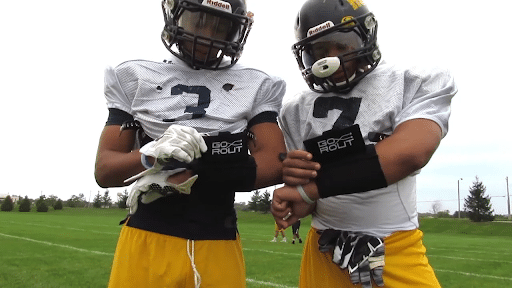
Football Terminology FAQs
What are the words used in football?
The words used in gridiron football are terms with specific definitions and use cases based on a variety of components.
The components football terminology is based around include:
- Strategic game concepts
- Official playing rules and penalties for violations
- Equipment and technology
- Slang, nicknames, and casual lingo
What are some calls in football?
Calls refer to one of two components in American football:
- Play calls: Coaches calling designed and coordinated movements (plays) on offense, defense, and special teams.
- Foul calls and penalty prescriptions: Officials calling clearly defined fouls, and prescribing pre-determined penalties for each specific rules violation.
Some examples of play calls in football include:
- Run-Pass Option (RPO): An offensive play call that gives the quarterback an option to either hand off for a running play or keep the ball and complete a quick pass, depending on the pre-snap alignment or post-snap decision of a specific defender.
- Zero Blitz: An aggressive defensive play call that sends any defender not covering an eligible receiver to rush the quarterback with no deep safeties in zone coverage, forcing man coverage for anyone not assigned to blitz.
- Onside kick: A risky special teams play where the kicking team attempts to recover a strategic kickoff attempt after it’s traveled the required distance.
What are some common phrases used in football?
Some of the most common phrases used in football include:
- Pass: Throwing the ball on offense.
- Catch: Receiver catching a pass thrown by the quarterback, or defensive player intercepting a pass.
- Tackle: Stopping the forward progress of a player in possession of the ball, often wrapping up and/or bringing them to the ground.
- Block: Restricting an opposing player from impeding into an area where the team with possession of the ball is standing or moving toward.
- Penalty: The punishment given to a player and/or team for a specific rules infraction and foul.