Softball vs. Baseball: What Are The Differences?
Reading Time: 13 minutes


Reading Time: 13 minutes
Baseball and softball are two distinct, unique sports. The end goal is similar: score more runs than the opposing team by the end of the game. But when breaking down specific components of each sport, the difference between softball and baseball are quite apparent.
It can be a challenge to analyze baseball vs. softball for a number of reasons. Within each sport, there are differences in how the game is played depending on age group, experience level, specific leagues or governing bodies, locations, and other factors.
- Major League Baseball has different rules and regulations than Little League Baseball and other youth baseball leagues.
- College softball programs operate differently than recreational leagues for youth softball players.
In this resource, we’ll focus on analyzing the difference between softball and baseball at the high school level and above. This is a nuanced discussion, as attempting to definitively cover every difference between baseball and softball at any level is a near impossible task.
- For example, we could discuss how slap hitting only occurs in softball, but that is one of many marginal differences between the two sports.
To make it more manageable, we’ve broken down the key differences between softball and baseball into four overarching categories:
- Field dimensions
- Rules and structure
- Pitching styles
- Equipment
Let’s dive in.

Field Dimensions
A huge difference between baseball and softball are the dimensions of the field. Field dimensions vary in each sport by age group, experience level, and other factors.
For the sake of this resource, we’re going to look at the highest level of play: a standard professional/college/high school baseball field and a standard professional/college/high school fast pitch softball field.
| Field Dimension | Baseball | Softball |
| Basepaths | 90 feet between bases | 60 feet between bases |
| Outfield fence | Between 300 and 400+ feet | Between 190 and 235+ feet |
| Pitcher’s mound | 60 feet, 6 inches from home plate; elevated mound | 43 feet from home plate; flat pitching surface |
| Field design | Infield can consist of grass and dirt, or all dirt | Infield is typically all dirt |
The key differences in field dimensions and makeup between softball and baseball are:
- Basepaths
- Outfield fence
- Pitcher’s mound
- Field design
Basepaths
Softball and baseball both have the same basepath structure:
- Home plate to first base
- First base to second base
- Second base to third base
- Third base to home plate
In baseball, the distance between each base is 90 feet, while in softball, it is only 60 feet.
Outfield Fence
In both baseball and softball, the outfield fence varies in distance from home plate. Every field has a unique design, with different distances at various parts of the field. Typically, right field and left field have shorter distances, while center field is furthest from home plate.
In general, the outfield fence on most baseball fields is approximately 400 feet from home plate, whereas softball averages about 220 feet.

Here is a more detailed breakdown of the distance to the outfield fence for each sport:
- Baseball: Between 300 and 400+ feet. The right and left field fences are usually between 300 and 350 feet, while center field is often 400+ feet.
- Softball: Between 195 and 235+ feet. The right and left field fences are usually between 195 and 220 feet, while center field is often 220-235+ feet.
Pitcher’s Mound
The pitcher’s mound is one of the biggest differences between baseball and softball field dimensions. Baseball fields typically have a pitcher’s mound that is 60 feet 6 inches from home plate, while softball fields have a flat pitching circle that is only 43 feet away.
Let’s take a closer look at the specifics of each sport’s pitching surface.
BASEBALL PITCHING MOUND DIMENSIONS
| Dimension | Metric |
| Pitching distance from home plate | 60 feet, 6 inches |
| Height | 10 inches raised pitching mound |
| Diameter | 18 inches |
| Other notes | The front slope of the mound drops 1 inch for every 1 foot towards home plate, starting 6 inches away from the rubber. |
SOFTBALL PITCHING MOUND DIMENSIONS
| Dimension | Metric |
| Pitching distance from home plate | 43 feet |
| Height | Flat |
| Diameter | 16 inches |
| Other notes | The Pitcher’s Lane is a chalked lane within the pitching circle that’s 3 feet, 4 inches wide and 8 feet long. Pitchers must stay within the lane while delivering the pitch to home plate. |
Rules and Structure
The core structure of a baseball game and a softball game are similar. Both sports involve a pitcher throwing the ball to a batter, who tries to hit the ball and get on base. The offensive team aims to score runs, while the defensive team tries to prevent runs from being scored. Whichever team scores the most runs at the end of the game wins.

There are a few key differences between the rules and structure of softball vs. baseball games, including:
- Game length
- Mercy “run” rules
- Lineup construction
- Substitution rules
- Illegal pitches
- Stealing
| Rule | Baseball | Softball |
| Game length | 9 innings | 7 innings |
| Mercy “run” rules | 7 innings (when one team leads by 10 or more runs) | 5 innings (when one team leads by 8 or more runs); 3 innings (when one team leads by 15 or more runs) |
| Lineup construction | Allows for a designated hitter [DH] who only plays offense, batting in place of a player who only plays defense (often the pitcher) | Utilizes a designated player [DP] who bats in place of a player who only plays defense, called a flex [FLEX]. The DP can enter the game on defense, take the place for any of the other players on the field except the FLEX. |
| Substitution rules | Once a player is substituted for, they are done playing for the rest of the game and cannot re-enter | A starter may re-enter the game after being replaced by a substitute, as long as the starter remains in the same place in the batting order. The same goes for starting pitchers, who can re-enter the game after being subbed for. |
| Illegal pitches | The play is called dead and deemed a balk, with all runners advancing one base and the pitch attempt counted as a ball | The play remains live, allowing the batter to reach base successfully. If the batter doesn’t reach base successfully, the play is negated, the pitch attempt is a ball, and all runners advance one base |
| Stealing | Players can take a lead off of the base while the ball is in the pitcher’s hand | Players must keep one foot on the base while the ball is in the pitcher’s hand |
Length of game
Both softball and baseball games are made up of innings. Each inning is broken down into two halves, allowing each team an opportunity for offense and defense. There is no timer on an inning, and each half inning ends when the defensive team gets three outs.
The difference between softball is how many innings designates a complete game:
- Regulation baseball games are played for nine innings, while
- Regulation softball games are played for seven innings
Mercy “Run” Rules
Depending on the level of play, both softball and baseball games can end earlier than a “complete” game. If one team leads by a certain number of runs by a specific inning, the game is called early. This is typically called a mercy rule or run rule, depending on the league and level of play.
The specifics of mercy rules vary by league, governing body, location, and other factors. Softball games can end early if one team has a significant lead, such as a 15-run lead after three innings or a seven-run lead after five innings. Baseball games typically end after a team goes up 10 or more runs after a certain number of innings.
Taking a look at the NCAA rules:
- Baseball games end after seven innings if a team leads by 10 or more runs
- Softball games end after five innings if a team leads by 8 or more runs, and after three innings if a team leads by 15 or more runs
Lineup Construction
Baseball and softball teams can both designate one player as offense only, taking the spot in the batting order for a player who only plays defense. The specific designation and rules differ by sport.

Baseball allows for a designated hitter (DH) who only plays offense, batting in place of a player who only plays defense.
- The DH often hits for the pitcher, though they can bat for anyone playing the field. In baseball, the DH cannot enter the game to play the field unless substituting out of the offensive-only designation to replace a player in the field.
Softball utilizes a designated player (DP) who bats in place of a player that only plays defense, referred to as a flex [FLEX]. The DP can enter the game on defense, taking the place for any player on the field except the FLEX.
- For example, if the center fielder is designated as the FLEX, then the DP bats and the center fielder does not. The DP can enter the game as a defensive sub for any player, except the center fielder, while retaining designated player status.
Substitution Rules
Substitutions are a crucial part of both baseball and softball games. It’s an integral part of a team’s strategy, and allows coaches to give players opportunities to make an impact on the game.
The substitution rules differ between baseball and softball:
- Baseball substitutions. Once a player is substituted for, they are done playing for the rest of the game and cannot re-enter.
- Softball substitutions. A starter may re-enter the game after being replaced by a substitute, as long as the starter remains in the same place in the batting order. Starting pitchers can also return to a game after being subbed out.
Illegal Pitches
An illegal pitch occurs when a pitcher throws a pitch without following the specific rules set in place by the sport’s governing body.

There is a difference in what an illegal pitch in baseball vs. softball means:
- Baseball illegal pitch. The umpire issues a balk, and the play is called dead. All runners advance one base and the pitch attempt is counted as a ball.
- Softball illegal pitch. The play remains live, allowing the batter to reach base successfully. If the batter doesn’t reach base successfully, the play is negated, the pitch attempt is counted as a ball, and all runners advance one base.
Stealing
Runners on base can steal on any given pitch in either sport. The specific rules regarding stealing in baseball vs. softball dictate what players can do before the pitch.
Specifically:
- Baseball stealing. Players can take a lead off of the base while the ball is in the pitcher’s hand, cutting the 90 foot distance short by whatever length lead the player decides to take.
- Softball stealing. Players must keep one foot on the base while the ball is in the pitcher’s hand.
Pitching Styles
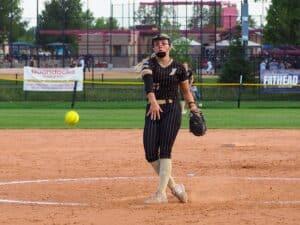
One of the most significant differences between baseball and softball is the pitching styles. Baseball pitchers throw overhand, while softball pitchers use an underhand motion, which creates different mechanics and outcomes for each game.
Baseball’s Overhand Pitching Motion
In baseball, the overhand pitching style allows pitchers to throw with more velocity and power. With the raised mound, baseball’s overhand motion generates higher pitch speeds than softball. Using various baseball pitch grips, pitchers manipulate the velocity and movement to keep batters on their toes. This enables pitchers to throw a range of off speed pitches.

Softball’s Underhand Pitching Motion
The underhand motion in softball is generally considered to be more natural for the shoulder and puts less strain on the arm compared to the overhand throw used in baseball. Despite throwing the ball underhand, there are numerous softball pitch types that pitchers can leverage to keep opposing offensive players guessing.
- The rise ball is an example of a pitch unique to fastpitch softball, as baseball players can’t replicate it with their overhand motion
Softball pitchers can throw multiple games in a day due to the less stressful underhand motion, while baseball pitchers typically require several days of rest between appearances due to the strain of the overhand style.

For a more thorough breakdown of the difference in pitching styles, check out our softball vs. baseball pitch blog.
Equipment
A key differentiator between baseball and softball is the equipment used. While both sports utilize gloves, balls, bats, and other protective gear, the specific design of equipment is tailored to each individual sport.
The most notable equipment differences between softball and baseball include:
- Balls
- Bats
- Gloves
- Protective gear
Balls
Softball and baseball each use a distinct, specific ball size. In general, softball uses a larger ball.
The design of a baseball vs. a softball differs in the following way:
- A regulation softball measures between 11.88 and 12.13 inches in circumference and weighs between 6.25 and 7.00 ounces, while
- A baseball measures between 9.00 and 9.25 inches in circumference and weights between 5.00 and 5.25 ounces
Bats
Baseball bats can be up to 42 inches long, while softball bats max out at 34 inches. However, the most commonly used bat length in both sports ranges between 32 and 34 inches.
Baseball bats feature wider barrels and are heavier to withstand the density of a baseball. Softball bats have narrower barrels with longer sweet spots to maximize swing speed and hit the larger, softer balls.
Gloves
Softball gloves are generally larger than baseball gloves to accommodate the size of the softball, which requires a deeper pocket for catching. This can enhance player safety by providing a better catch.
Protective Gear
Protective batting gear, such as elbow guards and shin guards, has seen a significant rise in use in both baseball and softball due to increasing pitch velocities. Softball players more commonly wear face masks when batting, though additional facial protection features have been incorporated into baseball helmets as well.

In softball, it is common for pitchers and infielders to wear face masks for protection due to the shorter distance from the mound to home plate, which increases the risk of being hit by a batted ball. This is not common in baseball, unless a player previously suffered a serious facial injury that requires extra protection.
Are There Similarities Between Softball and Baseball?
Despite the differences pointed out in this resource, the core concept and purpose behind baseball and softball are quite similar. They even share many of the same rules.
Here are some of the similarities shared between softball and baseball:
- The team that scores more runs than their opponent wins the game
- To score a run, players must make it from their at bat at home plate all the way around the basepaths and back through home plate
- When a player swings and misses, or watches a pitch that’s inside the strike zone, they are penalized a strike
- Each batter has three strikes before they’re out, and four balls until they earn a walk
- Bunting a foul ball with two strikes results in a strikeout
- Defensive lineups consist of a pitcher, catcher, infielders, and outfielders
- Offensive players use bats, batting gloves, and helmets, while defensive players use gloves and other protective equipment
- The scorekeeping process between baseball and softball are closely related
- Both sports can be played indoors (winter travel leagues, other indoor leagues)

GoRout Diamond Pitch Calling Technology for Baseball and Softball
Baseball and softball coaches share a crucial task in game strategy: calling pitches. Traditional hand signals take time and effort, and put teams at risk of tipping off opponents. A pitch calling watch is a secure, modern approach for softball and baseball teams.
GoRout Diamond is an innovative tool enabling coaches to call pitches and facilitate in-game strategy adjustments with the single push of a button. Diamond enables coaches to effectively communicate pitch calls to their team without miscommunications or opponents stealing signs through a real-time, encrypted pitch calling device.
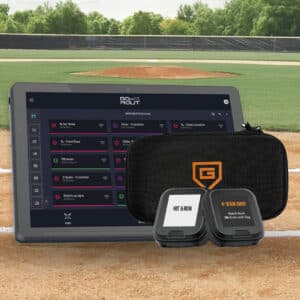
The electronic pitch calling system features:
- A tablet or mobile device for coaches to send calls from, and
- Wrist-worn devices for players to receive calls from
GoRout’s coach-to-player communication system comes with advanced analytics through GoRout Connect. In partnership with AWRE, GoRout Connect provides coaches with automated reports using pitch call data, including:
- Spray charts
- Heat maps
- Strike zone data, and
- Pitch intent vs. result breakdowns
Interested in learning more about GoRout Diamond? Get a quote today!
GoRout Coaches Toolbox: Free Resources for Baseball and Softball Coaches
Baseball and softball coaches juggle multiple roles and responsibilities throughout the season and on any given day. Practice prep, scouting opponents, setting lineups, creating game plans, and more, can start to take away time and attention from the team.
GoRout’s Coaches Toolbox is a one-stop-shop for free softball and baseball coaching resources. Available as free printable PDF files, the Coaches Toolbox offers a range of templates and tools for practice and games.
Some of the resources include:
- Baseball practice plan
- Softball practice plan
- Baseball lineup card
- Softball lineup card
- Baseball scorebook sheet
- Softball scorebook sheet
Access these assets and more, delivered to your inbox in 60 seconds free of charge!
A Summary of the Key Differences Between Baseball and Softball

Image courtesy of Luke Fancher on Unsplash
Here is a summary of the key differences between baseball and softball:
| Category | Baseball | Softball |
| Field Dimensions |
|
|
| Rules & Structure |
|
|
| Pitching Area |
|
|
| Pitching Styles |
|
|
| Equipment |
|
|

Baseball vs. Softball FAQs
What’s the difference between a softball and a baseball?
The biggest difference between a softball and a baseball is the size and weight. Softball uses a bigger ball than baseball.
- Baseball. A baseball has a circumference between 9.00 and 9.25 inches and weighs between 5.00 and 5.25 ounces.
- Softball. A softball has a circumference between 11.88 and 12.13 inches and weighs between 6.25 and 7.00 ounces.
Is softball harder than baseball to play?
Softball and baseball each have unique factors that make them equally challenging to play. Because it’s played on a smaller field, softball requires quicker reflexes and decision making. At the plate, players must have a compact swing due to limited reaction time.
Baseball has a larger field, requiring more power and covering greater distances. A baseball swing is still compact, though the longer distance of the pitching mound provides batters additional reaction time.
Softball pitchers throw underhand, which can be a more difficult motion to master than baseball’s overhand pitching mechanics.
Why do girls use softballs instead of baseballs?
It’s not entirely accurate to say girls play softball and boys play baseball. It all depends on the age group, skill level, and other factors.
Some girls play baseball before transitioning over to softball. Certain slow pitch softball leagues have a combination of both boys and girls.
Share This Article
Related Articles



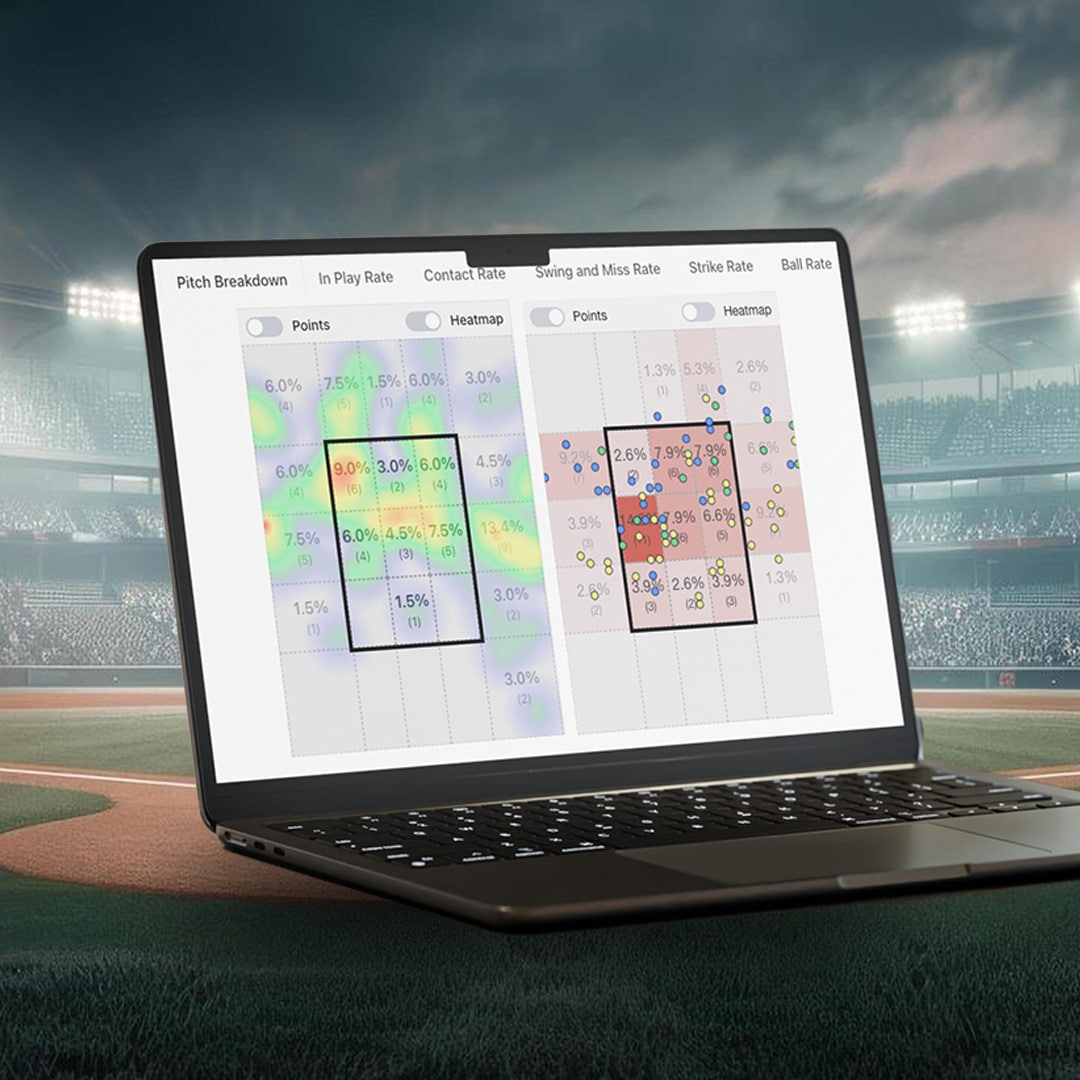
Big-League Analytics in your dugout for free
With GoRout Connect, GoRout Diamond customers receive access to AWRE Sports suite of analytics tools for free!