Football Wide Receiver Drills: The Complete Coaching Guide
Reading Time: 14 minutes


Reading Time: 14 minutes
Wide receiver drills provide players with the knowledge, physical instruction, and reps to serve their role successfully. Drills train the body to react correctly under pressure at game speed against real defensive backs.
Most poor reps for wide receivers aren’t a result of bad hands or lack of skill. A multitude of reasons contribute to sloppy and ineffective wide receiver play, including:
- Poor fundamentals
- Lack of physical reps and game-speed practice sessions
- Confusion at the line before the quarterback’s throw leaves their hands
- Poor understanding of the football route tree
This guide covers a wide range of drills for wide receivers, including:
- Fundamentals
- Route running
- Catching
- Speed and separation work
- Injury prevention
After reviewing the guide, you’ll understand the complete spectrum of football wide receiver drills and how to build the into your practice sessions. Continue reading to learn how to develop a full training program for wide receivers.
What Skills Should Wide Receiver Drills Target?

Photo courtesy of Quino Al on Unsplash
Wide receiver is a versatile position that requires a comprehensive skillset. It’s much more than simply catching the ball.
The four cornerstone skills of the wide receiver position include:
- Route running
- Hands
- Separation, and
- Football IQ
There are several types of wide receiver drills to build these four core skills. Some isolate specific skills to create muscle memory, while others connect multiple skills in a full-speed setting that transfers to game day.
Route Running
A football route is the path or pattern a receiver takes to get open on a passing play. The various routes consist of specific angles and directions assigned to a player. Routes are the primary responsibility of wide receivers on passing plays, though tight ends and running backs also run them.
Wide Receiver Routes
Basic routes that every wide receiver should know include:
- Slant: The slant route involves a 45-degree cut inside after a few yards
- Comeback: A comeback route requires a receiver to turn back one yard after running
- Corner: A corner route requires a 45-degree cut toward the outside after sprinting downfield
- Post: The post route involves a 45-degree cut towards the fields center after sprinting downfield
- Fade: The fade route starts with a quick step inward before running outside
- Fly (or Go): The fly or go route is a straight run for heavy (or chunk) yardage without stopping
Route running teaches a player to sell a stem and break at the right depth.
Hands
Hand-eye coordination is essential for an effective wide receiver. Without soft hands and strong tracking ability, coaches can’t rely on a player to consistently catch passes.
- Tracking is how a player locates the ball
- Soft hands enables a player to secure the pass
Hand work builds the catch radius and hand placement a good receiver needs in traffic.
Separation
Separation is the distance and space a wide receiver creates between themselves and their defender. Footwork, hand fighting, head movement, quickness, speed, and agility all play a role in creating separation.
Training for separation builds the quickness and body control for a clean release and to beat a defender at the top of the route. It helps create more space for receivers to attack the open field.
Football IQ
Football IQ refers to a player’s intelligence of strategy, tactics, decision-making, and technique. For wide receivers, it’s a sound understanding and knowledge of the position.
Football IQ ties everything together:
- Knowing the coverage
- Understanding the play
- Comprehending their responsibility on any given play
- Anticipating what might happen, and
- Knowing where help is coming from (or how the other wide receiver routes in a given play design work together)
Why Is It Crucial to Tie The Four Skills of a Wide Receiver Together?
If you only focus on one pillar, you won’t develop a complete receiver. While it can be beneficial to run drills that isolate a specific skill or pillar, you can’t rely on that alone.
Receivers who master all four move faster into advanced route work and make a bigger impact in your team’s offensive success.
Why is Assignment Clarity Essential to WR Drill Programs?
A receiver who doesn’t know their assignment at the line of scrimmage can’t run a route correctly. It doesn’t matter how skilled their footwork, speed, quickness or agility.
Assignment clarity is the key difference between an impactful rep and a wasted one.
Watch for these signs that a receiver is unsure of their assignment:
- Checking the sideline or a teammate before the snap
- Splits shifting from rep to rep with no coaching adjustment
- Running the wrong depth on a route they’ve drilled dozens of times
- Hesitating instead of exploding off the ball
- Inability to explain their assignment when asked between reps
Wide Receiver Fundamentals: Stance, Release, and Footwork Drills
A wide receiver’s stance, release, and footwork are the building blocks underneath every route they run. It sets them up for a successful rep and helps create separation between them and the defender.
Wide Receiver Stance and Alignment Fundamentals
A proper stance and alignment puts wide receivers in a position to attack the defense, have a clean release, and run more consistent routes.
Proper wide receiver stance looks like:
- A relaxed, athletic position with knees slightly bent
- Even weight distribution and a slight forward lean (about 60-70% forward)
- Feet shoulder width apart, with the front foot roughly 18-24 inches in front of the back
- Front toe pointing straight ahead
- Back heel slightly lifted
- Hands low and relaxed, hanging somewhere between the waist and knees
- Eyes and head looking inside to the football
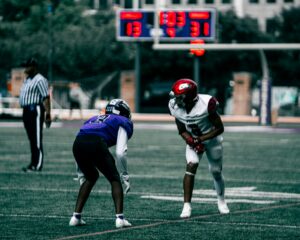
Photo courtesy of Will Colavito on Unsplash
Pre-snap alignment and splits shift based on the play call and the defender’s leverage.
Release Technique Drills: Beating Press Coverage and Off Coverage
A receivers release is the initial motion or burst in how they get off the line of scrimmage. An inside release beats outside leverage, and an outside release beats inside leverage. Both depend on a quick step and a strong first move off the line.
Swim and Swat & Rip Move Drills
The swim move and the rip move are the go-to hand techniques for beating press coverage. To drill each move, start with a slow-paced, step-by-step instruction and walkthrough of each. Each should be drilled first against a bag before a live defender.
Swim Move Drill
| Step | Move/Coaching Point |
| 1 | Get in a proper stance |
| 2 | Take a powerful outside step |
| 3 | Punch the defender’s inside shoulder (pad level) with the receiver’s inside arm |
| 4 | Come up over the shoulder with the outside arm |
| 5 | Get up the field |
Swat & Rip Move Drill
| Step | Move/Coaching Point |
| 1 | Get in a proper stance |
| 2 | Take a powerful outside step |
| 3 | Swat the defender’s outside shoulder (pad level) with the receiver’s outside arm |
| 4 | Rip underneath with the inside arm |
| 5 | Get up the field |
Quick-Step Ladder Drills
Quick-step ladder drills improve footwork for explosive starts, which are essential to an effective release. For each quick-step ladder drill, have players setup in their proper stance. Make sure to complete sets on both side to practice quick releases with both feet.
Ladder drills to improve quick footwork include:
- Speed release ladder drill. Standing on the outside of the ladder, practice a quick jab-step in and out of the ladder’s openings.
- Wide-step release ladder drill. Standing on the outside of the ladder, practice a wide jab-step in and out of the ladder.
- Double-move release ladder drill. Standing on the outside of the ladder, take a wide jab-step with the outside foot (further away from the ladder) then immediately take a quick jab-step with the inside foot into the ladder’s openings.
Route Running Drills for Wide Receivers
The route tree assigns a number to every route a wide receiver runs, and each one needs its own drill. Taking time to drill each route at a slow pace ensures proper footwork and technique, building muscle memory so the motions become second-nature come game time.
While you should take time to drill each route, some drills can be used for multiple routes to build basic technique. These include:
- Three-cone setup drill
- Plant-and-drive drill
- Stem drills
- Double-move drills

Photo courtesy of Martin Podsiad
Three-cone setup drill
The three-cone setup helps practice core routes for separation. It’s a simple drill that requires three cones set up in an L-shape:
- One at the line of scrimmage
- Another 5 yards straight ahead
- The third one 5 yards to the right or left
To complete the three-cone setup drill, follow these steps:
| Step | Move/Coaching Point |
| 1 | Get in a proper stance |
| 2 | Drive/explode off the line of scrimmage |
| 3 | Keep the shoulders square while sprinting until the break point |
| 4 | Make a sharp cut with the plant foot at full speed |
| 5 | Snap the head around quickly to locate the QB’s pass |
Plant-and-drive drill
The plant-and-drive drill trains a receiver to plant the outside foot, drop the hips, and drive back toward the ball on comebacks, curls, and digs. Proper hip turn and plant foot mechanics create sharp, effective cuts.
To complete the plant-and-drive drill, break it down into the three aforementioned steps:
| Step | Move/Coaching Point |
| 1 | Get in a proper stance |
| 2 | Sprint a set number of yards |
| 3 | Plant the outside foot to change direction |
| 4 | Drop the hips |
| 5 | Drive back toward the ball |
Stem drills
A stem is the part of a route run before the break. Selling it convincingly forces a defensive back to open their hips early. Stem drills at full speed teach a receiver to run every route the same way for the first several steps.
Different stem drills can be paired with specific routes. The importance is to emphasize and full commit to the stem before breaking whichever way the specific route requires.
Deep routes, like go, corner, and post routes, depend on this more than any other route type.
Double-move drills
A double-move is when the receiver takes an aggressive step one way before breaking a different way to fool the defender. One of the most popular and commonly used double-moves is a stop-and-go, where the receiver takes a step back like they’re running a short route, before bursting past the defender for a deep route . Advanced footwork is required for a receiver to run a double move.
The hitch-and-go, the post-corner, and the out-and-up all require selling the first break with total conviction, timed to the quarterback’s release point.
Catching Drills and Game-Situation Reps for Wide Receivers
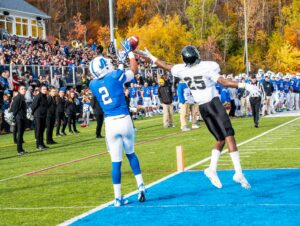
Photo courtesy of Darren Carroll
While there are multiple skills that make up an effective receiver, their core responsibility is to catch the ball. Players should practice 100-200 catches several days a week to build consistency. More reps help build more reliable hands to secure catches.
Ball security involves seeing the ball into the hands, making the catch, and retaining possession throughout the remainder of the play. Whether it’s a short pass into immediate contact or a long run downfield, it’s important to secure the ball and avoid any type of turnover.
The following sections will break down the fundamentals of hand position and ball-tracking, while highlighting some of the best drills for wide receivers to practice catching.
Hand position and ball-tracking fundamentals
Catching starts with proper hand position. Teach wide receivers the following technique for proper hand position:
- Form a diamond with the two thumbs and index fingers touching for passes above the waist
- With pinkies touching, cup the hands for passes below the waist
Ball-tracking drills like over-the-shoulder and back-shoulder catches teach a receiver to find the ball late without slowing their stride. Contested catches add a defender for a game-like simulation.
Concentration drills
Concentration drills help receivers build strength to catch contested passes, wild and wobbly throws, and perform at a high level in hostile environments.
JUGS Machine
JUGS machine work, a mechanical passing tool that fires footballs at a consistent speed, builds hand-eye repetition. Have players catch a rapid sequence of passes from the JUGS machine as a simple drill during indy periods.
If you have multiple JUGS machines, set them up in different locations. Have players stand in one spot and receive passes in rapid sequences from each JUGS machine. This helps with quick tracking, footwork, and soft hands.
Crowd Noise Simulation
Crowd-noise reps train focus in hectic environments. To simulate crowd noise, play music on the PA speakers at a high rate or pull up a stadium noise YouTube video. Run reps with the noise as a distraction to prepare for loud opposing stadiums.
Distraction Drills
Distraction drills teach players how to focus on their role while interacting with other players. Run play designs where multiple routes intersect so players can practice route running, tracking, and catching passes with other receivers moving through peripheral vision.
Red zone and end zone catching drills
Red zone and end zone drills prepare a receiver for the tight space near the goal line. Jump balls reward whoever tracks the ball at its highest point, and toe-tap drills train both feet down while the eyes stay on the ball.
Core Wide Receiver Catching Drills
Build these five game-situation reps into every session:
- Sideline catches with both feet in bounds (the single-leg stability drill can help improve body control for sideline catches)
- Back-shoulder throws against tight coverage
- Over-the-middle contested catches in traffic
- Red zone jump balls against a single defender
- Back-of-the-end-zone toe-tap catches
Speed, Separation, and Agility Drills for Wide Receivers
Speed, separation, and agility are three qualities that most great receivers posses.
- Speed forces defenders to guard against deep passing routes
- Separation gives players space to make open catches instead of fighting against defenders on contested balls
- Agility keeps the defender on their toes because the receiver can change direction on a dime.

Photo courtesy of Nicholas Wilson on Unsplash
Straight-line speed drills for wide receivers
Straight-line speed gets a receiver open on deep routes like the go, post, and corner. Drills designed to practice straight-line speed emphasize sprinting downfield.
- The 10-yard burst drill trains the first steps off the line, where most separation gets created.
- The 40-yard acceleration drill and flying 20s build top-end speed once a receiver is in stride.
Sprint mechanics matter as much as raw ability. Receivers who stand upright lose speed compared to those who keep the chest down and drive the knees.
Change-of-direction and separation drills
Separation speed, built through change of direction, helps create space and get receivers open on a variety of routes. Some drills for change-of-direction and separation include:
- The 5-10-5 shuttle
- L-drill
- Cone cuts
- Break-out drill
- Option-route drill
5-10-5 shuttle
The 5-10-5 shuttle involves short sprint bursts with quick changes of direction. It’s relatively self explanatory:
| Step | Move/Coaching Point |
| 1 | Start in an athletic position facing with a cone or line 5 yards to the right and 5 yards to the left (a 10-yard space in total) |
| 2 | Sprint 5 yards at full speed to one of the cones/lines |
| 3 | Quickly change direction when reaching the first cone/line, and sprint 10 yards at full speed to the opposite cone/line |
| 4 | Change direction immediately when reaching the second cone, and sprint 5 yards full speed through the starting point |
L-Drill
The L-drill trains direction changes and balance at competitive speed covering a total distance of 30 yards, broken into six 5-yard short sprints. This is similar to the Three-Cone Setup drill for catching, but without any passes.
Coaches set up three cones in an L-shape five yards apart from one another. Then, follow these steps to complete the L-drill:
| Step | Move/Coaching Point |
| 1 | Start in an athletic position facing at the first cone |
| 2 | Burst off of the point of the first cone and sprint 5 yards, touching the second cone with a hand |
| 3 | Return to the starting cone, sprinting 5 yards, and touch the first cone with the same hand |
| 4 | Sprint 5 yards back towards the second cone, plant off the inside foot around the second cone, and sprint 5 yards toward the third cone |
| 5 | Figure-8 around the third cone, plant off the inside foot, and sprint 5 yards back towards the second cone, rounding the corner of the second cone on your inside foot, and finish the drill with a 5-yard sprint through the first cone (starting point) |
1-on-1 drills: creating separation against live coverage
The 1-on-1 trail coverage drill puts a receiver against a defender with no help, simulating the same pressure a real snap creates. Whoever wins the first two steps has the advantage and usually wins the route, which is how a receiver learns to create separation against man coverage.
Open every practice period with this four-drill warm-up sequence:
- A 10-yard acceleration burst to activate the legs
- A 5-10-5 shuttle to prime change of direction
- Two cone cuts at different angles to simulate a route break
- One live 1-on-1 rep against a teammate to set the tempo
Pairing this with the speed drills that build burst and top-end speed rounds out a full warm-up-to-game-speed progression.
Injury Prevention Drills and Physical Development for Wide Receivers
Pulled hamstrings, ankle sprains, finger injuries, and shoulder contusions are the most common injuries for wide receivers. That’s often because the body wasn’t prepared for the specific physical demands of the position.
Here are a few drills and injury prevention best practices for wide receivers:
- Dynamic warm-ups
- Deceleration and landing mechanics
- Grip and hand strength
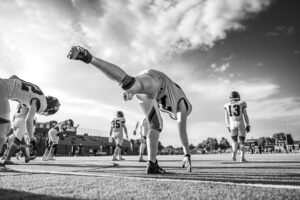
Photo courtesy of Tim Mossholder on Unsplash
Dynamic warm-up drills to prevent WR-specific injuries
Hip flexor activation, hamstring prep, and ankle mobility work should be included in a complete dynamic warm-up before every practice.
Deceleration and landing mechanics to protect hamstrings and ankles
Poor deceleration mechanics are a common cause of pulled and torn hamstrings on hard route breaks. Training a receiver to bend his knees and lower his center of gravity before a plant cut protects both the hamstring and the ankle.
Grip and hand strength development for wide receivers
Hip stability, core control, and grip strength are the physical priorities that carry over most directly to game performance.
Recovery matters as much as the work itself. Cooldown protocols and smart load management during two-a-days, and throughout the season, keep a receiver’s body ready to perform for the entire schedule.
Build this six-drill warm-up into the start of every session:
- Walking knee hugs for hip mobility (20 yards)
- Lateral lunges for hip flexor activation (20 yards)
- A-skips for ankle and calf activation (20 yards)
- Straight-leg marches for hamstring prep (20 yards)
- Carioca steps for hip rotation (20 yards)
- Build-up strides at 75 percent effort (20 yards)
Sample Wide Receiver Practice Sessions by Level
A wide receiver indy period should build from fundamentals to game speed inside a single practice window. The right length depends on the level of the athletes on the field, whether that’s youth tackle, NFL flag football, high school, or college.
Youth wide receiver drill session (45 minutes)
A youth session focuses on stance, release, and basic catching, with simple routes and high reps to build confidence.
High school wide receiver practice session (60 minutes)
High school practice adds full route running, 1-on-1 reps, and game-situation catching on top of the fundamentals.
College and advanced wide receiver session (75 minutes)
College and advanced programs add the full route tree, contested catches under pressure, and integration into 7-on-7 football (a pass-only practice format that removes linemen entirely).
High school WR practice session script
| Period | Duration | Drill Focus | Notes |
| Dynamic warm-up | 8 min | Hip flexors, hamstring activation, ankle mobility | Full group |
| Stance and release | 10 min | Press-release gauntlet, cone release drill | Indy, by position |
| Route running | 15 min | Stems, curl/dig/out breaks, double moves | Routes 1-9, assigned by GoRout Scout |
| Catching | 12 min | Back-shoulder, sideline, contested in traffic | JUGS or live quarterback throws |
| 1-on-1 vs. DB | 10 min | Competitive reps, live coverage | Track results |
| Cooldown | 5 min | Static stretch, deceleration notes | Full group |
GoRout Scout devices change what happens in the route-running period above. Receivers get their assignment on a wrist device the moment the period starts, so they can view a visual of their route before each snap.
Coaches building a full plan can download a free practice plan template and drop this WR period straight into it. Add it to a 7-on-7 football session for extra live reps. Download multiple free resources at GoRout’s football coaches toolbox.
Conclusion About Football Wide Receiver Drills
Wide receiver development requires thorough instruction, clean reps, clear assignments, and varying speeds. Within each drill, progress from a slow-motion walkthrough instruction to teach proper technique all the way through game speed against various defensive formations.
Every drill in this guide builds toward a standard that develops efficient, talented wide receivers.
FAQs About Football Wide Receiver Drills
How do you train like a wide receiver?
Training like a receiver means combining four pillars: speed work, route running, catching reps, and agility training. Build a weekly plan around straight-line sprints, cone-based direction-change drills, and daily hand-position catching work, then add contested reps as the season nears.
What are 7-on-7 drills?
7-on-7 is a pass-only practice format that removes offensive and defensive linemen entirely. It gives receivers, quarterbacks, and defensive backs live-coverage reps at game speed without contact at the line, and it works at every level, from youth leagues through college.
Do wide receivers do hitting drills?
Yes. Receivers are expected to block on run plays and screens, and drills should cover the crack block, the stalk block, and downfield blocking technique. A receiver who can’t block loses playing time, regardless of how well he runs routes.
Receivers also practice playing through contact to build strength for yards after catch (YAC).
How do you practice WR by yourself?
Solo work should include wall-ball for hand-eye coordination, cone-route running for footwork, tennis-ball drops for focus, and sprint-and-catch reps using a rebounder or a JUGS machine. None of these require a coach or a teammate to run.
Share This Article
Related Articles



Free Playbook Template
Our downloadable template offers a sleek, detailed design with space for positional roles, play descriptions, and any play notes that you want to include.