8 Football Conditioning Drills to Build Strength and Stamina
Reading Time: 21 minutes


Reading Time: 21 minutes
American football is a game of agility, endurance, speed, and strength. To excel on the field, players require peak physical and mental conditioning. As a coach preparing your team for the season, you know an effective football conditioning plan is essential for winning games.
Football requires aggressive and repetitive conditioning workouts for players to hone their skill development and perform their best on the field. A modern, holistic approach to conditioning aims to
In this resource, we’ll explore and learn about:
- The significance and importance of football conditioning
- How football conditioning transformed as the game progressed
- Key components of football conditioning
- The role of football conditioning drills
- Implementing a conditioning program into your football team’s regiment
- Warm-ups and other conditioning preparation
- Eight football-specific conditioning drills for athletic strength and stamina
- Position-specific conditioning drills
- Post-conditioning recovery and nutrition
- Monitoring player progress
From agility drills to endurance-building exercises, these football conditioning techniques will help your players push their limits and dominate the game.
What Is Football Conditioning?
Football conditioning is the practice of building and maintaining physical and mental strength and endurance, through both standardized and sport-specific exercises and training methods, in the game of American football.
In football, conditioning focuses on a combination of strength, endurance, speed, and agility. The physical challenge doubles as a method of developing mental toughness, discipline, focus, and attention-to-detail.
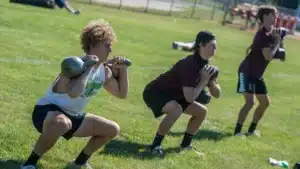
Image courtesy of Unsplash
Conditioning is both a team activity and an individual practice in gridiron football. Coaches at every level, from the earliest youth leagues through teams in the National Football League (NFL), prepare blocks in practices for position-specific and team conditioning drills. At many higher levels, including most college and professional programs, coaches also create individual conditioning programs for players to complete in the offseason on their own schedule.
Anyone can work on hyper-individualized conditioning outside of team assigned exercises. GoRout’s football offseason workout plan is a pre-designed six-week regiment any player can download for free and follow exactly, or tailor to specific needs.
Regardless of whether it’s assigned by a coach or independent, individual conditioning outside of practice and during the offseason is as important as in-season training.
History of Football Conditioning: The Transformation to a Modern Approach
Since American football was invented, conditioning has served a major role in preparing players and teams for the grueling physical nature of the game.
The Traditional Approach
Traditionally, conditioning in football focused on anaerobic exercises and continuous body movements. As with conditioning for many other sports, programs took place both in the weight room and outside or in the gymnasium/indoor facility.
The building blocks of football conditioning continue to play a role in modern programs and drills. Traditional football conditioning programs have typically involved:
- Strength training and resistance exercises, like lifting free weights, band work, or bodyweight exercises, to build muscle mass and maximal strength for combatting and overpowering opposing players.
- High-intensity anaerobic exercises that mirror the sporadic bursts of activity during a game and allow players to perform high-intensity efforts while recovering quickly.
- Game-like situations that address specific physical requirements for football, like explosive power and agility. This helps players evolve the tools to execute quick direction changes and maintain speed over short distances, both essential to the dynamic nature of football.
Essentially, traditional conditioning approaches in football have helped build a base fitness level for all players.
The Modern Transformation
All of the abilities and exercises discussed in the previous section remain significant and important in modern conditioning. The twist, or transformation, comes in the form of individualized training and advanced (and continually evolving) technology.
As American football has grown and evolved, the game has become more favorable to quick, agile. While brute strength is still important, the game moves faster and players that can accelerate and change direction on a second’s notice reap the most benefits.
With this change, conditioning has also transformed to better emphasize agility, speed, and functional football strength. It involves tailoring training regimens to replicate the movements and skills required during games.
Technology has also become integral in football conditioning. Conditioning coaches and staff use GPS tracking, wearable devices, communication systems, and video analysis tools for hyper-individualized tracking.
Monitoring performance, tracking workloads, and optimizing training, coaches use technology to provide insights into player metrics, enabling them to tailor training plans and identify specific areas for improvement.
In conclusion, modern conditioning programs maximize efficiency and minimize injury risk while boosting each player’s performance on the field.
Why Is Football Conditioning Important?
- Improved performance
- Injury prevention
- Durability
- Mental toughness
- Late-game performance
- Team building and camaraderie

Image courtesy of GoRout
1. Improved performance
At its very core, football conditioning is about training the cardiovascular and muscular systems to have improved performance, strength, and durability.
Modern conditioning programs improve football performance by employing football-specific exercises, speed and agility training, strength and power development, and recovery protocols.
Players improve their speed, agility, strength, and endurance each session, leading to better tackling and blocking, more powerful running, and quicker decision-making during games.
2. Injury prevention
Football conditioning now emphasizes targeted exercises, improving flexibility, strengthening muscles, and reducing the risk of injuries.
Coaches extensively use injury prevention strategies to help players maintain physical health and compete throughout the season.
3. Durability
Conditioning builds strength and durability. Stronger players can withstand the physicality that comes with the game and get back up, time and time again. A well-rounded conditioning program focuses on building range and flexibility, helping players navigate the rapid, violent motions day in and day out.
4. Mental toughness
Yes, conditioning’s main purpose is to maintain physical fitness and strength. In the various forms of conditioning throughout the year, players are put through grueling physical challenges. Their bodies are put to the test, and with the physical struggle comes the mental battle.
The best coaches find ways to motivate players, helping them bottle up their physical pain into mental strength. There’s a difference between pain from a challenging workout and injury, so always be sure to have players speak up if something doesn’t feel right from a health perspective.
5. Late-game performance
When it comes down to the final moments of a hard fought game, it’s often the team that’s better conditioned who comes out on top. Physically fit teams have the energy to keep going in the last quarter of play.
The mental toughness we previously discussed comes into play in these situations. Those trials and tribulations in conditioning pay off when it comes to attention-to-detail in crucial situations.
6. Team building and camaraderie
Team-based conditioning drills foster camaraderie, teamwork and competition while improving physical fitness.
Some common team drills used after practice or during warmups are:
- Relay races
- Partner drills
- Team circuit training
What Are The Elements of Football Conditioning?
If this resource hasn’t made it clear thus far, football conditioning is crucial to a team’s success.
We touched on it a bit in the previous sections, but football conditioning breaks down into three core elements:
- Strength and power training
- Speed and agility training
- Endurance and cardiovascular conditioning

Image courtesy of GoRout
Strength and power training
Strength training in football conditioning consists of resistance exercises that work to increase muscle strength and mass. Athletes use this to push their opponents with force, hold their ground, and perform explosive movements when blocking and tackling.
Power training, on the other hand, focuses on developing fast-twitch muscle fibers through explosive movements. It enhances an athlete’s speed, agility, and acceleration.
Together, strength and power training build the physical traits necessary to win one-on-one matchups on the gridiron.
Specific strength training exercises and drills for football conditioning
Athletes perform specific exercises to strengthen muscles and improve conditioning for football during practice drills.
Specific exercises and power drills for football strength and conditioning include:
- Box squats
- Deadlifts
- Bench and overhead presses
- Lunges
- Rows
- Plyometric jumps
- Medicine ball throws
- Kettlebell swings
- Sled pushes
- Tire flips
Periodization techniques in strength training for football conditioning
Periodization is a training system that divides training into specific blocks of time to optimize performance and minimize injury risk.
Preparation phase
The preparation phase emphasizes skill development, technical ability, endurance, and mobility. It is the first phase, establishing a solid training foundation and increasing overall volume before the competitive football season begins.
This phase is important because it’s about understanding the motions in each exercise and locking down proper form.
Intensification phase
The off-season training phase, referred to as intensification, aims to reduce volume and intensify conditioning workouts. The workouts are tailored to refine skills and preserve the central nervous system before training camp to complement on-field practice.
Because it takes place during the off-season, players use this time to build the physical strength required and mentally prepare for a full season.
Pre-competition phase
This phase is a training camp that simulates the structure of a competition. It involves in-season strength training routines that focus directly on the sport.
While it entails a lot of football-specific training, the pre-competition phase is also about honing in general conditioning and physical fitness for the season.
Competition phase
During the regular-season football schedule, athletes focus on optimizing game performance and prioritizing recovery.
During this period of the season, players are in the weight room three days per week, mostly focusing on recovery and game preparation.
Speed and agility training
Speed and agility training helps players develop the skills to change direction rapidly, accelerate, and maintain top speed during gameplay.

Photo courtesy of Nicholas Wilson on Unsplash
There are three main segments of speed and agility training for football conditioning:
- Agility ladders
- Cone work
- Sprinting techniques
Agility ladders
Agility ladders incorporate lateral shuffles, high knees and quick feet work into conditioning.
They improve footwork, agility and coordination. Agility conditioning segments can be tailored to position-specific needs or general team sessions.
Cone work
Cone work involves using plastic cones in different patterns and distances to help football players improve their speed and footwork during games with minimal equipment.
Every player on the gridiron benefits from cone work.
Sprinting techniques
Sprinting techniques are specific conditioning exercises that test and train players to run at top speeds.
It’s important to develop explosiveness and acceleration through sprinting drills for a football team to make quick breaks, outrun defenders in open space, chase down opponents, and execute fast plays.
Endurance and cardiovascular conditioning
Endurance and cardiovascular conditioning enable players to perform well throughout a football game without fatigue.
When it’s late in the fourth quarter and you need one big play to change the game, endurance and cardiovascular conditioning prepares your team to stand tall. While the opposing team is hunched over and sucking in air, your well-conditioned and cardiovascularly strong unit can march down the field and win the game.
Cardiovascular drills for football players
Cardiovascular exercises, such as interval runs, shuttle sprints, and jogging pace, are great for improving cardiovascular health and stamina.
These exercises simulate the stop-and-go nature of American football, whether you’re a wide receiver running routes or a defensive linemen tackling a ball carrier at the line of scrimmage.
Balancing intensity and recovery
Balancing high-intensity work with adequate rest and recovery prevents overtraining and injuries, requiring careful management by a conditioning coach.
The Role of Football Conditioning Drills
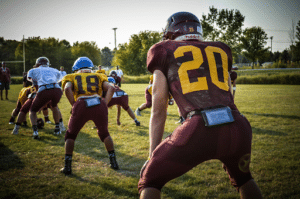
Imagery courtesy of GoRout
Football drills improve players’ cardiovascular endurance, strength, agility, and speed, allowing them to sustain high levels of play throughout a game. Over the course of any given practice, the on-field drill work and team period keeps players moving and active.
But specific conditioning drills transcend specific skillsets and talent, allowing any given individual to gain an advantage over their counterpart:
- Physical strength
- Energy
- Endurance, and
- Mental toughness
Well-conditioned players maintain peak performance, execute plays more effectively and recover quickly between intense bursts of activity, and have gas left in the tank during the final seconds of a grueling physical battle.
Conditioning drills strengthen muscles, improve joint stability and enhance flexibility, reducing the risk of common injuries like sprains, strains and tears. Squats and deadlifts build the lower body’s resilience, while plyometric exercises boost power and reduce the likelihood of muscle injuries.
Key Components of Football Conditioning Drills
Knowing how to coach football requires maintaining your athletes’ focus, physical condition, mental stability, and work ethic.
A great conditioning program consists of drills from four key components to condition football players and keep them performing well throughout the year:
- Strength for power and protection
- Stamina for sustained performance and endurance
- Agility for quick movements and direction changes
- Speed for outrunning opponents
You’ll notice a bit of an overlap between these components and the elements of football conditioning. What we’re focusing on here are the specific drills vs. the higher-level mentality of a conditioning program.
Strength for power and protection
Strength training brings the power needed for explosive movements and protection against injuries. Whether it’s the burst off the line of scrimmage as a wide receiver running a route or wrapping up and finishing a tackle as a middle linebacker, strength is required in nearly every football play.
Exercises like squats, deadlifts, lateral pulldowns and bench presses build muscle mass and strengthen an athlete’s base. These exercises increase core stability and muscle balance, crucial for high-impact plays.
Stamina for sustained performance
Endurance conditioning and stamina training drills improve cardiovascular endurance and help players recover quickly between plays.
These drills include long-distance, interval, and tempo runs, among others. Consistent stamina training helps players sustain energy and maintain focus on the field.
Agility for quick movements and direction changes
Agility drills train athletes to change directions quickly and efficiently. Ladder drills, cone drills, and shuttle runs all work on footwork, body control, coordination and reaction time.
These football conditioning drills simulate game situations where quick changes in direction are necessary to avoid opponents or to cover defensive assignments.
Speed for outrunning opponents
Speed conditioning builds acceleration and quickness, so football players can sprint rapidly over short distances. Sprint drills like resistance sprints and hill sprints increase top-end speed.
Quickness allows players on offense and defense to outpace opponents. Whether it’s outrunning a DB on a long handoff or chasing down the running back as a safety in pursuit, speed pays dividends in football.
Warm Up Drills: Preparing for a Football Conditioning Session
A proper warm-up prepares the body for intense physical activity during football conditioning. They get the blood flowing and raise the heart rate.
- Begin with 5-10 minutes of light aerobic exercise to increase blood flow and muscle temperature.
- Follow with sport-specific drills like high knees, butt kicks, and dynamic leg swings to improve the range of motion and activate the muscles, including:
- High knees
- Butt kicks
- Dynamic leg swings
- Jumping jacks
- Karaoke
Ensure all players use appropriate gear and perform exercises with the correct technique to avoid injury.
Always include and complete a proper cool-down with static stretching to aid recovery and prevent muscle stiffness.
Track key performance metrics, like speed, endurance, strength and agility, through regular testing and assessments. Use this data to set specific, achievable goals for improvement. Review and adjust these goals regularly based on individual player performance and feedback.
8 Football Conditioning Drills to Dominate the Field
Here are 8 football conditioning drills to consider introducing to your team or individual regimen:
- High-intensity interval training (HIIT) sprints
- Plyometric exercises
- Agility ladder drills
- Hill sprints
- Resistance training with sled pushes/pulls
- Circuit training for football
- Position-specific stamina drills
- Endurance runs with a twist
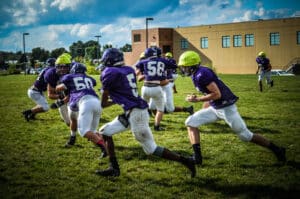
Image courtesy of GoRout
Drill 1: High-Intensity Interval Training (HIIT) sprints
HIIT sprints boost cardiovascular fitness and build muscular endurance. Mark out a sprinting distance of 20 to 40 yards on a flat, even surface. To manage intervals, you’ll need a stopwatch or a timer.
Begin with a dynamic warm-up. Sprint at maximum effort for the designated distance, then walk or jog back to the starting point to recover.
Typical intervals involve 30 seconds of sprinting followed by 30 seconds of rest, repeated for 10-15 minutes. Variations include increasing the sprint distance, shortening rest periods, or performing uphill sprints to intensify the workout.
Benefits
- Cardiovascular health
- Lower body strength and power
- Increased endurance
Drill 2: Plyometric exercises
Plyometric exercises are explosive movements that increase muscle power and twitchiness.
Some good plyometric conditioning drill exercises include:
- Box jumps
- Burpees
- Tuck jumps
- Lateral bounds, and
- Jump squats
You can integrate these exercises into a conditioning routine 2-3 times weekly, after a warm-up, and before heavy strength training.
Benefits
- Better muscle strength, power, and agility
- Explosive speed for sprinting and jumping
- Quicker direction changes and higher jumps
Drill 3: Agility ladder drills
Agility ladders develop quick, precise movements to navigate the field more effectively, change directions rapidly and improve athleticism.
One-Two-Step-Drill
The one-two-step drill is a great drill for quickness.
- Start by facing the agility ladder with feet touching together
- Step into the first box with your lead foot
- Quickly tap your opposite foot into the same box
- Immediately tap your lead foot into the next box
- Follow with your opposite foot
- Continue this rhythm in every box until you reach the end of the ladder
Other agility ladder drills include hopscotch, grapevine and lateral shuffle.
To keep players engaged, progressively increase the pace of agility ladder drills. Incorporate forward, backward, and lateral movements, using complex footwork patterns and timed intervals.
Benefits
- Foot speed
- Coordination and balance
- Change directions quickly and efficiently
Drill 4: Hill sprints
Hill sprints involve running at top speed up a hill or other inclined surface.
Coaches should choose a hill with a moderate incline and a smooth, even surface to prevent trips and falls. Players warm up thoroughly, lean slightly forward, drive their knees up and pump their arms.
Start with a 10-minute warm-up followed by 6-10 sprints of 20-30 seconds each, with walking recovery between sprints. Gradually increase the number of sprints and finish with a cool-down.
Benefits
- Enhanced leg strength
- Improved power
- Increased cardiovascular endurance
Drill 5: Resistance training with sled pushes/pulls
Resistance training builds muscle strength, power, flexibility and endurance.
It targets key muscle groups, including the:
- Legs
- Core
- Upper body.
Here’s how to complete resistance training with sleds:
- Set up sled drills with a weighted sled on a flat, smooth surface.
- Begin with moderate weights and mark a distance of 20-30 yards for players to push or pull the sled.
- To prevent injury, ensure the player’s back remains straight and the core is engaged.
- Start light and focus on proper pushing/pulling technique before increasing resistance.
Benefits
- Improved leg strength and power
- Enhanced acceleration and deceleration
- Core and upper body strength
Drill 6: Circuit training for football
Circuit training for football involves incorporating sport-specific movements into a single rotational circuit.
Tailor the football drill circuit to include game movements like throwing, catching, running, and tackling. Include a balanced mix of upper body, lower body, and core workouts.
A football-specific circuit could include cone drills for agility, sled pushes for explosive strength, and shuttle runs for speed and endurance.
Adjust the duration of each station. Allow longer rest periods for beginners while shortening them for advanced athletes and use lighter weights or easier variations of exercises for less fit players.
Benefits
- Improved reaction time and decision-making under fatigue
- Injury prevention
- Boosted teamwork and communication
Drill 7: Position-specific stamina drills
Customize a stamina drill based on each field position. Linemen require exercises that build strength and short-burst power, while wide receivers need drills that enhance speed, agility and endurance.
Position-specific stamina drills may include sled pushes for linemen, cone drills with sprint intervals for wide receivers, and backpedal and sprint drills for defensive backs. Later on in this resource, we’ll include a section with a full list of position-specific football conditioning drills.
A coach should create a balanced training program with general conditioning for team fitness and position-specific drills to address individuals.
Benefits
- Enhanced game-time endurance
- Functional strength and conditioning
- Athletic versatility in different positions
Drill 8: Endurance runs with a twist
Integrate sprints and cuts into endurance runs to simulate game scenarios. For example, include 10-yard sprints, lateral shuffles and a quick directional change drill during a 3-mile run to keep the team on their toes.
Plan runs with more complex football movements for peak off-season conditioning as fitness improves. These runs should be mixed, alternating between steady pace and intervals with explosive drill actions to build endurance and game stamina.
Benefits
- Enhanced endurance
- Improved agility and quickness
- Mental toughness through mimicking unpredictable game situations
Position-specific football conditioning drills
While the previous list of 8 drills covered general conditioning, football players can improve their skills and abilities by practicing position-specific drills.
These drills focus on different aspects of the game, such as passing accuracy, route running, blocking technique, tackling proficiency, and kicking skills.
It is important to customize drills based on a player’s position, whether offensive or defensive. By doing so, players can have effective workouts and become well-trained athletes.
Offense
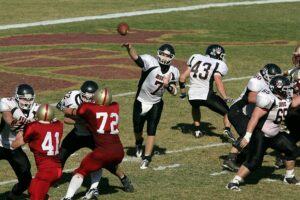
Courtesy of Keith Johnston on Unsplash
Quarterbacks
QB Conditioning Drill 1: Two-cone lateral weave
| Step | Instruction |
| 1 | Place 2 cones, approximately 2 yards apart, on a lateral line |
| 2 | Start in the middle of the two cones in an athletic QB position, holding the football at throat level with eyes looking downfield |
| 3 | Move forward with shuffle type steps |
| 4 | Go to the right side of the front cone and shuffle around the cone |
| 5 | Shuffle backwards, around the second cone |
| 6 | Complete five full trips |
QB Conditioning Drill 2: Lateral hat dance
| Step | Instruction |
| 1 | Place one 12” hurdle or cone near the lead foot |
| 2 | Start with the lead (front) foot next to the hurdle/cone in an athletic QB position, holding the football at throat level with eyes looking downfield |
| 3 | Lead with the front foot over the hurdle/cone |
| 4 | Bring the back foot over and touch the ground |
| 5 | With the back foot closest to the hurdle/cone, lead the back foot over and touch the gound |
| 6 | Bring the front foot over and touch the ground |
| 7 | Complete 5 rounds |
| 8 | On the 5th round, complete a five-step drop |
QB Conditioning Drill 3: Three hurdle drill
| Step | Instruction |
| 1 | Place three 12” hurdles or cones in a straight line |
| 2 | Begin in front of the hurdles in a good, athletic QB position with the ball high |
| 3 | Lead through with the foot closest to the hurdle |
| 4 | Bring the second foot and touch the ground |
| 5 | Both feet should be in the space between the hurdle/cones |
| 6 | Continue through all three hurdles, completing two round trips through the 3 |
Running backs and wide receivers
RB/WR Conditioning Drill 1: Linear hat dance
| Step | Instruction |
| 1 | Place 1 12” hurdle or cone on the field |
| 2 | Stand with feet close together and side-by-side, perpendicular to the hurdle/cone |
| 3 | Look down at the hurdle |
| 4 | Lead with either foot over the hurdle |
| 5 | Bring the back foot over to the ground |
| 6 | Lead with either foot back over the hurdle and follow with the other foot |
| 7 | Complete 5 rounds |
RB/WR Conditioning Drill 2: Four cone zig-zag
| Step | Instruction |
| 1 | Set up four cones in a zig-zag pattern, about 5 yards apart diagonally from one another |
| 2 | Stand in front of the first cone in an athletic position |
| 3 | Explode and sprint forward to the second cone |
| 4 | Decelerate as you reach the second cone |
| 5 | Plant firmly on your outside foot and cut |
| 6 | Push off and re-accelerate towards the third cone |
| 7 | Continue the pattern all the way through all four cones |
RB/WR Conditioning Drill 3: 90-degree cut drill
| Step | Instruction |
| 1 | Set up three cones in a triangle shape, approximately 5-8 yards apart |
| 2 | Start at the first cone in an athletic position |
| 3 | Explode and sprint toward the second cone |
| 4 | Plant with your outside foot |
| 5 | Make a sharp 90 degree cut |
| 6 | Turn and sprint towards the third cone, sprinting through the cone |
Offensive linemen
OL Conditioning Drill 1: Push-pull drill
| Step | Instruction |
| 1 | Offensive linemen pair up into partners |
| 2 | One player steps up as the offensive player and gets into a pass protection set with their hands behind their back |
| 3 | The non-participating “defensive” partner takes hold of the offensive player’s jersey with each hand positioned around the chest/shoulders |
| 4 | The “defensive” partner alternates between pushing and pulling the offensive player, in about a 3-5 yard space for 8-10 seconds |
| 5 | Partners should switch roles, and repeat until each player has completed the drill 3 times |
OL Conditioning Drill 2: Mirror drill
| Step | Instruction |
| 1 | Pair offensive linemen into partners |
| 2 | One player steps up as the offensive player in a pass protection set |
| 3 | The non-participating “defensive” partner moves quickly back and forth in a 5 yard space, attempting to shake the offensive player |
| 4 | Offensive players have to shuffle back and forth while keeping good posture to keep the defender in front of them |
| 5 | Each repetition lasts about 10 seconds |
| 6 | Partners switch roles and repeat until each player has completed the drill 3 times |
OL Conditioning Drill 3: W Drill
| Step | Instruction |
| 1 | Set up 4 cones in a 3 yard square |
| 2 | Have an offensive lineman in a pass protection set at the first cone, with the second cone to the left and the other two cones behind the player’s back |
| 3 | The offensive lineman takes a 3-inch lateral step to the left with their left foot and then slides their right foot 3 inches to the left, returning to their original pass protection set (and maintaining their posture throughout the “shuffling” movement) |
| 4 | Continue 3-inch lateral movements until reaching the second cone |
| 5 | When reaching the second cone, the offensive lineman takes a 6-8 inch step with their right foot at a 45 degree angle towards the third cone and slides their left foot 6-8 inches to return to their original positioning |
| 6 | Continue 6-8 inch diagonal movements until reaching the third cone |
| 7 | At the third cone, repeat the same 3-inch lateral movements to the left that were completed from the first cone to the second until reaching the fourth cone |
| 8 | From the fourth cone, repeat the same 6-8 inch diagonal movements to the right that were completed from the second to the third cone until completing the drill |
| 9 | End with a 10-yard sprint |
| 10 | Complete this drill 5 repetitions in each direction |
Defense
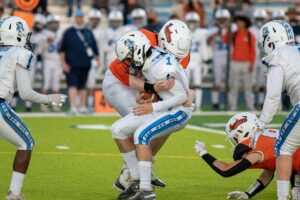
Courtesy of Luis Santoyo on Unsplash
Defensive backs
DB Conditioning Drill 1: W Drill
| Step | Instruction |
| 1 | Set up 8 cones, spaced five yards apart each, in rows of 4 |
| 2 | Start at the cone furthest to the right in an athletic position with square shoulders, and the second row of cones to the backside |
| 3 | Backpedal from the first cone to the second cone |
| 4 | When you reach the second cone, plant and sprint diagonally to the third cone |
| 5 | Upon reaching the third cone, plant and backpedal to the fourth cone |
| 6 | Continue this process until you’re backpedalling to the 8th (and final) cone |
| 7 | After reaching the final cone, sprint laterally and catch a football |
| 8 | Perform the drill twice in each direction |
DB Conditioning Drill 2: Backpedal and break
| Step | Instruction |
| 1 | Setup two cones five yards apart |
| 2 | Start in an athletic position facing one cone with the second to the read |
| 3 | Backpedal five yards to the back cone while keeping your eyes on the QB |
| 4 | Buzz your feet at the middle cone and break, in a full sprint, in one of the following directions:
|
| 5 | Finish by catching a football as you break in each direction |
| 6 | Complete each direction at least twice |
DB Conditioning Drill 3: T-speed turns
| Step | Instruction |
| 1 | Work with a partner to direct you |
| 2 | Get in an athletic position with your eyes on the quarterback (your partner) |
| 3 | Backpedal straight back |
| 4 | The quarterback is to point in one direction |
| 5 | On the quarterback’s signal, buzz your feet down and break at a 90 degree angle |
| 6 | The quarterback should immediately point in the opposite direction |
| 7 | On the quarterback’s signal, perform an exaggerated speed turn, whip your head around, and run down the same line, forming a T with your path |
| 8 | Finish with a ball drill |
| 9 | Repeat four times, twice in each direction |
Linebackers
LB Conditioning Drill 1: Flip and double-flip
| Step | Instruction |
| 1 | Place four cones five yards apart in a straight line. The distance should be: cone 1 at start, cone 2 at 5 yard mark, cone 3 at 10 yard mark, and cone 4 at 15 yard mark |
| 2 | Start at the first cone in an athletic position, with your back facing the other three cones, facing “the quarterback” or “the ball” |
| 3 | Backpedal on a straight line, while keeping your eyes on the ball |
| 4 | At the 5 yard mark (cone 2), flip your hips |
| 5 | Keep your eyes on the ball and run on a line to the 10 yard mark (cone 3) |
| 6 | At the 10 yard mark (cone 3), buzz your feet down and sprint back through the start line |
| 7 | Return to an athletic position at the start (cone 1) |
| 8 | Backpedal on a straight line to the 5 yard mark (cone 2) and flip your hips |
| 9 | Continue backpedalling on a straight line to the 10 yard mark (cone 3) and flip your hips in the opposite direction |
| 10 | Keep your eyes on the ball and run on the line to the 15 yard mark (cone 4) |
| 11 | At the 15 yard mark (cone 4), buzz your feet down and sprint through the start line |
LB Conditioning Drill 2: Crossover drop drill
| Step | Instruction |
| 1 | Setup five hurdles, each one yard apart, in a horizontal line |
| 2 | Place a cone five yards apart, vertically, from each end hurdle |
| 3 | Shuffle through the hurdles, keeping square shoulders and eyes up |
| 4 | Plant your leading foot over the last hurdle and open at a 45 degree angle |
| 5 | Crossover drop toward the cone and finish the drill by catching a football |
| 6 | Repeat at least 4 times |
Defensive linemen
DL Conditioning Drill 1: Get off sprints
| Step | Instruction |
| 1 | Start in a 3-point stance |
| 2 | Explode forward on movement for a 5-yard burst |
| 3 | Return to starting point |
| 4 | Explode forward on movement for a 10-yard burst |
| 5 | Repeat for 10-15 repetitions each |
DL Conditioning Drill 2: W bend drill
| Step | Instruction |
| 1 | Set up five cones in a W pattern |
| 2 | Start in stance at the first cone |
| 3 | Explode to cone 2, dropping hips to make the turn |
| 4 | Continue that pattern through all 5 cones |
| 5 | Complete 5-10 repetitions |
DL Conditioning Drill 3: The wheel drill
| Step | Instruction |
| 1 | Place four pads down on the ground in a pattern like spokes of a wheel |
| 2 | Get down on your hands and feet, in an athletic position, between one of the spokes |
| 3 | On command, begin rotating in one direction while hopping over all the pads on the ground |
| 4 | Complete one rotation and turn directions |
| 5 | After completing the second rotation, jump up and spring out of the wheel |
Recovery and Nutrition After Football Conditioning Drills
A proper cool-down and recovery routine reduces muscle soreness and prevents injury after intense football conditioning drills. Consuming a balanced mix of proteins and carbohydrates within 30 minutes post-training can aid muscle repair and replenish glycogen stores.
Players should drink plenty of fluids before, during and after sessions to replace lost electrolytes and prevent dehydration.
Monitoring Player Progress and Adjustments
Track conditioning improvements with sports coaching technology like fitness apps, heart rate monitors and performance-tracking software to gather data.
Increase the intensity or complexity of drills when players consistently meet their performance goals and show readiness for more advanced challenges.
During breaks, keep players motivated by setting clear, achievable goals, offering positive reinforcement and reminding them of their progress and the importance of their effort to the team’s success.
Implementing a Football Conditioning Program In-Season
In-season conditioning is a different ballgame from off-season workouts. When you have games to focus on, it’s important not to overdo it.
Here’s a sample of what to follow for in-season conditioning:
- At the beginning of the training week, focus on high-intensity conditioning drills to build strength and power.
- Midweek sessions should balance moderate-intensity conditioning with skill-focused drills for agility and position-specific training.
- Towards the end of the week, taper down to low-intensity activities like stretching to recover and prepare players for game day.
- Focus on building a solid fitness foundation with higher volumes of pre-season conditioning, maintaining fitness levels during the season and emphasizing strength and recovery work in the off-season.
- Provide safe recovery activities for injured players and position-specific exercises for each role
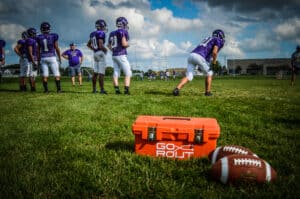
Image courtesy of GoRout
Conclusion
Strength and stamina are critical for football players to enhance performance and reduce injuries. There is more than one great drill to help players get in shape and meet a goal.
Football coaches should get creative and adapt conditioning drills to their team’s needs so each player gets what they need out of practice.
A successful conditioning program depends on regularly monitoring progress, adjusting drills as needed and emphasizing recovery and nutrition.
FAQs about Football Conditioning Drills
How to train for football conditioning?
To train for football conditioning, mix aerobic and anaerobic exercises, strength training and agility drills to build endurance and speed. Incorporate recovery practices and a balanced diet for muscle repair and sustained energy.
Check out our youth football playbook.
What is 4 quarters football conditioning?
The “Four Quarters Conditioning Drill” divides a workout into four segments. Each quarter consists of progressively longer sprints with increasing rest intervals: 10-yard sprints (10 seconds rest), 20-yard sprints (20 seconds rest), 30-yard sprints (30 seconds rest) and 40-yard sprints (40 seconds rest).
What is the terrible 20s exercise?
The “Terrible 20s” exercise combines push-ups, sit-ups and sprints. Start with 20 push-ups, then sprint 100 yards and do 20 sit-ups. After each round, you decrease the number of push-ups and sit-ups by one until you reach one rep.
How do you train to hit harder in football?
To train to hit harder in football, athletes use exercises like power cleans, rapid standing band presses and kettlebell swings to deliver powerful hits on the field.