How to Draw Football Plays: The Coach’s Complete Guide
Reading Time: 9 minutes


Reading Time: 9 minutes
Every football coach has been there: you draw up a perfect play, walk into practice, and half your team runs it wrong. The problem usually isn’t the play itself.
Knowing how to draw football plays is a foundational coaching skill, but it’s only half the battle. Getting those plays into players’ heads quickly and consistently is an entirely different challenge.
This guide covers:
- Standard symbols and notation every coach needs to know
- A step-by-step drawing process from a blank canvas to a finished play card
- How to diagram all three phases: offense, defense, and special teams
- Digital tools and how to choose the right one for your program
Why Drawing Football Plays Still Matters
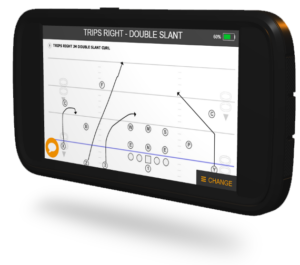
Drawing plays by hand or digitally is the foundation of every game plan, no matter what level you coach. Putting plays on paper forces clarity of thought, aligns your staff around a shared visual language, and gives your strategy a form that players can visually reference.
The gap between the drawing board and the field
The moment a play leaves a whiteboard and hits the field, things break down. Players read diagrams differently depending on their position, and a play that makes sense to the offensive coordinator can completely baffle the linemen who need it most.
Consistent notation, clear labeling, and position-specific play cards keep your entire staff on the same page. Without them, practice reps are wasted on confusion rather than execution.
Common play-drawing mistakes that cost reps
Most play-drawing problems come down to a few recurring habits:
- Overcrowded diagrams that try to show every assignment on a single card
- Inconsistent symbols across staff members: what looks like a block to one coach reads as a route to another
- No numbering system connecting a play’s name to its place in the playbook
- Coordinator-level diagrams with no player-readable version
- Missing variations: no indication of what changes when the defense adjusts
Fixing these habits before the season starts saves hundreds of reps.
Football Play Symbols and Notation
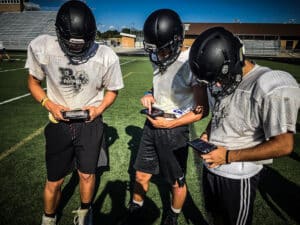
Standard play-drawing symbols let your entire coaching staff and player group read a diagram the same way, every time. Consistent notation matters especially when plays feed into a communication system like GoRout, which delivers them directly to players’ wrist devices.
Offensive symbols (routes, blocks, ball carrier)
The core offensive symbols you need:
- Solid or curved line with arrow: route or run path for receivers and running backs
- Dashed line with arrow: motion before the snap for any skill player
- Solid line with perpendicular end line: block or engage action, primarily for the offensive line and tight end positions
Defensive symbols (coverage, pursuit angles, assignments)
Standard defensive symbols to know:
- Shaded box: represents the defensive line technique
- Straight or curved line with arrow: blitz path for linebackers and defensive backs
- Arrow on a shaded box: leverage direction or pursuit angle
- Shaded zone area: coverage responsibility in zone schemes
Standard football play symbols reference
| Symbol | Meaning | Used For |
| Solid or curved line with arrow | Route or run path | Receivers, RBs |
| Dashed line with arrow | Motion before snap | Any skill player |
| Solid line with perpendicular end line | Block/engage | O-line, TEs |
| Shaded box | Defensive player | All defenders |
| Straight or curved line with arrow | Blitz path | LBs, DBs |
How to Draw Football Plays Step by Step
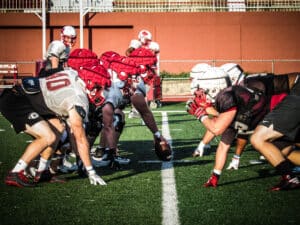
To draw football plays from a blank canvas, follow a clear sequence:
- Set the formation,
- Place personnel,
- Add movement, then
- Verify clarity before distribution.
Whether you’re working on paper or using football playbook software, the process is the same. The football playbooks guide goes deeper into organizing your full play library.
Step 1: Choose your formation and set the line of scrimmage
Start by drawing a horizontal line for the line of scrimmage. Then choose your formation and position your offensive players relative to that line. The formation determines every subsequent assignment, so lock it in before adding a single arrow.
Tip: Label each position (WR, TE, RB, QB) now to avoid ambiguity when you add routes and blocking assignments later.
Step 2: Place your offensive and defensive personnel
Add skill players above and behind the line. If you’re drawing a two-sided diagram, place your defensive personnel in their base alignment opposite the offense. Personnel placement only at this stage: no movement lines yet.
Tip: Use open circles for offensive players and shaded squares for defenders. Consistency matters more than style.
Step 3: Draw routes, run paths, and blocking assignments
This is where the play develops on the page. Draw routes from each receiver’s position, show blocking assignments for every lineman, then add the ball carrier path with a clear, distinct line.
- Solid or curved lines with arrow: run paths and definitive routes
- Dashed lines: optional routes or pre-snap motion
- Solid lines with perpendicular end line: block and fold assignments
- Double lines on a block: indicate a double-team assignment
Step 4: Add play name, number, and variations
Every play needs a name and a number. This ties the diagram to the playbook and makes play calling faster in a game. If the play has a variation based on the defense’s alignment, put it on a separate card rather than cluttering the primary diagram.
Tip: Add a short note for the quarterback at the bottom identifying the primary read before the snap.
Step 5: Review for clarity before distributing to players
Before you distribute the play, check it from a player’s perspective:
- A lineman should find their assignment without explanation
- A receiver should find their route without a verbal walkthrough
- The ball carrier’s path should be unambiguous
- No two arrows should cross in a way that creates confusion
If you have to explain the diagram before practice starts, it needs revision. Show it cold to someone unfamiliar with it. If they can’t read it in ten seconds, simplify. You can also use GoRout’s football playbook template as a shortcut.
Drawing Plays by Type: Offense, Defense, and Special Teams
Most resources on how to draw football plays focus only on offense. Effective play drawing covers all three phases, and each has unique diagramming requirements.
Offensive run and pass play diagrams
Run plays require:
- A clean ball carrier path, distinct from block assignments
- Detailed blocking schemes for every lineman, including pull assignments
- Backside contain responsibilities that coaches often leave off
Passing plays, including mesh concepts, crossing routes, and play-action designs, need a full route tree paired with a protection diagram underneath.
Explore GoRout’s football offensive schemes guide for scheme-specific breakdowns.
Defensive scheme diagrams: zone, man, and blitz
Each defensive coverage type has its own diagramming rules:
- Zone coverage: shade the area each defender owns, not just their starting position
- Man coverage: draw connecting lines between each defender and their assigned offensive player
- Blitz packages: show clear paths for each blitzer and indicate who drops into coverage
Leaving out the coverage adjustment on a blitz package is one of the most common diagramming mistakes at every level. Explore GoRout’s football defensive schemes guide for notation best practices.
Special teams: the most under-diagrammed phase of the game
Special teams elements coaches skip most often:
- Coverage lanes and spacing between gunners
- Return blocking assignments and who each blocker is targeting
- Gunner landmarks that shape release angles
- Field position context for where the play is designed to be used
A poorly drawn kick coverage card creates missed assignments that are just as costly as a broken route on offense.
Play drawing considerations by type
| Play Type | Key Elements to Diagram | Common Mistakes |
| Offensive run | Ball carrier path, blocks, pull assignments | Forgetting backside contain |
| Offensive pass | Route tree, protection, hot read | Cluttering routes for all 5 receivers |
| Defensive coverage | Coverage shell, gap assignments | Not showing leverage and alignment |
| Blitz package | Blitzer path, coverage adjustment | No indication of who drops in coverage |
| Special teams | Coverage lanes, return blocking | Omitting gunner landmarks |
Digital Tools vs. Paper for Drawing Football Plays
You have more play drawing options than ever, from clipboards and whiteboards to dedicated play designer software that connects directly to your sideline communication system. The right choice depends on how your plays need to move from design to the field.
When paper still works (and when it slows you down)
Paper works well for:
- Quick brainstorming and early-stage creation
- In-game sideline schematics
- Walk-throughs with small groups of coaches
It becomes a bottleneck when:
- You need to distribute your own plays to 22 players at once
- You update a diagram mid-week and need everyone to see the change
- Your staff works across multiple locations or devices
What to look for in a digital play-drawing tool
A good digital tool should be:
- User-friendly: coaches shouldn’t need a tutorial to draw a basic formation
- Built to save and version every diagram so your library grows cleanly
- Flexible for different situations: player cards, wristbands, game sheets, and scout team cards
- Easy to share with other coaches and staff
It should also let you create plays with a consistent symbol library and push them to players without manual re-entry.
How GoRout Connect bridges your play designer and the field

GoRout Connect links your existing drawing software directly to the GoRout communication system. Key benefits:
- Direct integration with Football Play Card (FPC) and FirstDown PlayBook
- New plays push straight to Scout and Gridiron automatically
- No re-entry and no transcription errors
- Less reformatting, more time coaching
See how GoRout Connect integrations work.
Play-Drawing Best Practices by Level
Play drawing looks different at every level of football. What works for experienced coaches running a college program won’t work for a first-year youth coach trying to focus 11 players on a single formation. Tailoring your approach to your level is essential.
Youth football: keep it visual and simple
At the youth level, the key priorities are:
- Large, clear symbols that players can read from a distance
- One or two options per play: no variations until fundamentals are solid
- Single-action assignments so every player knows exactly one thing to do
- Color coding, where possible, to distinguish offensive from defensive assignments
Visit the youth football playbook guide for age-appropriate design principles.
High school: building a play library that grows with your program
High school programs need a scalable approach. The playbook you build in your first season should be a foundation, not a collection of one-off diagrams.
Organize plays by formation, down and distance, and situational package. Putting together a game plan becomes faster each week when your library is structured from the start.
Game planning at this level also means building situational packages your staff can run without hesitation. A football play calling system that connects your drawings to game-day delivery separates organized programs from reactive ones.
College: speed, security, and system integration
At higher levels, play drawing connects directly to a larger scheme and communication infrastructure.
College programs need tight integration between drawing software and in-game systems, version control across the playbook, and security to keep signals inside the program.
The community of coaches at this level demands tools that match the speed and complexity of the game. A drawing solution connected to GoRout’s Scout and Gridiron gives programs the edge to adjust and execute faster than the defense can react.
Play drawing approach by coaching level
| Level | Complexity | Recommended Format | GoRout Fit Example |
| Youth (ages 6-12) | Low | Large symbols, 1-2 options per play | Scout for play delivery |
| Middle school | Low to medium | Formations + basic run/pass | Scout + basic playbook |
| High school | Medium to high | Full playbook, situational packages | Scout + Gridiron (where legal) + Connect |
| College | High | Full scheme integration | Scout + Gridiron (where legal) + Connect |
Conclusion on How to Draw Football Plays
Drawing plays is where every game plan starts. But the programs pulling ahead aren’t the ones with the most detailed diagrams. They’re the ones that get those plays into players’ hands faster, run more reps, and arrive at game day without handing opponents the chance to steal their signals.
FAQs on How to Draw Football Plays
What can I use to draw football plays?
Options range from paper and whiteboards to dedicated software like Football Play Card and FirstDown PlayBook. Digital tools let you share, version, and update plays far faster than paper.
The best options integrate directly with a communication system: GoRout Connect pushes plays from compatible software straight to Scout and Gridiron, removing the need to manually re-enter every diagram before practice or a game.
What is a draw play in football?
A draw play is a delayed handoff designed to look like a pass play at the snap, freezing the defense before the ball carrier attacks the line. It’s distinct from drawing plays, as in diagramming.
Draw plays work best against aggressive pass-rush defenses and are especially effective in short-yardage situations or when the defense has overcommitted to stopping the pass.
How do you draw routes and football players step by step?
Start by placing positional circles on the line of scrimmage to represent linemen. Add skill players above and behind the line, then mark the quarterback under center or in shotgun.
Layer in routes for each receiver, blocking assignments for the linemen, and the ball carrier’s path. Use consistent symbols throughout so every diagram reads the same way across your entire staff.
How do you predict a draw play in football?
Watch for offensive linemen standing up rather than firing out at the snap, a quarterback taking an unusually deep drop, and a running back aligned close to the backfield. The weak side lineman’s initial footwork is also a key tell: on a draw, linemen often catch and redirect rather than attack.
These are the reads that help experienced defenders identify draw plays before they fully develop.
Share This Article
Related Articles




Free Playbook Template
Our downloadable template offers a sleek, detailed design with space for positional roles, play descriptions, and any play notes that you want to include.