Football Play Sheet: How to Build One That Works
Reading Time: 8 minutes


Reading Time: 8 minutes
A football play sheet that looks great on Thursday morning is useless if the wrong play gets called in the fourth quarter. Coaches have been laminating the same format for decades, and most are still fighting the same problems:
- Misread calls under pressure
- Sheets soaked on the sideline
- Play cards that can’t be updated mid-drive
A football play sheet is the coach’s sideline reference document for organizing and calling plays during a game. It’s not a playbook, a practice script, or the player-facing wristband. It’s the command center that connects your game strategy to the field in real time.
This guide covers what belongs on a play sheet, how to organize plays by game situation, how to connect your sheet to a wristband system, and where the paper process breaks down under game pressure.
What Is A Football Play Sheet?
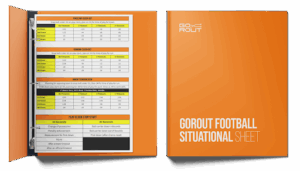
A football play sheet (also called a call sheet) is the document a football coach uses on the sideline to select and communicate plays during a game. It’s not the same as a playbook, which is the full library of every formation and scheme your team runs across a season.
There’s also a difference from a football play card, which is the player-facing version showing only that individual’s assignment.
As a coach, you should build the coordinator’s call sheet and the player wristband together. If you design them in isolation, the gap between the sideline and the huddle becomes a source of errors rather than an edge.
Play sheet vs. playbook vs. wristband card
Here’s how the three documents break down:
- Playbook: contains everything your program runs across the full season
- Play sheet: contains what you plan to call this week, organized by situation
- Wristband card: contains what each player needs to read before the snap
Confusing these three is one of the most common mistakes coaches make. The confusion always shows up on game day, when there’s no time to fix it.
Who uses the play sheet on game day?
Each role on your staff requires a different level of detail:
- Head coach or offensive coordinator: holds the primary call sheet with the full situational grid
- Position coaches: may carry simplified reference versions built from the same plan
- Quarterback: manages the wristband on the field and relays the call to the huddle
Designing your sheets for the right audience matters as much as the plays themselves.
Download GoRout’s football situational sheet and ensure your team is always prepared for the next play.
What Goes on a Football Play Sheet?
Every effective football play sheet organizes calls around game situations, not play type or formation family. Grouping by concept feels logical at your desk, but under pressure, you need to locate the right call for a specific down and distance in under five seconds.
That speed only comes from situational structure.
Organizing by down and distance
Structure your sheet around how the game actually unfolds across various game scenarios. Each of the following should have its own dedicated section:
- First-down calls (base runs, play-action)
- Second and short (quick hitters, misdirection)
- Third and long (pass-heavy, protection calls)
- Red zone (compressed route packages)
- Two-minute drill (no-huddle, tempo plays)
Coaches who organize by formation instead of situation risk delayed, unconfident play calls under pressure.
Situational packages every sheet needs
Your sheet needs to account for two-minute offense, and combatting goal-line defense and prevent packages so you can adapt quickly when the game shifts. Also include special teams calls on a separate card or back panel.
Leaving these categories off forces you to improvise at the worst possible moment. Improvisation under pressure is where plans fall apart.
Play sheet sections by game situation
| Section | What It Covers | Where It Goes on the Sheet |
| Opening script | First 10–15 scripted plays | Front, top left |
| First down | Base runs and play-action pass calls | Front, center |
| Second and short | Quick hitters, misdirection | Front, right |
| Third and long | Pass-heavy, protection calls | Back, top |
| Red zone | Compressed route packages | Back, center |
| Two-minute drill | No-huddle, tempo plays | Back, bottom |
| Special teams | Kick, punt, and return packages | Separate card or back panel |
The opening script and why it belongs on the front
Your first 10 to 15 pre-decided football plays belong at the top left of the front side. These calls are already locked in, requiring zero in-game decision-making.
Putting the script front and center means you can execute without hesitation and set the tone before you need to react to what your opponents show.
Learn how an effective football play-calling system connects your opening script to in-game adjustments throughout the game.
How to Build a Play Sheet Step by Step

Building a play sheet from scratch (or rebuilding one that isn’t working) starts with honest decisions about format, volume, and integration with your delivery system.
Choosing your format: paper, laminate, or digital
Most coaches default to laminated paper. A computer-generated sheet template printed fresh each week is a small improvement, but the same structural limitations follow you onto the field:
- The sheet can’t be updated between series
- Notes written in dry-erase marker smear when wet
- Any change after the final print run never makes it onto the field copy
Free options from generic coaching resources save time up front, but they’re typically too broad to use without significant rework. Always customize fully to your scheme before the sheet goes anywhere near the sideline.
The most durable alternative is a digital play sheet managed through a web app and pushed to devices in real time. That setup eliminates all of the above constraints without changing how you think or plan.
How many plays per section is too many?
Aim for six to 10 calls per section maximum. Beyond that, you’re creating a decision problem under pressure rather than solving one. If a section grows past 10 plays:
- Split it by personnel grouping
- Create plays within each sub-group as a separate block
- Label sub-groups clearly so any staff member can navigate fast
Color-coding and personnel groupings
Use color to separate personnel packages. A sheet where your 11-personnel plays appear in black, and your goal-line package appears in red, is one you can scan in 2 seconds.
Consistency between your call sheet and your football wristband templates is what keeps the entire team on the same page under game-speed conditions.
Building the sheet around your wristband system
Your call sheet and football wristbands must share the same naming conventions. If the coordinator calls “Right 38 Power” from the sheet, the wristband should show exactly that. Every translation step between the two documents is a chance for the wrong play to get executed.
Where Paper Play Sheets Break Down
Paper works in a controlled environment. The sideline is never controlled. Here’s where the paper process fails.
The mid-drive update problem
You spot a weakness in the defense at the end of the first quarter and want to adjust plays for your next possession. On a paper system, that adjustment travels verbally through your entire staff chain before it reaches players.
Think about how much time that costs across a full game, especially in a tight competition where one misread call is often the margin between winning and losing a drive.
When noise and pressure make the paper unreadable
A hostile sideline creates conditions that work directly against a paper system:
- Small text is hard to read at a distance or under poor lighting
- Multiple sheets must be tracked simultaneously during fast-tempo drives
- Verbal communication with players is unreliable when the crowd noise peaks
The wrong call often happens because the delivery broke down the moment it mattered most.
The weekly prep time nobody talks about
Every week, someone on your staff prints, cuts, laminates, and distributes sheets and football play-call wristbands. That process takes hours. It also locks in your plan before game day, so any changes you make on the night before never make it onto the field copy.
Play Sheet Best Practices by Level
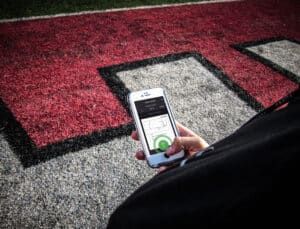
Football operates across vastly different levels of experience, roster complexity, and budget. Different levels require genuinely different approaches, not just scaled-down versions of the same document.
Youth and middle school: simple, visual, and short
Simplicity is everything at the youth level. Play sheets should use large print and simple symbols, and the total play count should stay between 10 and 20:
- Focus only on the core formations your team actually runs
- Avoid coded terminology that kids can’t decode in five seconds
- Keep your strategies tight and lean on visuals over text
Anything more complex creates hesitation on both offense and defense. The goal here is confidence.
High school: building a sheet your staff can all use
Your high school sheet needs to be navigable by every member of your staff under pressure, not just the coordinator. Use consistent naming, clear section breaks, and a structure that gives any position coach a winning edge by letting them find the right call in under five seconds.
The football charting sheet you use alongside your call sheet should follow the same structure so your staff can track what is working in real time.
College: integrating the sheet into a full communication system
College programs need a play sheet that functions as one component of a larger system: defensive signal packages, personnel grouping tags, emergency scripts, and tempo control protocols all need to fit together.
Speed and security matter equally here. Plays need to reach players fast and stay secure from opponents, which is why more programs are moving to encrypted digital delivery.
Play sheet complexity by level
| Level | Max Plays Recommended | Format | Key Consideration |
| Youth (6–12) | 10–15 | Large print, symbols only | Players must read it in 5 seconds |
| Middle school | 15–20 | Basic down-distance structure | Minimize terminology |
| High school | 25–40 | Full situational sheet | Wristband alignment critical |
| College | 40–60+ | Full scheme with personnel tags | Speed and security matter equally |
Conclusion About Football Play Sheet
A football play sheet is only as effective as the process it’s connected to. The best call sheet fails if the play gets miscommunicated, misread, or visible to opponents from the sideline.
FAQs About Football Play Sheets
What is a play sheet in football?
A football play sheet (also called a call sheet or game day card) is the sideline reference document a coach uses to organize and call plays during a game. It’s distinct from the playbook, which contains the full scheme library, and from the player wristband, which shows individual assignments in the huddle.
The coordinator’s sheet and the player’s wristband work together as a complete communication system.
What does an NFL play sheet look like?
NFL call sheets are typically laminated 8.5×11 cards organized into situational grids covering first down, second-and-short, third-and-long, red zone, two-minute, and special situations. Coordinators use color-coding and abbreviations to scan fast under game pressure.
The same organizational logic applies at every level, from high school to college programs, even when the total play count is smaller.
What are the 5 S’s of football?
The 5 S’s of football are Speed, Strength, Stamina, Skill, and Structure. Each represents a quality that teams must develop to compete effectively. A well-organized play sheet and a fast digital delivery system directly support both Structure and Speed, ensuring plays reach players quickly and every player understands their assignment before the snap.
How do you remember football plays easily?
Repetition across practice drills is the most effective way to build play recognition. Position-specific wristband cards reduce cognitive load by showing players only their own assignment.
Color-coded formations and short, consistent play names build muscle memory across the season. GoRout Scout reinforces recognition by pushing the same play card to a player’s wrist on every rep, eliminating extra verbal instruction and allowing coaches to focus on technique.
Share This Article
Related Articles




Free Playbook Template
Our downloadable template offers a sleek, detailed design with space for positional roles, play descriptions, and any play notes that you want to include.