Football Offensive Formations: The Ultimate Guide
Reading Time: 64 minutes


Reading Time: 64 minutes
Football offensive formations dictate the alignment of the 11 offensive players on the field and serve as the foundation of all offense in American football. An offensive coordinator and their coaching staff develop their entire philosophy, playbook, game plan, and play calling strategies using offensive formations as the base alignment for each play.
This guide serves as a comprehensive overview of the main offensive formations for American, Canadian, and any other form of gridiron football. We’ll start from the beginning, defining the key components of what makes up an offensive formation, all the way through some of the more obscure and less common formations you’ll see in football. Whether you’re a coach taking on your first job, an experienced veteran, or a casual football enthusiast, you’ll find value in the information covered throughout.
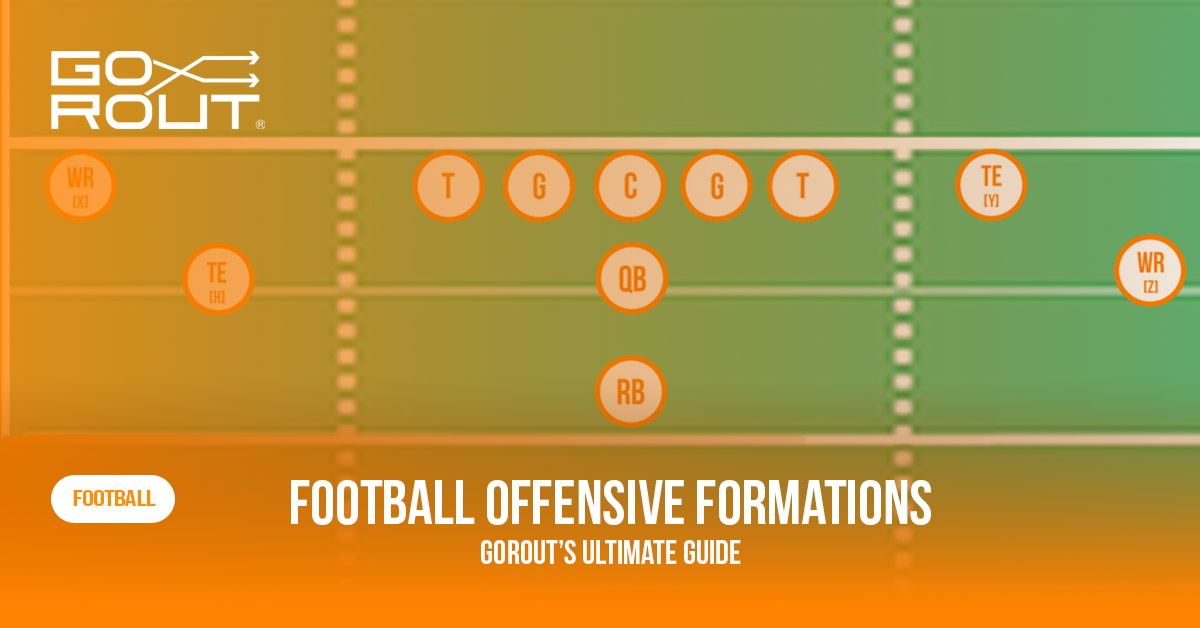
What is Covered in GoRout's Ultimate Guide to Football Offensive Formations?
GoRout’s ultimate guide to football offensive formations covers the following:
- Defining and explaining the concept of offensive formations in football
- Identifying what position groups make up football offensive formations
- Classifying what a legal offensive formation consists of
- Dissecting the difference between formation vs. scheme in football offense
- Explaining why offensive formations are important
- Covering how many offensive formations exist in football
- Breaking down The various factors that impact offensive formations
- Introducing two quarterback alignment in offensive formations, including
- Reviewing names & identifiers for offensive formations
- Designating offensive formation strength
- Labeling eligible receivers
- Basic football offensive formations
- Spread football offensive formations
- Other common football formations
- Less common football formations
- FAQs
What Are Offensive Formations for Football?
An offensive formation in American football is the specific alignment of all 11 offensive players on the field of play before the snap. Coaches use a variety of formations as the foundation for designing and calling plays on offense.
Offensive formations aim to put players in an advantageous position to move the ball downfield and score points.
What Does A Standard Football Offense Formation Look Like?
Most offensive football formations consist of a five-man offensive line, two eligible receivers as ends, and a “backfield” with four players (including the quarterback).

A standard offensive line, the anchor for a majority of offensive formations, is made up of the following positions:
- Left tackle (LT)
- Left guard (LG)
- Center (C)
- Right guard (RG)
- Right tackle (RT)
Two other players, called ends, line up on the line of scrimmage alongside the offensive line (or in the slot/split wide) as eligible receivers. The other four players, including the quarterback, line up behind the offensive line and/or off the line of scrimmage.
What Position Groups Make Up Offensive Formations in Football?
The following three position groups make up a majority of offensive formations in football:
| Position Group | Description | Typical Players |
| Offensive Line | Five big-bodied offensive players lined up on the line of scrimmage (LOS) as ineligible receivers with the sole responsibility of blocking. Offensive linemen typically line up in a two point or three-point stance. |
|
| Ends | Two players lined up farthest wide on the LOS toward the sideline as eligible receivers. There is a strong side end and a weak side end. |
|
| Backfield | Four players off the line of scrimmage as eligible receivers. |
|
What Is A Legal Offensive Formation in Football?

While there are hundreds of potential ways to align players, certain rules dictate and define what makes an offensive formation legal:
- At least 7 players must be on the line of scrimmage (LOS)
- Backfield players (players not on the LOS) must be at least 1 yard behind players on the LOS
- Ends (players on either end of LOS) are the only eligible receivers on the LOS
- All players on the LOS (aside from the ends) are ineligible receivers
- The offense must set before the play
- 1 of the 4 backfield players may be put in motion after the offense is set, but before the snap
What’s the Difference Between an Offensive Formation vs. Offensive Scheme in Football?
When running an offense, there are many football terms and concepts that overlap or sound similar. Two terms you’ll see in football that relate to offensive strategy are offensive formation and offensive scheme.
| Name | Definition | When It Occurs | Impact on Game |
| Offensive formation | Alignment of 11 players on the field for any given play on offense. | Before the snap | Pre-snap positioning |
| Offensive scheme | Strategy behind an offense’s approach, defined by tactical tendencies. | Before, during, and after the snap | Specific play design and sequencing to attack the defense using an overarching philosophy. |
While the two are similar, key differences separate them:
- Offensive formation is the alignment of the 11 players on the field for any given play on offense before the snap.
- While formations are a major component of offensive scheme and strategy, they do not change nor directly impact the game after the snap.
- A football offensive scheme is the specific strategy behind an offense's approach before, during, and after the snap. That can include alignment, but is more specifically defined by the tactical tendencies used to attack the defense.
- For example, West Coast is an offensive scheme that prioritizes short and intermediate horizontal passing concepts to stretch the defense and gain yards after the catch. Certain formations maximize the effectiveness of the scheme, but the philosophy and routes behind it are independent of formation.
Why Are Football Offensive Formations Important?
Offensive formations set the foundation for offensive strategy and play design in gridiron football. Without formations, an offense simply cannot function. It’s important for defensive coaches to study offensive formations, as it can help inform their gameplan and what calls they make.
Here are a few other reasons why offensive formations in football are so important:
- Formations can determine whether a play is more likely to be a run or a pass
- They also influence the run-pass balance and dictate defensive responses
- Most formations aim to create mismatches, attack specific defensive formations, and force defensive adjustments
- Specific base formations can be used for an entire game plan to simplify the playbook, especially in youth leagues and high school
- Defenses often respond to the number of receivers or tight ends on the field with specific personnel packages, based on the formation an offense aligns in.
How Many Offensive Formations Are There in Football?
Short answer: There’s too many to count!
Long answer: Gridiron football is the most popular sport to watch in the United States of America, and participation spans all ages and experience levels. From the earliest organized youth football leagues all the way through the National Football League (NFL), countless factors play a role in how an offense lines up on any given play.
Such a wide range of variables makes it nearly impossible to condense all of the offensive formations you might see on a football field at any given time into a comprehensible resource. Here at GoRout, we’ve boiled all potential combinations down to a manageable, useful guide with over 20 different offensive football formations.
What Factors Into Different Offensive Football Formations?
When talking about formations on offense, everything from experience level and football IQ to specific league regulations play a role. Whether you’re playing, learning how to coach football, or a general spectator of the game, you’ll see overlap between multiple core “offensive formations” within a team’s game plan.
Modern offenses frequently shift between several formations while maintaining the same personnel groupings. Oftentimes you’ll see characteristics of different formations within a single alignment. Some teams give multiple “looks”, or unique and set offensive formations, before the snap.
Here are five of the most influential components that factor into different offensive formations:
| Factor |
Explanation |
|
Experience (Football IQ) |
Teams consisting of players with less experience tend to run basic offensive sets. Locking down fundamentals and executing simple tasks takes precedence over complex offensive formation variations in a youth football playbook. |
|
Skill Level |
Formations are limited by the skill level of the players plugged into position. A quarterback still figuring out how to throw the ball can’t run an effective RPO out of the pistol. |
|
League Rules |
The definition of a legal formation varies by league, so certain alignments are prohibited in one game and allowed in another. Offensive linemen can report as eligible receivers in the NFL, where that’s not allowed in most high school and college rule books. |
|
Personnel & Roster |
The offensive players on a roster heavily dictate what formations a coordinator can work with. Certain strengths or limitations may push a team to use particular formations more or less frequently. |
|
Coaching Philosophy |
Offensive coordinators and coaches have a vision and set of beliefs, regardless of their roster. The foundation of a coach’s philosophy plays a pivotal role in how their team lines up on offense. |
Quarterback Alignment: The Foundation of American Football Offensive Formations
Expanding on the reality that “offensive formation” can be used to describe so many different possibilities in positioning, let’s build our definition of formation from the offensive foundation: the quarterback.
When in doubt, the offensive spotlight focuses on the quarterback. Nearly every discussion about offense in football involves the quarterback, in one way or another, and formations are no different.
To begin most offensive plays, the quarterback receives the center’s snap one of two ways: under center or shotgun.
While neither a formation on its own, under center and shotgun determine the quarterback’s positioning on any given play. Most of the specific formations we’ll dive into can be, and are, run out of both under center and shotgun alignment.
Under Center

Under center describes any offensive formation in football where the quarterback lines up directly behind the center for a hand-to-hand snap. The quarterback crouches in a low, athletic stance with their hands placed under the center’s rear end, therefore the name.
Most associated with the combination of downhill running plays and play action passing concepts, under center alignment gives the running back a “head start” of momentum downfield before receiving a handoff or toss from the quarterback.
Under center looks tend to keep the field tighter and more condensed, with the defense forced to respect the run. This can create one-on-one matchups for receivers and opportunities to exploit their counterpart’s weaknesses through the air.
The most effective under center passing game often comes in the form of deceptive play action. Spread formations can work from under center as long as the quarterback has vision, conviction in decision making, and arm strength. It helps to have a versatile, athletic tight end or two.
Regardless of the roster, commitment to the run opens ample opportunities to throw the ball. Whether it’s play action or a standard drop back, lining up under center forces the defense to consider the run possibility in their pre-snap reads and initial reactions to pass plays.
Under center formations dominated football from its inception through the early 2000s, before the introduction and rise in popularity of shotgun.
Shotgun

Shotgun describes any offensive formation in football where the quarterback lines up 5-7 yards behind the center to receive a thrown snap. Because they’re positioned further away from the line of scrimmage than when under center, quarterbacks have more time to read the field and work their progressions in the passing game.
As gridiron football evolved from a run-dominant sport, passing became a larger component of offensive strategy. Shotgun alignment was introduced as a pass-dominant look, leading to a decades-long transformation of the game.
Today, shotgun is a staple for teams at all levels of play and serves as the base alignment for some. Shotgun alignment provides the quarterback with better vision and extra time to pass, which is something certain quarterbacks prefer on an every-down basis.
Despite its reputation as a pass-heavy look, shotgun presents numerous ways to attack on the ground. Running backs are at a disadvantage, since they typically have to move sideways to get the ball before beginning their forward burst. That doesn’t mean they aren’t a threat.
HB draw acts as a reverse play action, with the quarterback dropping back like they’re going to pass before handing off to the running back. Backs with patience, vision, quickness, and agility utilize the space shotgun creates to make impactful plays. That space and visibility also opens up doors for read options and RPOs, other ways to put the defense in unfavorable positions.
Football Offense Formation Names & Identifiers
As we discussed earlier and will continue to hammer home throughout this article, football is a widely popular game with significant variety and subjectivity in offensive strategy, play design, and terminology.
Every circumstance is unique. What one coach calls singleback, another may refer to as ace. Pistol is, in theory, I-formation with the QB in shotgun. There’s a lot of leeway when discussing offensive formations and it wouldn’t be uncommon to hear 10 distinct definitions for the same “formation” if you’d ask 10 different coaches.
When we break down American football offensive formations at a high-level, we’re generally focused on one of two core identifiers: backfield alignment or eligible receiver alignment.
|
Identifier |
Explanation | Positions Included |
Example |
|
Backfield Alignment |
An offensive formation dependent on the positioning of certain players in the backfield. |
|
|
|
Eligible Receiver Alignment |
An offensive formation based around the positioning of specific eligible receivers. |
|
|
Most names of offensive football formations are based on these core identifiers. Arguably more important, the names are based on physical alignment of specific groups of players.
- Backfield alignment is built around the QB, RBs, FB, and other backfield players. A backfield alignment formation can have any number of looks for the eligible receivers outside of the backfield.
- Eligible receiver alignment is built around the alignment of eligible receivers including WR, TE, RB, and any other. An eligible receiver alignment can have any number of looks for the backfield.
Let’s take a look at this concept in practice. Here is one example for each: :
- Singleback is an offensive formation based on backfield alignment, with one single running back. Positioning for the two other eligible receivers off the LOS, as well as the two ends on the LOS, varies depending on play design.
- Trips is an offensive formation based on eligible receiver alignment, short for “triple” with three eligible receivers to one side of the field. All players not included in the trio of eligible receivers may be positioned on the field (legally) wherever the coach or coordinator prefers.
These aren’t the end-all-be-all identifiers for naming formations, and all coaches have their own philosophy and perspective. As you climb the competitive ladder to college and professional football, the lines become more blurred and the spectrum of formation designation and play calling expands.
Additional Concepts, Language, and Jargon Used in Offensive Football Formations
Two additional concepts to be aware of when discussing offensive football formations are:
- Designating formation strength, and
- Labeling eligible receivers
Designating Formation Strength

Formation strength refers to the side of an offensive formation loaded with a particular numbers advantage over the other. From the quarterback’s perspective, the offensive field of play is split down the middle into two sides. You can use the football’s laces as the center point.
Offensive formation strength identifies either side as weak or strong.
- Strong side refers to the side with the particular advantage
- Weak side refers to the side without the particular advantage
How is formation strength determined on offense?
The particular advantage or strength that a formation provides is entirely dependent on the coaching philosophy. In general, the side with more players total, or where the primary TE lines up, determines formation strength.
If there’s anything we’ve learned up to this point, it’s that offensive formations are very subjective. The way a team approaches offensive strategy impacts the language and philosophy of its formation names.
Here are some of the most common methods coaches and coordinators use to determine formation strength:
|
Method |
Explanation |
|
Total number of players |
Most commonly, offensive formation strength is determined by the number of players on one side of the ball. If there are more players to the left of the quarterback than the right, the left side is the strong side and the right side is the weak side. |
|
Primary tight end (TE) |
Another common indicator of formation strength is whichever side of the ball the primary TE lines up on. If the primary TE lines up on the left side of the quarterback in programs that operate this way, left is the strong side and right is the weak side. |
|
Wide receivers (WR) |
In some scenarios, a coach may designate the strong side as whichever side has more receivers. If the primary tight end lines up on the right side of the ball while two receivers line up on the left side, that left side would still be the strong side using this philosophy. |
| Other coaching preferences |
Football coaches are creatures of habit. Certain coaches may take a different approach than the three previous when determining formation strength. As always, it’s up to the discretion of the coach and program. |
Labeling Eligible Receivers
Labeling eligible receivers is the process of assigning a letter of the alphabet to each eligible receiver in an offensive formation (separate from that of their position abbreviation) as a shorthand identifier on diagrams and in practice.
This is where things get a little tricky, because every coach opts for their own preferred method of labeling and identifying players. We’re going to try and keep this as barebones and basic as possible.

In general, eligible receivers are labeled as:
| Label | Description |
|
Y |
Typically a tight end or bigger bodied receiver with strong blocking abilities. The Y is often the play side (or call side) strength. |
|
Z |
Usually a receiver lined up on the strong side with a solid grasp on the football route tree. Ideally, the Z is a route technician with a knack for finding gaps in zone coverage. |
|
X |
Often the star receiver who can win one-on-one, lined up on the weak side. Because the X is usually a talented player, coaches try to isolate them on the weak side and take advantage of the defense. |
|
H |
Either a scatback with a profile like Darren Sproles or Tyreeke Hill, or an additional tight end, running back, or H-back. Players like Kyle Juszczyk and Taysum Hill may also fit the profile of an H. |
GoRout’s Ground Rules and Guidelines for Offense Formations in Football

In attempting to name, define, contextualize, and analyze all offensive formations in football (or at least the most common traditionally and in the modern game), we have to set some guidelines and ground rules.
- Rule #1: Standard five-man offensive line. We’ll assume that every formation we discuss consists of a standard five-man grouping that plays offensive line: LT, LG, C, RG, RT (unless otherwise noted).
- Rule #2: Y is always the formation strength. We’ll take a run-centric approach and use the Y as the strength designation for every formation we discuss (unless otherwise noted)
- Rule #3: Eligible receivers will be labeled Y, Z, X, and H. Each receiver will match their corresponding label’s descriptions in the previous section (unless otherwise noted). Some formations won’t include eligible receiver labels, for the sake of simplicity in explaining and dissecting the alignment.
- Rule #4: (Almost) Any formation can be run out of shotgun or under center. While certain looks favor under center over shotgun (and vice versa), the sheer variety of looks you might see on any given Sunday in the NFL alone makes it impossible to say for certain whether each formation has to be run from under center or shotgun.
Consider this the most basic, generic approach to offensive strategy that allows individuals with differing levels of knowledge and experience to understand, comprehend, and learn these sometimes complex concepts.
Basic Formations for Football Offenses
Now that we’ve covered all of the jargon and ground rules, we can dive into some of the most basic formations that you’ll see on offense in football.
This first category of formations are often referred to as base, or the primary formation which a team’s offensive strategy is built around. Think of it like the offense’s home field. Sometimes they have to go off and run other formations, but they feel most comfortable and at home in their base formation.
These basic formations include:

As we go through the list, you’ll notice that all of the base formations are primarily based on backfield alignment.
I Formation
The I Formation is one of the most traditional offensive formations in football, featuring the quarterback under center and two running backs stacked behind in a vertical straight line. Typically the formation incorporates a fullback positioned directly behind the QB as a lead blocker for the primary ball carrier, a RB lined up behind the FB.
The particular line up of QB -> FB -> RB is coined I Formation because the trio of players form a capital “I” shape when viewed from an aerial perspective. It’s been (and continues to serve as) a staple in the game, creating opportunities for a balanced play-calling mix between run and pass plays.
I formation is one of the few offensive formations run exclusively from under center. Many NFL teams and college football programs, including the 1995 Nebraska Cornhuskers, have used the I Formation to win a national championship, Super Bowl, or other playoff title. It’s dominated football for decades and continues to be used at every level today.
I Formation Alignment & Diagram:

|
Position |
Alignment |
|
QB |
Under center |
|
FB |
Directly behind QB |
|
RB |
Directly behind FB |
|
TE [Y] |
Strong side on LOS, next to OT |
|
WR [Z] |
Strong side off LOS, split wide |
| WR [X] | Weak side on LOS, split wide or in slot |
Variations of the I Formation include the Maryland I and Power I (which we’ll cover a little later).
What are the benefits of running I Formation?
There are three primary benefits or advantages of running the I Formation in football:
- Power running between the tackles
- Play-action pass
- Balanced play calling attack
| Benefit | Explanation | Use Case |
| Power running between the tackles |
I Formation incorporates two additional blockers in an already run-advantageous under center setup: a TE on the LOS and the lead-blocking FB. The additional TE on the LOS gives a significant numbers advantage to the offensive line. Meanwhile, the FB serves as a bodyguard for the RB, leading the way to block at the second-level and beyond, clearing a path for the ball carrier to work with. Because of these additional blockers, the I Formation allows for effective running plays up the middle. |
|
| Play-action pass |
Because of the under center look and numbers advantage, defenses are forced to respect the run and load the box. Despite the heavy look, the I formation still includes five pass-catching threats. Along with the FB and RB, it’s typically two WRs and a TE, or two TEs and a WR. This opens up opportunities for play-action passing. When the defense is leaning run, a play-action pass can be an effective change of pace. LBs that bite on the fake run leave space for tight ends and receivers to attack. Talented receivers are more likely to face one-on-one matchups in I formation, so play-action passes give WRs the chance to beat their man and make a play. |
|
| Balanced play calling attack |
As a base offense, or a formation frequently featured in the mix, the I formation is designed for a balanced play calling attack between rushing and passing. The key is to use strategy in sequencing so each play builds off the last. Marrying a consistent commitment to the run with play-action passes sprinkled throughout is a formula for success in the I formation. Until the defense proves they can stop the run, keep pounding it down their throat. As soon as the defense starts to cheat the run, that’s when you call the play-action pass. Once a successful play-action pass negatively impacts the defense, they’ll think twice about what the play call may be on every snap. A defense on their toes opens up your entire playbook for a balanced attack and keeps your opponents guessing. |
|
How can a defense combat I Formation?
For defensive minds in search of a strategy to stop I formation offenses, there are a few adjustments to consider:
| Strategy | Explanation | Risks |
| Switch to a heavier box formation | To combat the run, defenses can load the box. Switching to a heavier defensive formation (like 4-4, 5-3, or 6-2) adds a layer of protection in either the first or second level. | By loading bigger bodies into the box, defenses sacrifice speed and quickness in pass coverage.
Especially on heavier 5 and 6-man defensive line alignments, a lack of defensive backs leaves units vulnerable through the air. |
| Adjust technique | Defensive players can adjust their technique, like smashing the line or slanting movement towards one side of the field, to disrupt the opponent’s running game. |
When defensive players are more aggressive, they’re vulnerable to getting beat. Whether that’s cheating the run and getting burnt on a play-action pass, or slanting too hard to one side and allowing the ball carrier to cut back. |
Singleback Formation
Singleback is another commonly used offensive football formation consisting of one single running back, lined up either 5-7 yards behind the QB (under center) or directly next to the QB (shotgun). This offensive formation is named after the lone, single running back in the alignment. Unlike the I formation, singleback does not involve a FB unless they’re the sole back on the field.
Most often, singleback is used for a look with the standard five-man offensive line, quarterback, one running back, and a combination of four wide receivers and tight ends.
Singleback is the first base offensive set that overlaps with other formations. Primarily, singleback refers to an under center look with one running back. That means any eligible receiver-based formations with only one running back are also categorized as singleback.
For example:
- Running trips with one running back is technically both trips and singleback formations.
- When a team runs a play from shotgun with one single running back, commentators and fans often refer to it as “shotgun” formation. Following our approach in this resource, that would be running a singleback formation with the QB out of the shotgun.
Outside of the I formation, singleback is often the most prominent formation for under center offense you’ll see in the NFL. Many other levels of play use singleback as well, but at lower levels there is a wide range of under center formations you’ll see.
Singleback Alignment & Diagram:

| Position | Alignment |
| QB | Under center (or shotgun) |
| RB | Behind QB, 5-7 yards back |
| TE [Y] | Strong side on LOS, next to OT |
| WR [Z] | Strong side off LOS, split wide |
| WR [X] | Weak side on LOS, split wide |
| WR [H] | Weak side off LOS, in slot |
What are the benefits of running Singleback?
There are four primary benefits or advantages of running the singleback formation in football:
- Balance
- Versatility, flexibility, and adaptability
- Blocking
- Slot WR creates mismatch
|
Benefit |
Explanation |
Use Case |
|
Balance |
Singleback formation, no matter the iteration, creates a balanced offensive attack and unpredictability for the defense on every snap. Unlike the I formation, singleback emphasizes passing while maintaining the threat to run. With five viable pass catchers and playmakers as eligible receivers on any given play, including a RB who is also an option to run, the defense can’t easily key in on one threat or play type. |
|
|
Versatility, flexibility, and adaptability |
A base offensive formation as open-ended as singleback expands the playbook for a creative and innovative program. The single RB plays a vital role in this formation. They must be versatile so defenses have to respect them as a runner, receiver, and blocker. Whether under center or in shotgun, the coach can assign the RB one of three responsibilities on any given play in singleback:
The various looks a coach can use within the singleback formation lends a hand in creating an unpredictable playbook. Some examples may include:
|
|
|
Blocking |
With 5 eligible receivers on the field, singleback sometimes strengthens a team’s run blocking and pass protection on top of the five-man offensive line. The alignment we’ve outlined above places a 6th blocker on the LOS in the Y TE to bolster run-blocking and provide a dual-threat option blocking in pass protection or going out as a receiving option. The RB serves as a 7th blocker when they stay in the pocket for pass protection instead of releasing out as a receiving option. |
|
|
Slot WR creates a mismatch |
A 3-WR singleback formation positions the H slot WR in between the OT and Z WR split wide on the weak side. If the defense remains steadfast in stopping the run, they are likely to assign a slower LB to cover the smaller, speedier H slot receiver. This creates a mismatch the offense can exploit through the air. |
|
How can a defense combat Singleback?
For defensive minds in search of a strategy to stop singleback formation offenses, there are a few adjustments to consider:
|
Strategy |
Explanation |
Risks |
|
Bring an extra defender into the box |
To protect against the running threat in singleback formation, defenses can load the box with an additional defender.
Especially against a multiple TE look, an additional defensive player in the box reduces the offense’s strength on the LOS. |
Loading the box with too many bodies leaves the defensive backfield vulnerable. Especially when teams run out a solid combo TE who can burn the run-stopping approach by releasing out on play-action.
To be safe, defensive coordinators should avoid going overboard on heavy boxes and keep enough capable pass defenders on the field of play. |
| Cover receivers with defensive backs | Considering the passing threat in singleback formations, defenses can send out additional defensive backs to cover eligible receivers.
Especially with pass-catching tight ends and 3 or 4 WR looks, sending out any version of Nickel or Dime coverage can help prevent significant damage through the air. |
Sending out additional defensive backs inherently thins the herd in the box. Less big bodied, powerful defensive players on the field makes it easier for the offense to run the ball. It’s a give and take. Defenses give up run-stopping players on their end, but take away pass catchers on the offense. |
Pistol Formation
Pistol is an offensive formation in football with the quarterback lined up in shotgun and a running back directly behind the QB. In theory, the pistol formation combines elements of the typical shotgun formation and I formation for balanced play. Unlike the I formation, the pistol removes a fullback from the backfield equation, opening up a spot for an additional receiver or blocker.
Pistol is most commonly used as a singleback formation, with the RB lined up directly behind the QB in shotgun and a combination of four TEs and WRs. Versatile RBs and FBs may line up as eligible receivers at times, so Pistol isn’t exclusively a subset of singleback.
The pistol formation sets a sound foundation for RPOs and zone reads. Because the quarterback is in shotgun with a clear view of the defense, they can decide whether to:
- Hand the ball off
- Pull it back and find an open receiver, or
- Keep it themselves as an additional running threat if they have enough speed and quickness.
For that reason, the pistol is well-suited for a team with a mobile quarterback and those who can effectively read the defense.
Pistol Alignment & Diagram:

|
Position |
Alignment |
|
QB |
Shotgun, 4-5 yards back |
|
RB |
Directly behind QB |
|
TE [Y] |
Strong side on LOS, next to OT |
|
WR [Z] |
Strong side off LOS, split wide |
|
WR [X] |
Weak side on LOS split wide |
| WR [H] |
Weak side off LOS, in slot |
What are the benefits of running Pistol?
There are four primary benefits or advantages of running the pistol formation in football:
- I formation and shotgun combined
- RPOs and zone reads
- Play action
- Keeps defense guessing
|
Benefit |
Explanation |
|
I formation and shotgun combined |
Pistol combines the best of I formations and shotgun alignment to give your quarterback the best chance for success and keep the door open for downhill running plays.
By positioning the quarterback in shotgun, they’re able to make pre-snap reads with better visibility than under center. It removes the need for the quarterback to drop back, making it easier to receive the snap, go through progressions, and find an open receiver. |
|
RPOs and zone Reads |
With the quarterback in shotgun and the running back behind, Pistol opens the door for RPOs and zone read options with a twist.
The Pistol formation provides visibility for the quarterback while allowing the running back to attack downhill with the same momentum as the I formation. A quarterback can read the defense upon the snap without having to drop back, and simply rotate their body for the handoff motion to the running back. Similar components that provide benefits to the RPO game also open up possibilities for zone read options. The quarterback has visibility without having to drop back. Because they’re behind the quarterback, the running back gets a hint of downhill momentum before receiving the handoff (whereas a traditional shotgun formation does not allow the north-to-south head of steam). |
| Play action |
Pistol is an alignment that allows the running back to attack both downhill and laterally, while the quarterback has increased visibility at the line of scrimmage, providing opportunities for creative play action concepts. |
| Keeps defense guessing |
Combining all of the previous benefits, the Pistol formation offers numerous creative strategic moves to ensure the defense doesn’t catch on to any tendencies. Mixing in downhill runs, pass plays, RPOs, zone read options, and play action (in non-predictible sequences) makes it impossible for defenses to predict what’s coming next. |
How can a defense combat Pistol?
For defensive minds in search of a strategy to stop offenses in the pistol, there are a few adjustments to consider:
| Strategy | Explanation | Risks |
| Load the box | Pack additional defenders in the box to combat the threat of downhill run plays. If a team has a power back that’s tough to bring down or a strong offensive line, loading the box protects against the offense using the pistol for downhill leverage.
Depending on offensive and defensive personnel, some examples may include 4-4 with a single-high safety, 5-2 with an additional nose tackle, 5-3 with a single-high safety, or any other unique formation placing extra bodies in the box. |
Susceptible to damage through the air by sacrificing players in the secondary to load the box.
Versatile backs can still beat you on outside runs, if your linemen/linebackers don’t have enough speed. Mobile quarterbacks pose a threat to run the zone read or scramble, where they can break free on the outside for positive gains if defenders in the box aren’t quick enough. |
| Expand the secondary | When your opponent has a precise, confident quarterback and legitimate threats at receiver positions, run sets with additional defensive backs to beef up your pass defense.
Nickel and dime packages are smart choices for extra protection through the air. Consider the legitimate threat of the running back and tight end as pass catchers when deciding what to call. |
More defensive backs means less bodies in the box, putting you at risk of downhill both downhill and lateral run plays, as well as zone reads. Less bodies in the box and a priority on pass defense may reduce the effectiveness of your pass rushing defensive linemen, especially if you opt for a 3-man front. |
Split Backs [Pro Set] Formation
Split backs is an offensive formation in American football with the quarterback under center and two players in the backfield split 4-5 yards back, one over each of the QB’s respective shoulders. Two wide receivers split wide, one on each side of the field, with the tight end on the strong side of the line of scrimmage.
Also known as the pro set, split backs formation is named after the two players in the backfield. Typically a running back and fullback, each player lines up in a position that splits the offensive guard and offensive tackle approximately 4-5 yards off the line of scrimmage on their respective side of the field.
Teams can run split backs out of the shotgun though, in those instances, both backs typically position themselves in line with the quarterback. As always, formations are up for creative interpretation and there’s nothing stopping you from running a hybrid pistol/split backs alignment with the two backs split several yards behind the QB.
Split Backs [Pro Set] Alignment & Diagram:

| Position |
Alignment |
|
QB |
Under center |
|
RB |
Weak side, 4-5 yards back splitting OG and OT |
|
FB |
Strong side, 4-5 yards back splitting OG and OT |
| TE [Y] |
Strong side on LOS, next to OT |
| WR [Z] |
Strong side off LOS, split wide |
| WR [X] |
Weak side on LOS, split wide |
What are the benefits of running Split Backs [Pro Set]?
There are four primary benefits or advantages to running split backs formation:
- Two running backs in the backfield present a threat on the ground
- Utilize depth at the running position
- Five pass catching weapons
- Marry the running game with short passes to move the ball
| Benefit |
Explanation |
|
Two running backs in the backfield present a threat on the ground |
Positioning two running backs split behind the quarterback in Pro Set forces the defense to protect against the run. Often, this means loading the box with additional defenders.
Backs with speed and quickness benefit from outside running plays like sweep, toss, or stretch. Combining a power back with a speedy, elusive counterpart widens the playbook and forces the defense to consider the rushing attack to all parts of the field. |
|
Utilize depth at the running back position |
Teams with deep running back rooms can leverage that depth and versatility by running split backs.
On the flip side, teams that lack depth at the wide receiver and tight end position can run pro set to make the most out of their roster by using a second running back. |
| Five pass catching weapons |
Even though split backs substitute an additional back in lieu of a third receiver or second tight end, both running backs serve as potential pass catching weapons. |
| Marry the running game with short passes to move the ball |
With five pass catching options and two running threats, split backs open the door to marrying the run and pass game for a balanced attack. The passing attack typically consists of shorter, horizontal routes, allowing receivers to gain yards after the catch. Mixing short passes with downhill and lateral running plays keeps defenses on their toes. A healthy balance and commitment to the run also creates opportunities for play action pass, baiting the defense to bite on the run and capitalizing through the air. |
How can a defense combat Split Backs [Pro Set]?
For defensive minds in search of a strategy to stop pro set offenses, there are a few adjustments to consider:
| Strategy | Explanation | Risks |
| Switch to a heavier box formation | To combat the run, defenses can load the box. Switching to a heavier defensive formation (like 4-4, 5-3, or 6-2) adds a layer of protection in either the first or second level. | By loading bigger bodies into the box, defenses sacrifice speed and quickness in pass coverage.
Especially on heavier 5 and 6-man defensive line alignments, a lack of defensive backs leaves units vulnerable through the air. |
| Adjust technique | Defensive players can adjust their technique, like smashing the line or slanting movement towards one side of the field, to disrupt the opponent’s running game. | When defensive players are more aggressive, they’re vulnerable to getting beat. Whether that’s cheating the run and getting burnt on a play-action pass, or slanting too hard to one side and allowing the ball carrier to cut back. |
Jumbo/Heavy [Goal Line] Formation
Jumbo, also referred to as Heavy, is a powerful short-yardage offensive formation in American football where an additional offensive tackle lines up next to the strong side OT and a tight end lines up next to the weak side OT for additional blocking support on the line of scrimmage.
A second tight end lines up next to the additional strong side OT, off the line of scrimmage, and a full back or third tight end lines up next to the weak side TE, also off the line of scrimmage. The quarterback lines up under center with a running back 5-7 yards behind in the backfield.
While Jumbo/Heavy is a brute force running formation designed for any short yardage situation to maximize blocking power, it’s commonly called “Goal Line” formation (or offense) because useful within a few yards of the goal line to bulldoze into the end zone.
Jumbo/Heavy [Goal Line] Formation Alignment & Diagram

|
Position |
Alignment |
|
QB |
Under center |
|
RB |
Behind QB, 5-7 yards back |
|
Extra OT |
Strong side on LOS, next to OT |
| TE |
Weak side on LOS, next to OT |
| TE |
Strong side off LOS, next to OT |
| FB |
Weak side off LOS, next to TE |
What are the benefits of running Jumbo/Heavy [Goal Line]?
There are three primary benefits to running jumbo or heavy goal line sets:
- Overpower the defense with blocking strength
- Call pass plays to combat the defensive adjustments
- Utilize unconventional players on offense
| Benefit |
Explanation |
| Overpower the defense with blocking strength |
By bringing out an extra offensive lineman on one side and a blocking tight end on the other, along with a strong blocking fullback and a second blocking tight end, defenses are forced to load the box with additional defenders. When defenses load the box, the offense has enough blockers on the field to combat most looks, making it easier to clear a path for the ball carrier. If they choose not to load the box, you have a wall of blockers to help the ball carrier waltz through for a first down or touchdown. |
|
Call pass plays to combat the defensive adjustments |
With a blocker-heavy personnel grouping, defenses are likely to load the box (as mentioned in the previous benefit).
Whether you have dual threat blocking/pass catching tight ends and backs, or you bring out a wide receiver or two instead of the fullback and second tight end, calling pass plays can exploit the run-centric defense. Even in looks where defensive backs match up against pass catching threats, whether it’s man or zone, there is less help and receivers with speed and quickness can exploit those matchups. |
| Utilize unconventional players on offense |
Jumbo packages allow coaches to utilize unconventional players on offense, including defensive tackles as blockers or ball carriers and linebackers or other non-traditional receivers as pass catching options. Back in the 1980s, the Chicago Bears used DT William “The Refrigerator” Perry as an offensive weapon in jumbo sets. The New England Patriots also brought out linebacker Mike Vrabel as a tight end in heavy goal line formations, catching touchdowns in two separate Super Bowls. |
How can a defense combat Jumbo/Heavy [Goal Line]?
For defensive minds in search of a strategy to stop jumbo or heavy goal line offenses, there are a few adjustments to consider:
| Strategy | Explanation | Risks |
| Switch to a heavier box formation | To combat the run, defenses can load the box. Switching to a heavier defensive formation (like 4-4, 5-3, or 6-2) adds a layer of protection in either the first or second level. | By loading bigger bodies into the box, defenses sacrifice speed and quickness in pass coverage.
Especially on heavier 5 and 6-man defensive line alignments, a lack of defensive backs leaves units vulnerable through the air. |
| Adjust technique | Defensive players can adjust their technique, like smashing the line or slanting movement towards one side of the field, to disrupt the opponent’s running game. | When defensive players are more aggressive, they’re vulnerable to getting beat. Whether that’s cheating the run and getting burnt on a play-action pass, or slanting too hard to one side and allowing the ball carrier to cut back. |
Football Spread Formations on Offense
Football spread formations are self explanatory: they spread out the offensive attack to stretch the defense horizontally. Spread formations are prominent in modern day Air Raid playbooks and frequently used on passing downs.
Here is a list of the rest of the formations used in Spread offensive football schemes, typically consisting of eligible receiver-based naming conventions:

Ace Formation
Ace is a football spread offensive formation with two wide receivers split wide, one on either side, and two tight ends. One wide receiver and tight end line up on the line of scrimmage, while the other receiver and tight end make sure to stay behind it.
Ace can be run from under center or out of shotgun, with a running back either 5-7 yards behind the QB (under center) or next to them (in shotgun).
The Ace formation is a staple of modern spread offenses and can substitute additional slot receivers in place of tight ends. As a subset of the singleback formation family, there’s typically one running back on the field (unless a special instance where a hybrid TE/FB/H-Back takes the spot of one of the TEs). The balance of two eligible receivers on each side of the LOS makes it a hugely successful formation for a mix of run and pass plays.
Ace Formation Alignment & Diagram

|
Position |
Alignment |
|
QB |
Under center |
|
RB |
Behind QB, back 5-7 yards |
|
TE [Y] |
Strong side on LOS, next to OT |
|
TE [H] |
Weak side off LOS, in slot |
|
WR [Z] |
Strong side off LOS, split wide |
| WR [X] |
Weak side on LOS, split wide |
What are the benefits of running Ace?
There are two primary benefits or advantages to running Ace formation:
- Balance in personnel and offensive play calling
- Strategic sequencing to set up play action passes
|
Benefit |
Explanation |
| Balance in personnel and offensive play calling |
Ace is a near-symmetrical alignment with a receiver split wide and tight end to the outside shoulder of the offensive tackle on both sides of the line of scrimmage. While it’s not perfectly mirrored, the balanced look creates freedom for a mix of run and pass plays. Both tight ends are dual threat run/pass blockers, while simultaneously serving as pass catching weapons. Blocking strength on the offensive line paves a path to attack the ground between the tackles and laterally. With two receivers split wide, defenses are forced to respect the deep ball. If they don’t, teams can capitalize on big plays where help in the secondary is lacking. |
| Strategic sequencing to set up play action passes |
With a balanced look and creative mix of pass and run plays, Ace formation sets the stage for creative sequencing that punishes defenses through play action passes. When the running game is rolling and defenses start to cheat, that’s the perfect time to call the play action pass. Specifically, setting up play action in a similar alignment as previous running plays that found success. Once a defense gets burnt on play action, they’ll think twice every time the offense lines up in Ace. |
How can a defense combat Ace?
For defensive minds in search of a strategy to stop Ace formation offenses, there are a few adjustments to consider:
|
Strategy |
Explanation |
Risks |
|
Eight Man Box Against Run |
Bring a safety down into the box to establish a numbers advantage against the offense's two-tight-end rushing attack.
This provides additional support against inside zone, power, and other downhill runs while allowing linebackers to aggressively attack their assigned gaps. |
Committing a safety to run support leaves fewer defenders in deep coverage, increasing vulnerability to play-action passes, tight end seam routes, and one-on-one matchups outside. |
| Set Edge With Strong Defensive Ends | Align defensive ends outside the tight ends to establish firm edges and force rushing plays back toward the interior defenders.
This helps contain outside zone, stretch, and off-tackle runs while allowing linebackers to pursue downhill without worrying about losing outside leverage. |
Widening defensive ends can create larger interior rushing lanes, leaving the defense vulnerable to inside zone, trap plays, and runs attacking the space between the tackles. |
Twins Formation
Twins is a football spread offensive formation where two wide receivers line up on the weak side (or back side) of the line of scrimmage. One receiver lines up on the line of scrimmage, while the other remains a few yards back in the slot, and a tight end lines up strong side on the line of scrimmage.
Offenses can run the twins formation from under center or out of the shotgun. When lined up under center, the backfield often takes an I formation approach. Because twins formation describes the wide receivers alignment, coaches have complete creative control on how to position their backfield.
Twins Formation Alignment & Diagram

|
Position |
Alignment |
|
QB |
Under center |
|
FB |
Directly behind QB |
|
RB |
Directly behind FB |
|
TE [Y] |
Strong side on LOS, next to OT |
|
WR [Z] |
Weak side off LOS, in slot |
| WR [X] |
Weak side on LOS, split wide |
What are the benefits of running Twins?
There are two primary advantages or benefits to running twins formation:
- Overload receiving threats to one side of the line of scrimmage
- Split the defense
| Benefit |
Explanation |
|
Overload receiving threats to one side of the line of scrimmage |
Positioning both wide receivers on one side of the line of scrimmage allows for creative route combinations and forces the defense to heavily account for passing plays on one side of the field. |
| Split the defense |
While the defense worries about the receiver-loaded weak side, positioning a tight end on the opposite side of the line of scrimmage provides extra protection and opens up the running game. Specific alignments in twins formations vary. In our example, we included a fullback and set the backfield in I Formation.This ultimately splits the defense, forcing them to protect against the pass on the weakside while defending I formation power runs and lateral explosives on the strong side. |
How can a defense combat Twins?
For defensive minds in search of a strategy to stop twins formation offenses, there are a few adjustments to consider:
| Strategy | Explanation |
Risks |
|
Stack Box Against Downhill Rushing Attack |
Bring a safety into the box to create an eight-man front and counter the additional lead blocker.
This helps linebackers attack isolation, power, and inside runs while maintaining gap integrity against the fullback and running back. |
Committing an additional defender to the box leaves the secondary vulnerable to play-action, particularly deep routes and one-on-one coverage opportunities toward the twins side. |
| Shift Secondary Coverage Toward Twins Side | Adjust the secondary toward the two-receiver side to provide additional coverage support against quick passes, slants, and vertical combinations.
Maintain disciplined linebacker positioning to defend against play-action and prevent easy throws into the intermediate passing lanes. |
Shifting coverage toward the twins side can leave the tight end isolated and reduce defensive support against runs or play-action passes attacking the opposite side. |
Trips Formation
Trips is an offensive formation in American football that features three receivers on one side of the line of scrimmage. Typically, a fourth receiver lines up on the weak side split wide. Often a subset of the singleback formation, the quarterback can line up under center or from the shotgun with one running back in the backfield.
As with many offensive formations, coaches aren’t limited to a specific alignment or design outside of three wide receivers on one side. Moving away from singleback, coaches can replace the fourth wide receiver with a second running back lining up anywhere in the backfield, forcing the defense to respect the run, or spread out as the fourth receiver option.
Alternatively, offensive play designers can place a second tight end on the weakside line of scrimmage as additional blocking power while retaining the fourth threat through the air. There’s nothing stopping a coach from designing a unique trips look with 13 personnel, especially with a deep roster of pass-catching tight ends.
Trips Formation Alignment & Diagram

| Position |
Alignment |
|
QB |
Under center (or shotgun) |
|
RB |
Behind QB, 5-7 yards back (or next to QB in shotgun) |
|
TE [Y] |
Strong side on LOS, next to OT |
| WR [Z] |
Strong side off LOS, split wide |
| WR [X] |
Weak side on LOS, split wide |
| WR [H] |
Strong side off LOS, in slot |
What are the benefits of running Trips?
There are two primary benefits or advantages to running trips formation:
- Creative route concepts
- Overloading the strong side
| Benefit |
Explanation |
|
Creative route concepts |
By placing three pass catchers on one side of the line of scrimmage, coaches can design creative route combinations to confuse the defensive backs and cause miscommunications. Meanwhile, the weak side receiver and running back double as fourth and fifth receiving route options to further enhance an already creative combination. |
|
Overloading the strong side |
Positioning two receivers and a tight end on the strong side, the offense overloads that side and forces the defense to adjust accordingly. Two receivers, one in the slot and one split deep, off the line of scrimmage and a tight end on the line of scrimmage force defenses to consider numerous possibilities:
|
How can a defense combat Trips?
For defensive minds in search of a strategy to stop trips formation offenses, there are a few adjustments to consider:
|
Strategy |
Explanation |
Risks |
|
Roll Secondary Coverage Toward Trips Side |
Rotate a safety toward the three-receiver side to provide additional coverage support against quick passes, crossing routes, and vertical combinations.
This helps defenders match the offense's numbers advantage and defend bubble screens while maintaining coverage over the top. |
Rotating coverage toward trips can leave the backside receiver isolated in man coverage and expose the defense to runs or play-action targeting the tight end side. |
| Pressure Quarterback From Weak Side Edge | Bring pressure from the weak side to disrupt the quarterback's timing and force quicker decisions before trips-side routes develop.
This can limit deep passing combinations and force the quarterback to throw underneath, where defenders can rally to make tackles. |
Weak-side pressure can leave the defense vulnerable to quick throws, screens, and runs attacking the vacated area. If the pressure fails to reach the quarterback, the trips receivers may find favorable coverage matchups. |
Bunch Formation
Bunch is an offensive formation in American football that consists of three receivers closely aligned on the strong side of the line of scrimmage. The three receivers, typically consisting of wide receivers, tight ends, and pass-catching backs, “bunch” together on the strong side in a more condensed subset of trips. On the weak side, a fourth receiver typically splits wide on the line of scrimmage.
The bunch formation is no different from numerous other offensive alignments, in that it can be run from under center or out of the shotgun. When under center, a running back typically lines up behind the quarterback as a subset of singleback formation. Out of the shotgun, the back usually stands next to the QB, in a shotgun singleback subset.
While we’ve covered bunch as a singleback formation with four receivers, coaches can get creative with it as long as they remain within the playing rules of their respective league. Some alternative looks might include:
- Placing the running back in the weak side slot for a hybrid empty/trips formation
- Replacing the tight end (in our diagram) with a fourth wide receiver or second running back
- Swapping any of the receivers or running backs for additional tight ends to beef up blocking power while retaining the threat of a passing attack
Bunch Formation Alignment & Diagram

| Position |
Alignment |
|
QB |
Under center (or shotgun) |
|
RB |
Behind QB, 5-7 yards back (or next to QB in shotgun) |
|
TE [Y] |
Strong side on LOS, in slot |
|
WR [Z] |
Strong side off LOS, behind outside shoulder of TE [Y] |
| WR [X] |
Weak side on LOS, split wide |
| WR [H] |
Strong side off LOS, behind inside shoulder of TE [Y] |
What are the benefits of running Bunch?
There are two primary benefits or advantages to running bunch formations:
- Confuse defenders with creative route combinations
- Screen passes
|
Benefit |
Explanation |
|
Confuse defenders with creative route combinations |
Expanding upon our discussion with trips, bunch adds an additional layer of confusion for the defense by condensing three receiving options into a tight triangle formation.
Immediately upon the snap, defenders must communicate based on the routes the offensive coordinator draws up. If they fail to adjust, it can create busted coverage for a chunk play. |
| Screen passes |
With all three receiving options on the strong side bunched, offensive coordinators can call a variety of screen plays with different blocking combinations. |
How can a defense combat Bunch?
For defensive minds in search of a strategy to stop bunch formation offenses, there are a few adjustments to consider:
| Strategy | Explanation |
Risks |
|
Utilize Banjo Coverage Against Bunch Receivers |
Use banjo coverage to have defenders switch assignments based on receiver releases rather than chasing individual players through traffic.
This helps neutralize rub routes, crossing patterns, and pick plays while keeping defenders in position to contest quick throws. |
Miscommunication or hesitation when exchanging assignments can leave receivers uncovered, particularly against vertical releases or combinations designed to confuse coverage responsibilities. |
| Overload Bunch Side With Defensive Support | Shift a linebacker or safety toward the bunch to establish a numbers advantage against screens, outside runs, and quick passes.
This provides immediate support against perimeter blocking schemes while allowing defenders to aggressively attack the ball before receivers gain space. |
Overcommitting defenders to the bunch side can expose the backside to isolated receiver matchups, inside runs, and play-action passes targeting vacated areas. |
Empty Formation
Empty is an offensive formation in American football that has five eligible receivers on the field and no players (other than the quarterback) in the backfield. It’s a variation of the spread with an empty backfield formation, after which the alignment is appropriately named. Coaches can draw up empty formations with various personnel groupings, from 00 to 14 or 41 and anything in between.
Like many of the football offensive formations in this guide, empty can be run from under center or out of the shotgun. As long as the quarterback is the only player in the backfield, it’s a take on the empty formation alignment.
Although there are no running backs in the backfield, defenses have to respect both the run and pass threat with empty formation. Specifically, when a team runs empty with a mobile quarterback or on short-yard downs, defenses should be aware of the potential for a running play.
Empty Formation Alignment & Diagram

|
Position |
Alignment |
|
QB |
Under center (or shotgun) |
|
RB/FB/TE/WR |
Strong side off LOS, in slot |
|
TE [Y] |
Strong side on LOS, next to OT |
| WR [Z] |
Strong side on LOS, split wide |
| WR [X] |
Weak side off LOS, split wide |
| WR [H] |
Weak side off LOS, in slot |
What are the benefits of running Empty?
There are three primary benefits or advantages to running empty offensive formations:
- Five pass catching options
- Quarterback runs
- Use of motion
| Benefit |
Explanation |
|
Five pass catching options |
Spreading out the field with no one besides the quarterback in the backfield opens up the full route tree for creative combinations at all levels. |
|
Quarterback runs |
While the defense is likely to come out in a nickel or dime look, protecting against the pass, a speedy quarterback with strong vision can wait for a hole and scramble if all the receiving options are covered. Offensive coaches can also design creative QB runs out of empty formations. |
| Use of motion |
Motion allows coaches to play with positioning before the snap. Even if a team comes out in empty formation, motion can place any number of players in the backfield as a running option. |
How can a defense combat Empty?
For defensive minds in search of a strategy to stop empty formation offenses, there are a few adjustments to consider:
|
Strategy |
Explanation |
Risks |
|
Switch To Dime For Better Coverage |
Replace linebackers with additional defensive backs to match the offense's five receiving threats and improve coverage across the field.
This provides better matchups against quick passes, crossing routes, and vertical combinations while limiting opportunities to exploit linebackers in space. |
Removing linebackers reduces the defense's physical presence in the box, creating vulnerabilities against quarterback draws, scrambles, and designed quarterback runs. |
| Bring Pressure Against Empty Backfield Protection | Attack the quarterback with a five-man pressure package to exploit the lack of a running back in pass protection.
This forces the quarterback to make quick decisions and limits the time available for deeper routes to develop. |
Sending additional rushers reduces the number of defenders available in coverage, leaving the defense vulnerable to hot routes, quick screens, and explosive plays if the quarterback identifies the pressure. |
Quads Formation
Quads is an offensive formation in American football that features four receivers on one side, the strong side of the line of scrimmage. It’s prominently a passing formation that loads one side of the field with the majority of receivers, forcing the defense to combat the overloaded look.
As with many other offensive formations, quads can be run from under center or out of the shotgun. It’s a rather versatile formation that can take numerous forms, from empty with five receivers to pistol with a running back or full back behind the quarterback in the backfield.
While our example diagram consists of an empty look in 11 personnel, it serves as a base to build off of.
Quads Formation Alignment & Diagram

| Position |
Alignment |
|
QB |
Shotgun (or under center) |
|
RB |
Strong side off LOS, in between two other receivers |
|
TE [Y] |
Strong side on LOS, next to OT |
|
WR [Z] |
Strong side off LOS, split wide |
| WR [X] |
Weak side on LOS, split wide |
| WR [H] |
Strong side off LOS, in slot |
What are the benefits of running Quads?
There are three primary benefits or advantages to running quads formation:
- Creative route combinations on the strong side and field as a whole
- Screen plays
- Leveraging motion
|
Benefit |
Explanation |
|
Creative route combinations on the strong side and field as a whole |
The combination of an overloaded strong side with four pass catching options, along with an empty backfield, opens the door for any number of creative play designs.
Coaches can leverage the four strong side receivers and one weak side receiver for a range of creative route combinations, designed to confuse the defense. |
|
Screen plays |
Four pass catchers or blockers on the strong side enables coaches to call screen plays to one player. Utilizing the other three receiving options, along with offensive linemen, as blockers creates a wall for the ball carrier to run behind. |
| Leveraging motion |
A defense that’s protecting against an overloaded strong side is forced to adjust when offensive coaches send players in motion before the snap. Not only do defenders need to communicate as players motion to different parts of the field, but it also creates avenues for jet sweeps, reverse plays, and other creative WR runs. If a RB is one of the five options on the field, they can motion into the backfield as a running threat or additional pass blocker. |
How can a defense combat Quads?
For defensive minds in search of a strategy to stop quads formation offenses, there are a few adjustments to consider:
|
Strategy |
Explanation |
Risks |
|
Overload Secondary Coverage Toward Quads Side |
Rotate a safety and adjust linebacker alignment toward the four-receiver side to match the offense's numbers advantage.
This provides additional support against screens, quick passes, and layered route combinations while allowing defenders to maintain outside leverage and prevent easy perimeter gains. |
Shifting too many defenders toward the quads side leaves the isolated backside receiver in single coverage and creates opportunities for quarterback draws, backside runs, and quick throws away from the overloaded defense. |
| Apply Immediate Pressure From Weak Side | Bring a linebacker or defensive back off the weak-side edge to attack the quarterback before the four-receiver passing concepts develop.
With no running back in the backfield to assist in protection, this can force rushed throws and disrupt screens or deeper route combinations. |
Weak-side pressure can expose the defense to quick throws toward the isolated receiver and quarterback runs through vacated gaps. If the quarterback identifies the pressure early, the offense can exploit open space before defenders recover. |
Other Common Football Offensive Formations

Wildcat Formation
Wildcat is an offensive formation in American football that features a player other than the quarterback taking the snap out of the shotgun. Popularized by the Miami Dolphins in 2008, with the running back tandem of Ricky Williams and Ronnie Brown, the Wildcat formation features an unbalanced line for extra run blocking.
The wildcat formation is effective against traditional defensive alignments because it allows for ten offensive players to block, maximizing space for the running back to find space after receiving the snap. While some may consider the wildcat a form of a trick play, at its core it’s simply a creatively designed offensive formation.
While once a craze in all levels of football, defenses have learned how to combat the wildcat formation. It’s still run at the youth level and in high school and college leagues, though its been phased out within the past decade from modern NFL playbooks.
Wildcat Formation Alignment & Diagram

|
Position |
Alignment |
|
RB/WR/TE [As QB] |
Shotgun |
|
RB |
Strong side off LOS or next to QB |
|
TE [Y] |
Strong side on LOS, next to OT |
|
TE [H] |
Weak side on LOS, next to OT |
| WR [Z] |
Strong side off LOS, split wide |
| WR [X] |
Weak side off LOS, split wide |
What are the benefits of running Wildcat?
There are three primary benefits or advantages of running wildcat formation:
- Two running backs as rushing threats
- 10 blockers on offense
- Creates defensive confusion through misdirection
| Benefit |
Explanation |
|
Two running backs as rushing threats |
Wildcat places two running backs in the backfield, with one receiving the snap and the other as a secondary rushing option.
It serves as a read-option style play out of shotgun, but with two of the most athletic players in the backfield for the defense to worry about. |
|
10 blockers on offense |
Whether the running back taking the snap keeps it or hands off, there is only one ball carrier in Wildcat. That means the other 10 players on the field serve as blockers, making it easier to clear a path for the runner to follow. |
| Creates defensive confusion through misdirection |
The Wildcat forces defenders to account for multiple potential ball carriers, pre-snap motion, and unconventional rushing angles. This can create hesitation, disrupt defensive assignments, and open running lanes before defenders can react. |
How can a defense combat Wildcat?
For defensive minds in search of a strategy to stop wildcat formation offenses, there are a few adjustments to consider:
|
Strategy |
Explanation |
Risks |
|
Load Box To Stop Direct Runs |
Bring an additional safety into the box to establish an eight-man front against the Wildcat's multiple rushing threats.
This creates additional gap support against power, counter, and inside runs while allowing linebackers to aggressively attack the direct-snap ball carrier. |
Committing additional defenders to the box leaves the secondary vulnerable to trick plays, jump passes, and play-action, particularly if the direct-snap player is capable of throwing. |
| Maintain Edge Containment Against Misdirection Plays | Position defensive ends with outside leverage and assign linebackers to maintain disciplined gap responsibilities against sweeps, counters, and read-option plays.
This prevents the offense from exploiting defensive overpursuit and forces ball carriers back toward interior defenders. |
Prioritizing outside containment can reduce interior penetration, allowing the offense to establish favorable blocking angles and gain consistent yardage on |
Unbalanced Formation
Unbalanced is an offensive formation in American football where both offensive tackles line up next to each other, overloading the strong side with three linemen (two offensive tackles and the strong side guard) and a tight end on the outside shoulder of the outermost tackle on the line of scrimmage.
The two guards remain in their normal position, but shifting both tackles to one side eliminates the traditionally balanced formation of the offensive line. Because the center is on the weak side of the offensive line with only the guard on their outside shoulder, and not positioned in the middle with two linemen on either side, the formation is considered unbalanced.
A second tight end lines up on the weak side line of scrimmage, next to the offensive guard. Two wide receivers line up off the line of scrimmage, one split wide on each side. The quarterback lines up under center or in the shotgun, with a running back behind when under center or next to the QB in the shotgun.
Unbalanced formations are used to overload one side of the line of scrimmage with blocking power, forcing defenses to adjust their strategy to prevent run plays. With two wide receivers and two tight ends on the field, offenses still have the option to pass the ball.
Unbalanced Formation Alignment & Diagram

What are the benefits of running Unbalanced?
There are three primary benefits or advantages to running unbalanced formations:
- Create numerical advantages at point of attack
- Force defenses into unfamiliar alignment adjustments
- Exploit defensive overcommitment with counter runs
| Benefit |
Explanation |
|
Create Numerical Advantages At Point Of Attack |
Shifting an additional offensive tackle to one side creates a numbers advantage against traditional defensive fronts.
This allows the offense to establish stronger blocking angles, generate double teams, and create running lanes for power, outside zone, and off-tackle runs. |
| Force Defenses Into Unfamiliar Alignment Adjustments |
Unbalanced formations force defenders to recognize the altered offensive line and adjust their gap responsibilities before the snap. This can create confusion among defensive linemen and linebackers, leading to missed assignments and favorable blocking matchups. |
| Exploit Defensive Overcommitment With Counter Runs |
The overloaded offensive line encourages opposing coaches to have the defensive line shifted, moving additional players toward the formation's strength. This creates opportunities for counters, cutbacks, and misdirection plays that attack the weaker side of the defense. |
How can a defense combat Unbalanced?
For defensive minds in search of a strategy to stop unbalanced offenses, there are a few adjustments to consider:
| Strategy |
Explanation |
|
Shift Defensive Front Toward Overloaded Side |
Adjust the defensive line and linebacker alignment toward the additional offensive tackle to match the offense's blocking strength.
This helps eliminate numerical disadvantages, maintain gap integrity, and prevent the offense from consistently gaining yards on power and off-tackle runs. |
| Penetrate Interior Gaps To Disrupt Blocking |
Use defensive line slants and interior penetration to disrupt blocking assignments before the offense can establish its numbers advantage. This creates opportunities to stop power, counter, and inside runs behind the line of scrimmage while forcing the running back to adjust their intended path. |
Victory Formation
Victory is a specialized offensive formation in American football utilized to run out the clock at the end of a half or game while protecting possession of the ball and, often, securing a win for the offensive team. This formation is also referred to as “QB kneel” because the quarterback typically takes the snap and kneels down to keep the clock running.
In Victory formation, the offensive line takes a standard position with one tight end on each side of the line of scrimmage. The quarterback lines up under center, with two running backs aligned directly behind either shoulder and a third running back 5-7 yards behind the QB.
Victory formation was developed in 1978 after the New York Giants botched the final play of a game they had the lead in, fumbling the ball and allowing the Philadelphia Eagles to recover the ball and take it back for a game-winning touchdown in a play known as “The Miracle at the Meadowlands.”
Since then, victory formation has become a standard practice when leading a game with enough time to run out the clock or preventing the other team from the opportunity of a possession or score at the end of a half.
Victory Formation Alignment & Diagram

|
Position |
Alignment |
|
QB |
Under center |
|
RB |
Behind QB on either shoulder |
|
RB |
Behind QB on other shoulder |
| RB |
Directly behind QB, 5-7 yards back |
| TE |
On LOS next to OT |
| TE |
On LOS next to other OT |
What are the benefits of running Victory formation?
There are two primary benefits or advantages to running victory formation:
- You won the game
- Get the game to halftime
| Benefit |
Explanation |
|
You Won the Game! |
The most common reason to get into the victory formation is to run out the clock at the end of a game when you are ahead and your opponent has no timeouts. |
| Get the Game to Halftime |
You can also use the victory formation when you do not have enough time to put together a solidified drive at the end of the first half and would rather run the clock down to get to halftime. |
How can a defense combat Victory formation?
| Strategy | Explanation | Risks |
| Watch for Trickery | Some offensive coaches use the victory formation as a tool to run a fake knee. | It is good to be aware that the other team could fake a knee, but calling a zero blitz against the victory formation could make you look like a real piece of work.
Just be alive on defense until the ball is in the referee’s hands. |
Less Common Football Offensive Formations
The following offensive formations have historical context in the game of American football, though they are less common in modern day play:
- Wishbone
- Flexbone
- Double Wing
- T Formation
- Wing T
- Power I
- Tackle Spread [Emory & Henry]
- Swinging Gate
- Short Punt

While most of these formations are obsolete in the NFL, some youth, high school, and college programs still rely on them as key elements of their offensive attack.
Wishbone Formation
Wishbone is an offensive formation in American football that features three running backs in the backfield, effective for running option plays. The quarterback lines up under center with a fullback directly behind, and two running backs split behind the fullback.
A tight end lines up on the line of scrimmage next to the strong side offensive tackle, while a receiver splits wide on the line of scrimmage to the weak side.
The wishbone was developed in the 1960s by Emroy Bellard while offensive coordinator for the University of Texas at Austin (Texas). Bellard began toying with three running back formations from the time he started coaching football at the high school level, ultimately developing the wishbone with inspiration from Homer Rice’s variations of the veer formation.
Texas won the national championship in 1969 using the wishbone offense as offensive coordinator, and Bellard went on to become head coach at Texas A&M in the 1970s. While you rarely, if ever, see it in the NFL, wishbone is commonly used in high school football and some college programs today.
Wishbone Formation Alignment & Diagram

|
Position |
Alignment |
|
QB |
Under center |
|
FB |
Directly behind QB |
|
RB |
Behind FB on the weak side shoulder |
| RB [H] |
Behind FB on the strong side shoulder |
| TE [Y] |
Strong side on LOS, next to OT |
| WR [X] |
Weak side on LOS, split wide |
What are the benefits of running Wishbone?
- Create multiple threats through option football
- Establish numerical advantages against defensive fronts
- Exploit defensive over pursuit with misdirection plays
| Benefit |
Explanation |
|
Create Multiple Threats Through Option Football |
The Wishbone allows the offense to threaten defenses with the fullback dive, quarterback keep, and running back pitch within the same play.
This forces defenders to account for multiple ball carriers simultaneously, creating hesitation and opportunities for explosive rushing plays. |
|
Establish Numerical Advantages Against Defensive Fronts |
With three running backs available, the offense can deploy additional lead blockers to overwhelm defenders at the point of attack. This creates favorable blocking matchups on power, isolation, and off-tackle runs while allowing the offense to control the line of scrimmage. |
| Exploit Defensive Over Pursuit With Misdirection Plays |
The Wishbone's backfield alignment allows the offense to disguise its intended rushing direction through counteraction, fake handoffs, and option reads. This can draw defenders away from their assignments and create open running lanes against aggressive defenses. |
How can a defense combat Wishbone?
For defensive minds in search of a strategy to stop wishbone offenses, there are a few adjustments to consider:
|
Strategy |
Explanation |
|
Load Box To Contain Multiple Rushers |
Bring a safety into the box to establish an eight-man front against the Wishbone's three-back rushing attack.
This provides additional defenders to fill interior gaps, challenge lead blockers, and limit the effectiveness of fullback dives, power runs, and other downhill concepts. |
| Assign Defenders To Each Option Threat |
Establish clear defensive responsibilities for the fullback dive, quarterback keep, and running back pitch to counter the triple-option attack. Defensive linemen and linebackers must maintain disciplined assignments rather than pursuing the first ball carrier they see, preventing the offense from exploiting hesitation or blown responsibilities. |
Flexbone Formation
The flexbone is an offensive formation in American football that features two wingbacks, one off the line of scrimmage on the outside shoulder of the weak side offensive tackle and the other off the line of scrimmage on the outside shoulder of a tight end on the strong side, and a fullback behind the quarterback. The quarterback typically lines up under center and a receiver splits wide to the weak side on the line of scrimmage.
A wingback is a running back (or fullback/H-back/versatile tight end) that lines up in a “wing” position, off the outside shoulder of the last blocker on the line of scrimmage. The last blocker is typically the offensive tackle on the weak side and a tight end on the strong side, but can vary depending on play design.
Flexbone is derived from the wishbone formation, and is commonly used for running the triple option. Because of its versatility, flexbone formations can create multiple run and pass options.
Though it’s used in youth and high school leagues, Flexbone became less common in higher levels of football as offensive formations evolved. Paul Johnson re-popularized it at the Power 5 college level as head coach at Georgia Tech in the late 2000s through the majority of the 2010s.
Flexbone Formation Alignment & Diagram

|
Position |
Alignment |
|
QB |
Under center |
|
FB |
Behind QB |
|
RB |
Weak side off LOS, next to OT |
| RB [H] |
Strong side off LOS, next to TE |
| TE [Y] |
Strong side on LOS, next to OT |
| WR [X] |
Weak side on LOS, in slot |
What are the benefits of running Flexbone?
There are three primary benefits or advantages to running flexbone:
- Stretch defenses horizontally with option attacks
- Create defensive confusion through pre-snap motion
- Exploit aggressive defenses with misdirection plays
|
Benefit |
Explanation |
|
Stretch Defenses Horizontally With Option Attacks |
The Flexbone forces defenses to defend the full width of the field through quarterback keeps, slotback pitches, and perimeter rushing concepts.
This stretches defensive alignments horizontally, creating opportunities for the fullback to attack interior gaps when defenders widen to protect the edges. |
|
Create Defensive Confusion Through Pre-Snap Motion |
Motioning slotbacks across the formation forces defenders to adjust their alignment and responsibilities immediately before the snap. This can create hesitation, reveal defensive assignments, and establish favorable blocking angles for option plays, counters, and outside runs. |
| Exploit Aggressive Defenses With Misdirection Plays |
The Flexbone uses multiple backfield threats and deceptive ball handling to force defenders into committing before identifying the actual ball carrier. This creates opportunities for counter runs, reverses, and play-action passes that exploit defenders who aggressively pursue the initial rushing action. |
How can a defense combat Flexbone?
For defensive minds in search of a strategy to stop flexbone offenses, there are a few adjustments to consider:
|
Strategy |
Explanation |
Risks |
|
Assign Defenders To Each Option Threat |
Establish clear defensive responsibilities for the fullback dive, quarterback keep, and running back pitch to prevent the Flexbone from exploiting missed assignments.
Defensive linemen must maintain gap discipline while linebackers and secondary defenders account for the quarterback and perimeter rushing threats. |
Focusing heavily on individual option responsibilities can limit aggressive pursuit, leaving defenders vulnerable to counters, misdirection, and blocking schemes designed to exploit their positioning. |
| Disrupt Slotback Motion With Defensive Adjustments | Adjust linebacker and safety alignments in response to slotback motion while maintaining outside leverage against perimeter runs.
This allows defenders to anticipate rocket tosses, speed options, and pitch plays without sacrificing interior gap responsibilities against the fullback dive. |
Overreacting to slotback motion can create vulnerabilities against counter runs, inside veer, and misdirection plays attacking the opposite side of the formation. |
Double Wing Formation
Double wing is an offensive formation in American football that features two wingbacks and a fullback. Two tight ends bookend the offensive line, one on either side, with the quarterback under center.
Double wing emphasizes tight offensive line splits, leaving little space between each lineman, making it effective for running plays. The double wing is challenging for defenses to prepare against, especially if the offense running it has a strong blocking offensive line.
Glenn "Pop" Warner is credited with inventing the double wing, while legendary high school football coach Don Markham popularized the modern version of the formation in the 1970s. The formation is often used in youth football and high school programs for its effectiveness.
Double Wing Formation Alignment & Diagram

|
Position |
Alignment |
|
QB |
Under center |
|
FB |
Directly behind QB |
|
TE |
Strong side on LOS, next to OT |
|
TE |
Weak side on LOS, next to OT |
| RB |
Strong side off LOS, just behind TE outside shoulder |
| RB |
Weak side off LOS, just behind TE outside shoulder |
What are the benefits of running Double Wing?
There are three primary benefits or advantages to running double wing formation:
- Overwhelm defensive fronts with additional blockers
- Disguise running direction through backfield misdirection
- Control possession through physical rushing attacks
| Benefit |
Explanation |
|
Overwhelm Defensive Fronts With Additional Blockers |
The Double Wing creates a concentrated blocking advantage by utilizing two tight ends, two wingbacks, and a fullback in the rushing attack.
This allows the offense to generate double teams, create favorable blocking angles, and overwhelm defenders on power, toss, and off-tackle runs. |
| Disguise Running Direction Through Backfield Misdirection |
The Double Wing's balanced alignment allows the offense to run similar concepts in either direction without revealing its intentions before the snap. Counteraction, pulling linemen, and deceptive backfield exchanges can force defenders to pursue the wrong direction, creating opportunities for explosive runs. |
| Control Possession Through Physical Rushing Attacks |
The Double Wing emphasizes downhill runs and consistent short-yardage gains to sustain long drives and control the tempo of the game. Its multiple lead blockers allow the offense to repeatedly attack favorable matchups while wearing down defensive fronts over time. |
How can a defense combat Double Wing?
For defensive minds in search of a strategy to stop double wing formation offenses, there are a few adjustments to consider:
|
Strategy |
Explanation |
Risks |
|
Pack Interior Gaps Against Power Runs |
Bring additional defenders into the box and tighten defensive line alignments to eliminate interior running lanes.
This helps combat wedge, trap, and power concepts by disrupting double teams and preventing offensive linemen from generating movement at the point of attack. |
Concentrating defenders inside can leave the defense vulnerable to outside tosses, sweeps, and play-action passes targeting uncovered areas. |
| Penetrate Backfield To Disrupt Pulling Blockers | Use aggressive defensive line techniques to attack gaps and disrupt pulling guards and lead blockers before the play develops.
This can neutralize the Double Wing's power and counter concepts by forcing ball carriers to redirect before their blocking schemes are established. |
Aggressive penetration can create cutback lanes and leave defenders vulnerable to traps, counters, and misdirection if they overcommit or lose gap discipline. |
T Formation
T formation is an offensive formation in American football that features three running backs lined up laterally behind the quarterback. Two tight ends line up on the line of scrimmage, one on each side, on the outside shoulder of the offensive tackle and the quarterback lines up under center.
Popularized by George Halas in the 1940s, the T Formation was used in the 1940 NFL Championship game where the Halas led Chicago Bears leveraged it for an astounding 73-0 victory.
The formation allows for misdirection and quick handoffs. Though it’s rarely used in modern football, T formation is considered the precursor to most modern under center formations.
T Formation Alignment & Diagram

|
Position |
Alignment |
|
QB |
Under center |
|
FB |
Behind QB, 4-5 yards back |
|
RB |
Weak side, next to FB |
| RB [H] |
Strong side, next to FB |
| TE [Y] |
Strong side On LOS, next to OT |
| TE [X] |
Weak side On LOS, next to OT |
What are the benefits of running T Formation?
There are three primary benefits or advantages of running T formation:
- Establish powerful downhill rushing attack
- Disguise ball carriers through backfield
- Attack either side without formation changes
| Benefit |
Explanation |
|
Establish Powerful Downhill Rushing Attack |
The T Formation positions three running backs directly behind the offensive line, allowing the offense to utilize multiple lead blockers on downhill rushing plays.
This creates favorable blocking matchups against defensive fronts and helps generate consistent yardage through power, isolation, and inside runs. |
|
Disguise Ball Carriers Through Backfield Action |
With three running backs aligned at similar depths, the offense can disguise which player will receive the football through quick handoffs, fakes, and crossing backfield action. This forces linebackers to hesitate before committing, creating opportunities for traps, counters, and misdirection plays. |
| Attack Either Side Without Formation Changes |
The T Formation's balanced alignment allows the offense to run similar rushing concepts toward either side without shifting personnel or revealing its intentions. This makes it difficult for defenses to anticipate play direction and allows the offense to exploit whichever side presents the most favorable blocking matchup. |
How can a defense combat T Formation?
For defensive minds in search of a strategy to stop T formation offenses, there are a few adjustments to consider:
|
Strategy |
Explanation |
Risks |
|
Load Interior Gaps Against Downhill Runs |
Bring an additional safety into the box and tighten defensive line alignments to counter the formation's three-back rushing attack.
This provides additional gap support against fullback dives, isolation, and power runs while allowing linebackers to aggressively meet lead blockers near the line of scrimmage. |
Concentrating defenders inside leaves the defense vulnerable to outside sweeps, off-tackle runs, and play-action passes that exploit reduced perimeter and deep coverage. |
| Maintain Gap Discipline Against Backfield Misdirection | Assign defenders clear gap responsibilities and emphasize reading offensive line blocking rather than reacting immediately to backfield movement.
This helps neutralize counters, traps, and deceptive handoffs by preventing linebackers from overpursuing the initial rushing action. |
Maintaining conservative gap assignments can slow defensive pursuit, allowing running backs to gain additional yardage when the offense successfully establishes blocking leverage. |
Wing T Formation
Wing T is an offensive formation in American football that features a tight end on the line of scrimmage and wide receiver lined up next to the strong side offensive tackle on the offensive line, with a second receiver lined up wide on the weak side line of scrimmage. The quarterback lines up under center with a fullback directly behind and a running back aligned with their toes at the FB’s heels, split between the weak side offensive guard and tackle.
Because of the versatility with extra blocking strength on (TE) or near (WR) the line of scrimmage, and their dual-threat pass catching/blocking abilities, the Wing-T offense utilizes misdirection and deception for both run and pass plays. A Wing T playbook is a popular offense for high schools and small college football teams.
Originally designed by University of Delaware head coach and NCAA Rules Committee chairman, David M. Nelson, and perfected another coach at Delaware, Harold "Tubby" Raymond, this formation is sometimes referred to as the Delaware Wing T.
Wing T Formation Alignment & Diagram

| Position |
Alignment |
|
QB |
Under center |
|
FB |
Behind QB, 3-4 yards back |
|
RB |
Weak side, toes on FB heels between OG and OT |
| TE [Y] |
Strong side on LOS, next to OT |
| WR [Z] |
Strong side off LOS, next to TE |
| WR [X] |
Weak side on LOS, split wide |
What are the benefits of running Wing T?
There are three primary benefits or advantages to running Wing t:
- Create defensive hesitation through backfield misdirection
- Create blocking advantages with pulling linemen
- Attack multiple gaps with similar plays
| Benefit |
Explanation |
|
Create Defensive Hesitation Through Backfield Misdirection |
The Wing T uses coordinated backfield action and multiple potential ball carriers to disguise the intended direction of the play.
By making the fullback trap, buck sweep, and counter look similar initially, the offense forces linebackers to hesitate or pursue the wrong rushing lane. |
|
Create Blocking Advantages With Pulling Linemen |
The Wing T utilizes pulling guards and tackles to create additional blockers at the point of attack. This allows the offense to establish favorable blocking angles on buck sweeps, counters, and power runs while exploiting defenders who aggressively pursue the initial backfield action. |
| Attack Multiple Gaps With Similar Plays |
The Wing T allows offenses to attack interior and perimeter gaps using complementary plays that begin with similar backfield movements. This makes it difficult for defenders to anticipate whether the offense will run a fullback trap, buck sweep, or counter until the play has developed. |
How can a defense combat Wing T?
For defensive minds in search of a strategy to stop Wing T formation offenses, there are a few adjustments to consider:
|
Strategy |
Explanation |
Risks |
|
Read Offensive Guards Instead Of Backfield |
Train linebackers to recognize offensive guard movement and blocking schemes rather than reacting immediately to deceptive backfield action.
This helps defenders identify traps, buck sweeps, and counters while maintaining proper gap responsibilities against the Wing T's misdirection attack. |
Relying heavily on guard reads can leave linebackers vulnerable to false pulls, blocking variations, and quick-hitting runs that develop before defenders can react. |
| Set Hard Edges Against Buck Sweeps | Position defensive ends and outside linebackers to maintain outside leverage and prevent pulling blockers from sealing the perimeter.
This forces buck sweeps and off-tackle runs back toward pursuing linebackers while limiting the offense's ability to consistently gain yards outside. |
Aggressive edge containment can create vulnerabilities against fullback traps, belly runs, and counters that attack interior gaps vacated by widening defenders. |
Single Wing Formation
Single wing is an offensive formation that is rarely used in modern day American football, but served as a predecessor to the shotgun alignment with the ball snapped to a player a few yards back from the line of scrimmage. It’s also an unbalanced formation, aligning both offensive tackles on the strong side of the line of scrimmage and placing the center in a position that’s not the middle of the offensive line, but offset to the weak side.
In place of the quarterback, a running back lines up between the center and weak side offensive guard to take the snap, while a larger blocking back (often one of the biggest offensive linemen, a defensive tackle, or another big bodied reserve) lines up split between the center and strong side offensive guard. A fullback rounds out the backfield, lined up in between the strong side offensive guard and interior offensive tackle.
Two wide receivers line up on the strong side, one split wide on the line of scrimmage and one in the slot off the line of scrimmage, next to the outermost offensive tackle. A third wide receiver lines up on the weak side line of scrimmage, on the outside shoulder of the offensive guards.
Single Wing Formation Alignment & Diagram

|
Position |
Alignment |
|
RB (as QB) |
Weak side, splitting OG and C back 4-5 yards |
|
FB |
Strong side, splitting OG and C back 4-5 yards |
|
BB (blocking back) |
Next to FB on weak side shoulder |
| WR [X] |
Strong side on LOS, split 7 yards out from OT |
| WR [H] |
Strong side off LOS, next to OT |
| WR [Y] |
Weak side on LOS, next to OG |
What are the benefits of running Single Wing?
There are three primary benefits or advantages of running single wing formation:
- Overload defensive fronts with unbalanced blocking
- Create confusion through multiple direct snaps
- Maximize blocking with additional backfield personnel
| Benefit |
Explanation |
|
Overload Defensive Fronts With Unbalanced Blocking |
The Single Wing offense shifts additional offensive linemen toward one side of an unbalanced line, creating favorable blocking angles and a numbers advantage at the point of attack.
This allows the offense to utilize double teams, lead blockers, and powerful off-tackle runs to overwhelm defenders. |
|
Create Confusion Through Multiple Direct Snaps |
The Single Wing allows the center to snap directly to different backfield players, making it difficult for defenders to identify the ball carrier immediately. Combined with deceptive backfield action, this creates hesitation among linebackers and opportunities for counters, sweeps, and misdirection plays. |
| Maximize Blocking With Additional Backfield Personnel |
By eliminating the traditional quarterback handoff, the Single Wing allows the blocking back and other backfield players to immediately contribute to the rushing attack. This creates additional lead-blocking opportunities on power, sweep, and off-tackle runs while allowing the primary ball carrier to attack the defense directly. |
How can a defense combat Single Wing?
For defensive minds in search of a strategy to stop single wing formation offenses, there are a few adjustments to consider:
|
Strategy |
Explanation |
Risks |
|
Shift Defensive Front Toward Unbalanced Strength |
Adjust the defensive line and linebacker alignment toward the overloaded side of the offensive line to counter the Single Wing's additional blockers.
This helps maintain gap integrity against power, off-tackle runs, and sweeps while preventing the offense from establishing easy rushing lanes. |
Overcommitting toward the unbalanced side can expose the defense to counters, reverses, and misdirection plays attacking the weaker side of the formation. |
| Maintain Gap Discipline Against Direct Snaps | Assign defenders clear gap responsibilities and emphasize identifying the actual ball carrier before aggressively pursuing the play.
This helps counter deceptive direct snaps, backfield exchanges, and misdirection while preventing defenders from abandoning their assignments. |
Waiting to identify the ball carrier can slow defensive pursuit, allowing powerful downhill runs to develop before defenders aggressively attack the line of scrimmage. |
Power I Formation
Power I is an offensive formation in American football that takes the traditional I Formation and places a second fullback on either outside shoulder of the FB aligned directly behind the quarterback. The quarterback lines up under center, with a fullback directly behind and a running back directly behind the first fullback. Two tight ends bookend the line of scrimmage, one on the outside shoulder of each offensive tackle.
The second fullback takes the place of a wide receiver when comparing Power I to traditional I formation, adding additional blocking power or running threats to the backfield. Aptly named for its power in blocking, Power I forces defenses to expect the run while still preparing for potential pass plays.
Power I Formation Alignment & Diagram

|
Position |
Alignment |
|
QB |
Under center |
|
FB |
Directly behind QB |
|
FB [H] |
Next to other FB on strong side shoulder |
| RB |
Directly behind FB |
| TE [Y] |
Strong side on LOS, next to OT |
| TE [X] |
Weak side on LOS, next to OT |
What are the benefits of running Power I?
There are three primary benefits or advantages of running power I:
- Overwhelm defensive fronts with multiple blockers
- Create favorable short yardage rushing opportunities
- Exploit defensive overcommitment with misdirection plays
| Benefit |
Explanation |
|
Overwhelm Defensive Fronts With Multiple Blockers |
The Power I uses two fullbacks and two tight ends to create additional blocking support at the point of attack.
This allows the offense to generate favorable blocking angles and overwhelm defenders on power, isolation, and downhill rushing plays. |
|
Create Favorable Short Yardage Rushing Opportunities |
The Power I provides multiple lead blockers who can attack linebackers and defensive linemen to generate movement at the line of scrimmage.
This makes the formation particularly effective in goal-line and short-yardage situations where gaining a few yards is critical. |
| Exploit Defensive Overcommitment With Misdirection Plays |
The offset fullback creates an additional blocking threat that can influence defensive alignment and draw attention toward one side. This allows the offense to use counters, cutbacks, and play-action to exploit defenders who overcommit to the initial blocking action. |
How can a defense combat Power I?
For defensive minds in search of a strategy to stop power I formation offenses, there are a few adjustments to consider:
|
Strategy |
Explanation |
Risks |
|
Load Interior Gaps Against Power Runs |
Bring an additional safety into the box and tighten defensive line alignments to match the Power I's concentrated blocking strength.
This helps prevent double teams from creating movement while providing additional defenders to challenge lead blockers on power, isolation, and downhill runs. |
Concentrating defenders inside can leave the defense vulnerable to outside runs, counters, and play-action passes that exploit reduced perimeter and deep coverage. |
| Attack Lead Blockers With Aggressive Linebackers | Have linebackers aggressively meet fullbacks in their assigned gaps to disrupt the offense's lead-blocking schemes before the running back reaches the line of scrimmage.
This helps neutralize isolation and power runs by preventing blockers from reaching the second level and creating clean rushing lanes. |
Aggressively attacking lead blockers can leave linebackers vulnerable to misdirection, counters, and play-action if they commit before identifying the actual rushing direction. |
Tackle Spread [Emory and Henry] Formation
Tackle spread, also known as Emory & Henry, is an unconventional offensive formation in American football where both offensive tackles split (or spread) wide in trips bunch-style alignments with two other eligible receivers on either side of the line of scrimmage, while the offensive line consists of a center and two offensive guards on either side.
The quarterback lines up in shotgun with a running back on either side. There’s no rule restricting the quarterback from lining up under center with the running back behind them, but it’s an unusual approach to an already unconventional offensive alignment.
Originally utilized by Emory & Henry College in the 1950s, tackle spread offers the element of surprise and confusion when used in the modern game, forcing defenses to adapt to a unique alignment that many base defensive formations aren’t prepared to combat.
Tackle Spread [Emory and Henry] Formation Alignment & Diagram

| Position |
Alignment |
|
QB |
Shotgun |
|
RB |
Next to QB |
|
RB [H] |
Weak side off LOS, splitting T and TE |
| TE [X] |
Weak side on LOS, split wide |
| WR [Y] |
Strong side on LOS, split wide |
| WR [Z] |
Strong side off LOS, between WR and T |
What are the benefits of running Tackle Spread [Emory & Henry]?
There are three primary benefits or advantages to running tackle spread formation:
- Create defensive confusion through unusual alignments
- Stretch defensive fronts to create space
- Exploit defensive overreactions with quick passes
| Benefit |
Explanation |
|
Create Defensive Confusion Through Unusual Alignments |
Spreading the offensive tackles away from the interior line forces defenders to adjust their alignments and responsibilities before the snap.
This can create uncertainty about pass-rush assignments, coverage responsibilities, and rushing lanes, allowing the offense to exploit defensive hesitation. |
|
Stretch Defensive Fronts To Create Space |
The wide offensive tackle alignments force defenders to cover more horizontal space, potentially creating favorable rushing lanes and one-on-one matchups. This can open opportunities for quarterback draws, inside runs, and quick passes that exploit defenders spread across the field. |
| Exploit Defensive Overreactions With Quick Passes |
The Tackle Spread encourages defenses to shift coverage and pass-rush responsibilities toward the unusual offensive line alignments. This creates opportunities for quick screens, short passes, and misdirection plays that attack areas vacated by defenders adjusting to the formation. |
How can a defense combat Tackle Spread [Emory & Henry]?
For defensive minds in search of a strategy to stop tackle spread formation offenses, there are a few adjustments to consider:
|
Strategy |
Explanation |
Risks |
|
Attack Interior Gaps With Immediate Pressure |
Align defensive linemen and blitzing linebackers to attack the spaces between the widely separated offensive tackles and interior linemen.
This allows defenders to exploit potential protection weaknesses and disrupt the quarterback before quick passes, screens, or unconventional rushing plays develop. |
Aggressive interior pressure can leave defenders vulnerable to quarterback draws, quick screens, and misdirection plays designed to exploit vacated areas. |
| Maintain Coverage Discipline Against Wide Alignments | Keep defensive backs aligned to the eligible receiving threats rather than automatically following the displaced offensive tackles.
This helps prevent coverage confusion while allowing linebackers to maintain responsibility for running backs, screens, and underneath passing routes. |
Maintaining conservative coverage assignments can give the quarterback additional time to identify favorable matchups, particularly if the defensive front fails to generate pressure. |
Swinging Gate Formation
Swinging gate is an unconventional offensive formation in football where the center serves as the lone offensive lineman in their usual position with a quarterback and running back directly behind, while all other linemen split wide to create a pseudo offensive line near the strong side boundary line.
Both offensive guards and tackles, as well as a tight end on the outside shoulder of the outermost tackle, line up on the line of scrimmage. A second tight end lines up off the line of scrimmage on the outside shoulder of the innermost offensive guard and a wide receiver stands several yards behind the innermost offensive tackle. Another wide receiver lines up on the weak side line of scrimmage, split wide.
Swinging gate is used to confuse the defense, and often serves as a form of a trick play. Loading all blocking power toward the strong side boundary line, with a wide receiver in a position to receive a screen, opens the door for effective screen pass plays.
Swinging Gate Formation Alignment & Diagram

| Position |
Alignment |
|
QB |
Under center |
|
RB |
Directly behind QB |
|
TE [H] |
Strong side on LOS, split wide next to OT |
| TE [Y] |
Strong side off LOS, on inside shoulder of OG |
| WR [Z] |
Strong side off LOS, 5-7 yards behind OT |
| WR [X] |
Weak side on LOS, split wide |
What are the benefits of running Swinging Gate?
There are three primary benefits or advantages to running swinging gate formation:
- Create numerical advantages on the perimeter
- Force defenses into unfamiliar alignment adjustments
- Force opponents to prepare for unlikely plays
| Benefit |
Explanation |
|
Create Numerical Advantages On The Perimeter |
Shifting multiple offensive linemen and tight ends to one side creates a significant blocking advantage against defenses that fail to adjust.
This allows the offense to attack the perimeter through quick screens, outside runs, and short passes behind a wall of blockers. |
| Force Defenses Into Unfamiliar Alignment Adjustments | The Swinging Gate forces defenders to quickly identify eligible receivers, recognize blocking threats, and adjust their positioning across an unusually spread formation.
This can create confusion, communication breakdowns, and favorable matchups that the offense can exploit before the defense gets properly aligned. |
| Force Opponents To Prepare For Unlikely Plays |
The Swinging Gate forces opposing coaching staffs to dedicate valuable practice time and game-planning resources to defending an unconventional formation. Even if the offense rarely runs a play and typically shifts into a traditional kicking formation, the defense must still prepare for multiple possibilities, adding unnecessary complexity to its weekly preparation and game week schedule. |
How can a defense combat Swinging Gate?
For defensive minds in search of a strategy to stop swinging gate formation offenses, there are a few adjustments to consider:
| Strategy | Explanation |
Risks |
|
Match Defensive Numbers To Overloaded Side |
Shift defensive linemen, linebackers, and secondary support toward the overloaded offensive line to eliminate numerical disadvantages.
This helps prevent the offense from creating easy running lanes or completing quick screens behind its concentrated blocking strength. |
Overcommitting defenders toward the overloaded side can leave the center, quarterback, and backside receiver with favorable matchups, creating opportunities for quick passes and runs away from the formation's strength. |
| Pressure Isolated Center And Quarterback Immediately | Attack the isolated center with interior pressure to disrupt the quarterback before the offense can execute quick throws or unconventional rushing concepts.
This exploits the limited pass protection near the snap while forcing the offense to make immediate decisions under pressure. |
Aggressive pressure toward the quarterback can leave defenders vulnerable to quick screens and perimeter plays behind the overloaded line, especially if the ball is delivered before pressure arrives. |
Short Punt Formation
Short punt is an outdated, historic offensive formation in American football where the quarterback served as a dual pass/punt threat on any given down. Popular in the early-to-mid 1900s, short punt was a legitimate threat when teams used to punt on early downs as an offensive weapon.
In short punt, the offensive line takes their standard position with two tight ends split semi-wide on either side of the line of scrimmage. The quarterback lines up 5-7 yards behind the center with a fullback directly behind the QB. One running back lines up directly behind an offensive guard, while a second back lines up 3-5 yards behind the other guard.
Short Punt Formation Alignment & Diagram

| Position |
Alignment |
|
QB (P) |
Behind center, 5-7 yards back |
|
FB |
Behind QB |
|
RB |
Behind weak side OG, 3-5 yards back |
| RB |
Behind strong side OG |
| TE |
Strong side on LOS, in slot |
| TE |
Weak side on LOS, in slot |
What are the benefits of running Short Punt?
There are three primary benefits or advantages to running short punt formation:
- Threaten defenses with multiple play options
- Create defensive confusion through backfield misdirection
- Control field position with unexpected punts
| Benefit |
Explanation |
|
Threaten Defenses With Multiple Play Options |
The Short Punt allows the quarterback to execute a traditional offensive play or quickly punt without changing formations.
This forces defenders to prepare for multiple possibilities on every snap, creating uncertainty about whether to defend the run, pass, or kick. |
|
Create Defensive Confusion Through Backfield Misdirection |
The formation's three running backs create opportunities for deceptive handoffs, counters, and direct-snap rushing concepts. This forces defenders to identify the actual ball carrier while accounting for multiple rushing threats, creating hesitation and potentially opening running lanes. |
| Control Field Position With Unexpected Punts |
The quarterback's deep alignment allows the offense to execute surprise punts before the defense has fully adjusted into a traditional punt-return structure. Historically, this gave offenses an opportunity to pin opponents deep in their own territory while reducing the need for obvious punting formations. |
How can a defense combat Short Punt?
For defensive minds in search of a strategy to stop short punt formation offenses, there are a few adjustments to consider:
| Strategy | Explanation |
Risks |
|
Maintain Balanced Run Pass Punt Responsibilities |
Keep defenders in disciplined positions to account for the formation's multiple offensive threats without overcommitting to any single possibility.
Linebackers must maintain run fits while defensive backs protect against passing concepts and remain alert for potential quick punts. |
Maintaining a balanced defensive structure can limit aggressive pressure and leave the defense vulnerable to downhill runs or quick passes that exploit conservative alignments. |
| Pressure Quarterback Before Plays Fully Develop | Bring controlled pressure toward the quarterback's deep alignment to disrupt his ability to execute passes, direct-snap runs, or surprise punts.
This forces quicker decisions and can create opportunities for negative plays if the offense struggles to protect the backfield. |
Aggressive pressure can create open rushing lanes, leave eligible receivers uncovered, or allow the quarterback to punt into open space behind defenders who abandon their return responsibilities. |
Football Offensive Formations FAQs
What are the most common offensive formations for football?
The most common football offensive formations include:
- Under center (alignment)
- Shotgun (alignment)
- I Formation
- Singleback
- Split Backs [Pro Set]
- Jumbo/Heavy [Goal Line]
- Spread (a group of formations that spread offensive players across the line of scrimmage)
What are the most common offensive formations in college football?
Offensive formations vary widely in college football, due to the different levels of competition and styles of play.
Power 5 conferences tend to run modified pro-style offenses or spread formations, while smaller colleges utilize some of the more traditional formations like Flexbone, Wishbone, Wing T, and Double Wing.
What defensive formations can be used to combat common offensive formations?
The main piece of information for defensive coordinators to predict from an offensive formation is whether the play will be a run or pass. Which specific defensive formations to call often depend on that prediction.
Defensive formations to combat run-heavy offensive formations include:
- 5-2
- 4-4
- 46
- 5-3
- 6-2
Formations on defense to combat pass-heavy looks from the opposing offense include:
- Nickel (4-2-5 or 3-3-5)
- Dime (3-2-6 or 4-1-6)
What are the 11 offensive positions in football?
While there are 11 players on the field on offense, there are only 10 main offensive positions in football, including:
| Position | Abbreviation |
| Left Tackle | LT |
| Left Guard | LG |
| Center | C |
| Right Guard | RG |
| Right Tackle | RT |
| Quarterback | QB |
| Running Back | RB/HB |
| Fullback | FB |
| Wide Receiver | WR |
| Tight End | TE |
Share This Article
Related Articles




Free Playbook Template
Our downloadable template offers a sleek, detailed design with space for positional roles, play descriptions, and any play notes that you want to include.